For legal work, getting the facts right is only part of the job.
The answer also needs to draw on the right authorities, reflect the specifics of the matter, and cover enough ground to be useful to a lawyer. The hard part is doing all of this at once, consistently.
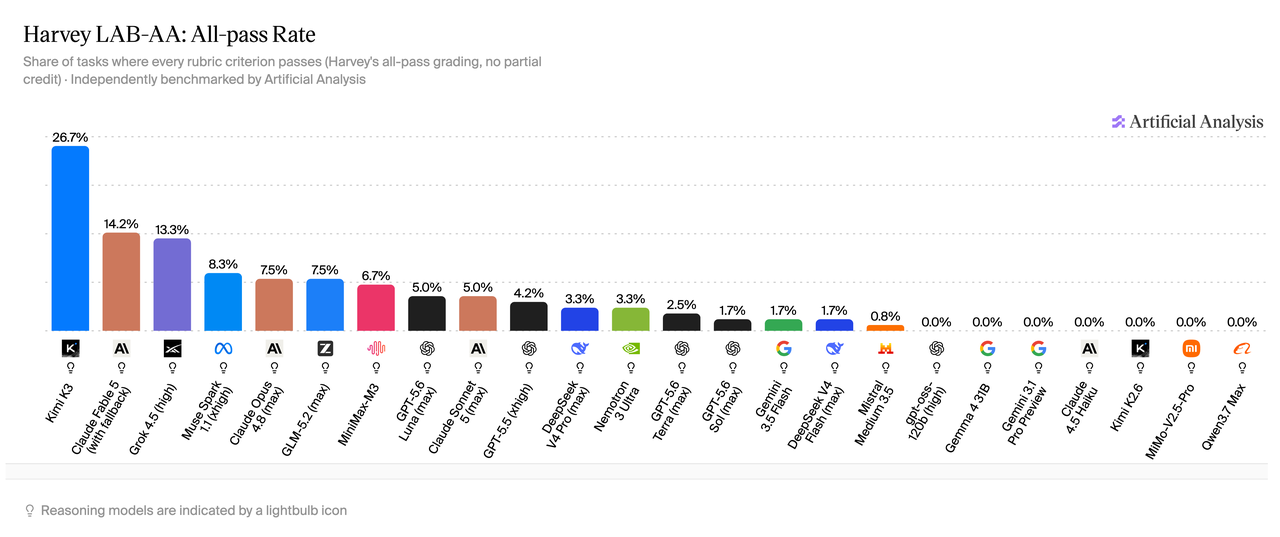
Harvey's Legal Agent Benchmark (LAB) is designed to test models against this kind of work. Developed by legal AI company Harvey, the benchmark covers more than 1,200 real-world law-firm tasks across 24 practice areas, from reviewing matter files to producing memos, redlines, and presentations. Each task is scored against a detailed expert rubric, and an all-pass is awarded only when every criterion is met.
Artificial Analysis recently evaluated Kimi K3 on this benchmark using a minimal harness and no document-generation skills.
K3 recorded a 26.7% all-pass rate, up from 0% for K2.6 and the highest result in that evaluation. Under LAB's expert rubrics, an all-pass is awarded only when every criterion for a task is met.
Harvey Tenet: Adapting K3 for Legal Work
On August 20, Harvey introduced Tenet, a research-preview model post-trained on Kimi K3 for long-horizon legal work.
On Harvey's evaluations, Tenet outperformed today's leading models across several legal benchmarks. Before beginning post-training, Harvey conducted a broader evaluation of Kimi K3 across legal use cases. The results showed that Kimi K3 already demonstrated frontier-level legal capabilities.
Harvey's work shows how a general model can be adapted to a specific legal environment through domain data, task design, and evaluation standards.
Most legal teams, however, are not deciding whether to train a model.
They want AI to help with work that is necessary but repetitive: comparing contract versions against a playbook, reconstructing a matter from emails and attachments, following up on missing intake information, or turning the same context into a memo, cover note, and status update.
How Kimi Fits into Existing Workflows
Kimi currently supports these legal workflows through a focused set of tools:
Documents: Create and edit Word files, add comments directly to relevant clauses, turn comments into tracked-change revisions, and link draft content back to its source files.
Email: Use relevant messages and attachments as context, then draft a cover note, follow-up, or matter update.
Kimi Browser Extension (formerly Kimi WebBridge): Work through the user’s signed-in browser to retrieve information from web-based systems or enter approved content.
Computer Use: Assist with steps in local desktop applications, such as locating files or moving drafts between tools.
Deep Research: Plan a multi-step research process, review a range of sources, and prepare a structured report with citations.
Agent Swarm: Assign different lines of inquiry to multiple agents working in parallel, with a lead agent bringing the findings together.
We are continuing to connect more plugins and build more skills around the tools legal teams already use. Any filing, submission, or external communication should still be reviewed and approved by a lawyer.
3 Practical Workflows for Legal Teams
Much of legal work happens between identifying the relevant rule and producing a reviewable deliverable. Facts may be spread across matter files, while contract positions and drafting conventions sit in playbooks and precedents. The following 3 examples focus on how Kimi can support this middle layer by organizing the available context and preparing a first pass for lawyer review.
Contract Review and Redlining
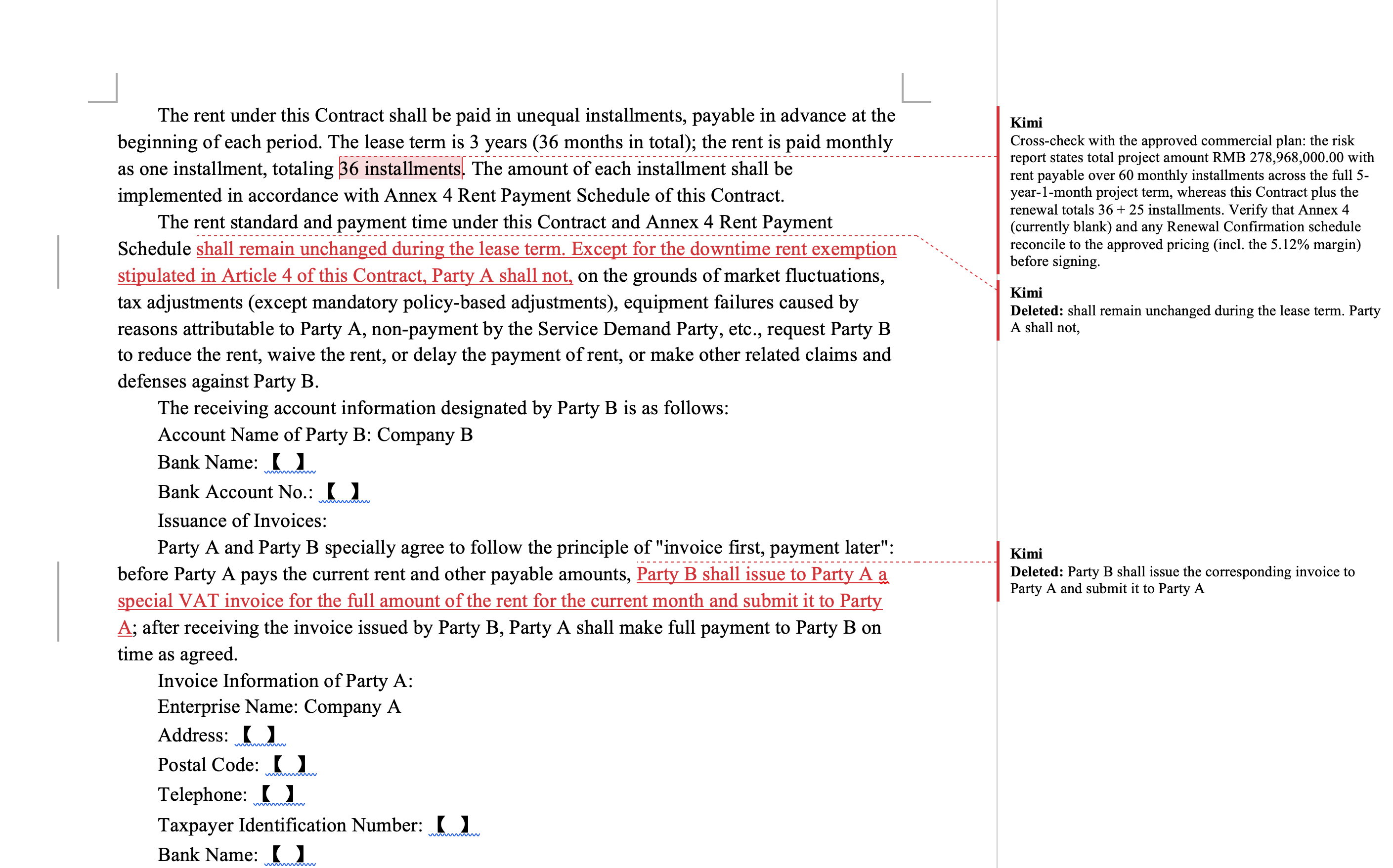
When a new agreement comes in, the lawyer has to do more than identify risky language. They must compare the draft with the team's standard positions, decide which departures matter in the context of the deal, and return a Word document that a client, business team, or counterparty can use in the next round of negotiations.
That usually means clause-level comments and tracked changes—not a summary in a chat window.
To prepare a first pass, the lawyer can upload the agreement to Kimi or select the folder in Kimi Work, together with the relevant playbook, preferred form, and approved fallback positions.
A typical instruction might be:
Kimi can produce an annotated agreement and a proposed redline. The lawyer then reviews each comment and edit, decides what should be accepted or escalated, and approves the next draft.
Legal Research and Due Diligence
Lawyers are often asked to get up to speed quickly on an unfamiliar jurisdiction, regulatory regime, or emerging legal issue—before a client meeting, market entry, or transaction.
It may require reviewing legislation, regulatory guidance, cases, enforcement actions, and commentary across many different sources, while keeping a clear record of where each conclusion comes from.
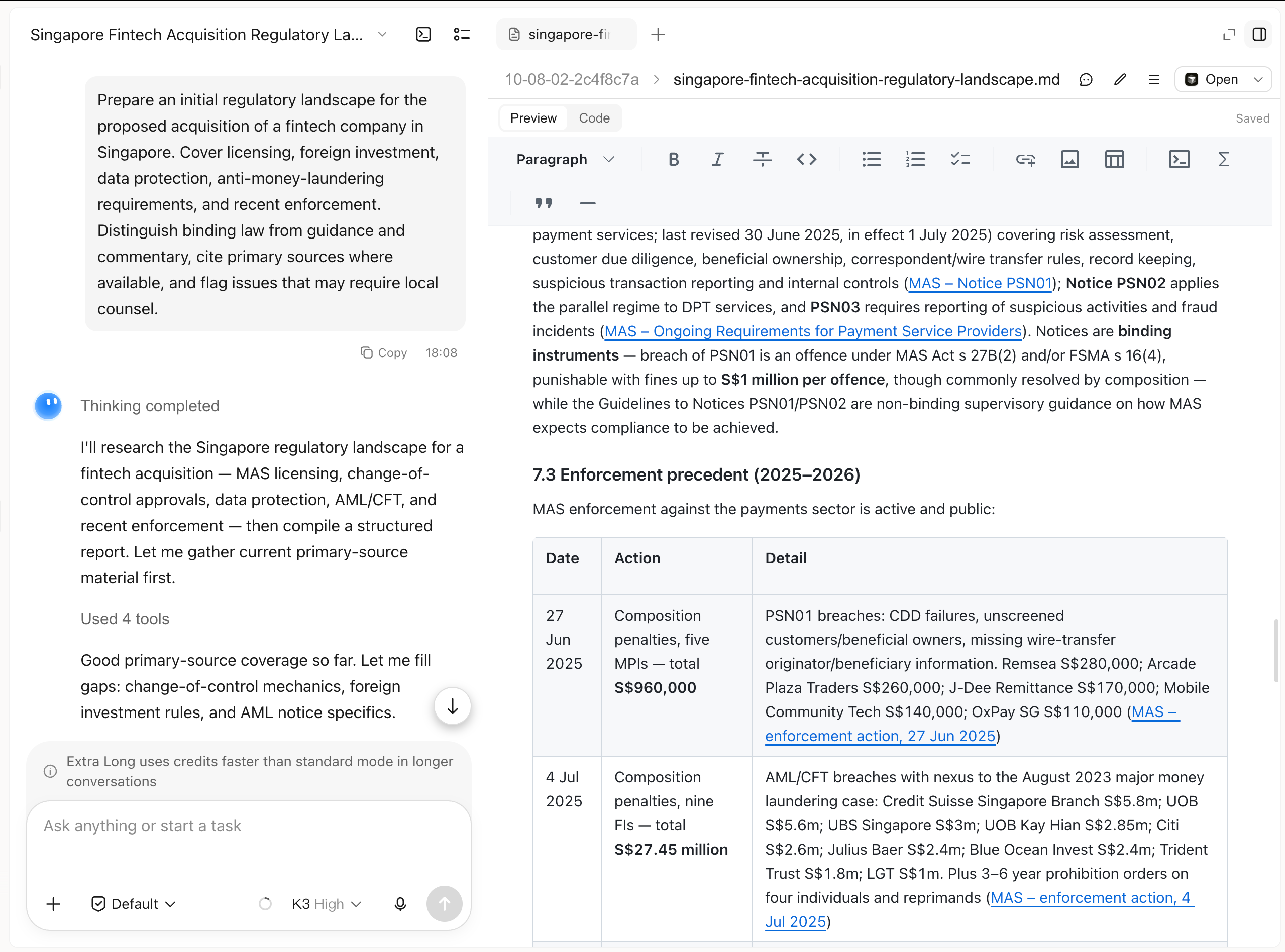
With Deep Research in Kimi, the lawyer can define the question, jurisdiction, research cutoff date, and scope of the review.
For example:
Kimi will then carry out the initial research automatically: planning the research path, reviewing relevant sources, and organizing the findings into a structured report with citations.
For broader questions, you can also use Agent Swarm mode, where multiple agents investigate different lines of inquiry in parallel before a lead agent brings the findings together. This can shorten the initial research cycle and broaden its coverage.
Email Triage and Matter Follow-up
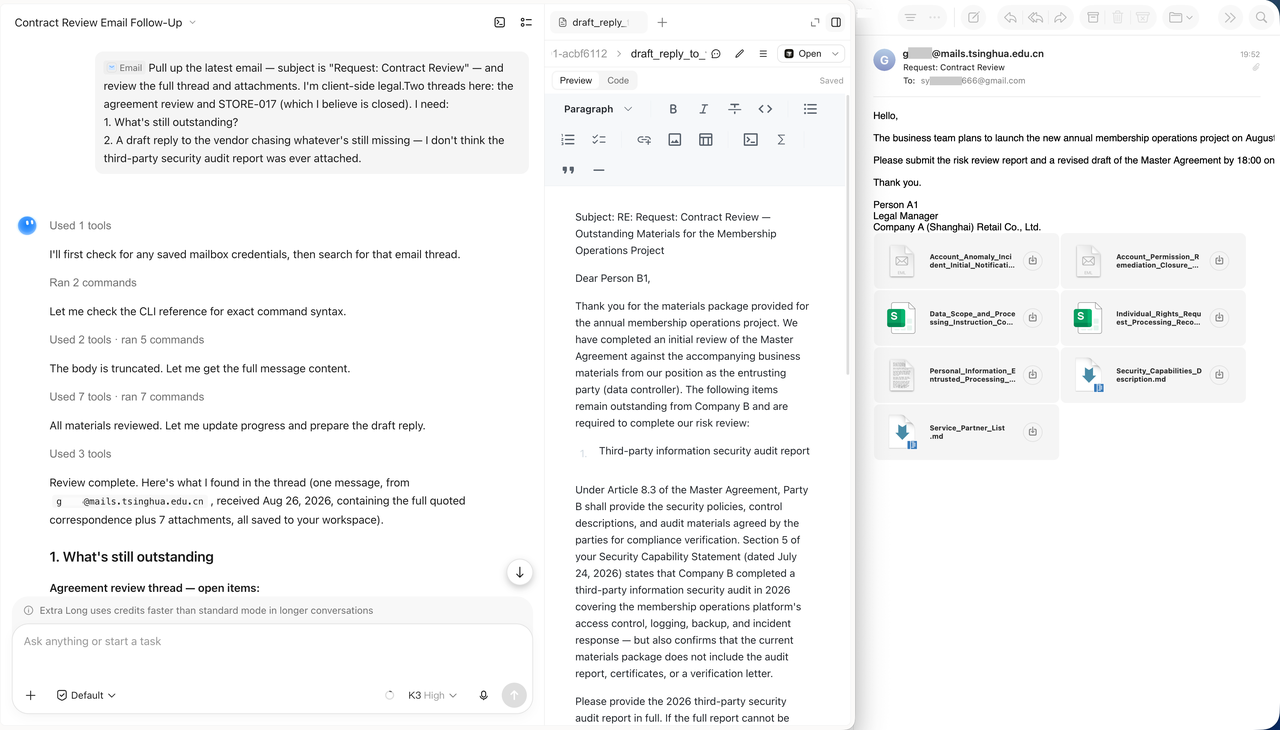
Email is often where legal work is initiated and coordinated. A new request may arrive without the necessary facts, instructions may be split across a long thread, and deadlines or unanswered questions may be buried among multiple messages and attachments.
After connecting Gmail to Kimi Work, you can ask Kimi to review the relevant thread and attachments, reconstruct the current status, extract deadlines and action items, and identify missing information.
For example a prompt could go like this:
Kimi can prepare a matter summary, an action list, and a draft response. You can then verify the context, decide what action to take, and approve the email before it is sent.
Finding a Better Way to Work Together
Contract review used to start with worrying about what I might have missed. Now it starts with seeing what the AI has found.
A lawyer who has been using Kimi regularly in his day-to-day work
That points to a more collaborative way of working: Kimi can help carry the work forward, while lawyers remain closely involved in shaping, questioning, and refining the result.
We will continue to improve Kimi with legal teams and to learn where it is useful, where it still falls short, and what better support for legal work should look like.
If you have a legal background and would like to help shape this work, come join us.