Reviewing financial statements, tracking business performance, and analyzing large datasets can take significant time and effort. Rather than handling these tasks manually, you can equip AI agents with financial analysis skills to automate research, performance analysis, valuation, and report generation. Explore the AI skills in this article to discover suitable options for improving your financial analysis workflow.
What are financial analysis skills for AI agent?
Financial analysis skills are specialized AI agent skills that enable AI agents to analyze financial data, evaluate business performance, and generate actionable insights. They can review financial statements, calculate key metrics, identify trends, assess risks, and support valuation or investment analysis based on natural language instructions. By automating complex financial workflows, these skills help users make faster, more informed decisions.
AI financial planning and analysis skills in Kimi
Kimi's AI-powered financial analysis skills simplify complex financial tasks by analyzing data, building models, and generating research insights. From company analysis and valuation to market research and risk assessment, these skills help users make faster, data-driven financial decisions. Explore the 15 skills below to improve your financial workflow:
| Skill name | Description |
|---|---|
| financial-ratio-toolkit | Analyzes company fundamentals by computing over 20 financial ratios across profitability, solvency, liquidity, efficiency, and growth, plus DuPont analysis, from user-provided financial statements. |
| financial-statement-analyzer | Analyzes income statement, balance sheet, and cash flow statement data to generate year-over-year and quarter-over-quarter trend analysis and flag anomalies such as receivables surges or cash flow divergence. |
| discounted-cashflow-model | Builds a discounted cash flow valuation model that calculates enterprise value, equity value, and per-share price, with a growth rate and discount rate sensitivity analysis matrix. |
| value-investing-scorecard | Evaluates a company across 20 criteria in four dimensions covering moat, management, financials, and valuation, producing a 0 to 100 score based on Buffett and Graham value investing principles. |
| saas-metrics-coach | Acts as a SaaS financial health advisor that analyzes revenue and customer metrics such as ARR, MRR, churn, LTV, CAC, and NRR to assess business performance. |
| stock-signal-analyzer | Analyzes OHLCV data to compute over 15 technical indicators including MA, MACD, RSI, Bollinger Bands, and KDJ, generating a bullish or bearish signal summary with an overall assessment. |
| fund-risk-compare | Compares multiple ETFs using NAV data, generating key risk and return metrics such as annualized return, max drawdown, Sharpe ratio, and a correlation matrix. |
| equity-research | Analyzes companies and generates investment research for Chinese A shares, Hong Kong stocks, and US stocks, with concise tear sheets or in-depth report modes including a financial model. |
| equity-research-report | Creates institutional-grade investment research reports with sell-side styling, dense information layout, and comprehensive section structure for equity, fixed income, sector, derivative, ETF, and quantitative research. |
| stock-research-report | Generates securities research reports in Guotai Haitong style for Chinese equity research, industry tracking, investment notes, and financial research documents. |
| earnings-review-note | Generates sell-side earnings review reports for quarterly or annual results with EPS analysis, guidance review, and variance tables for any public company. |
| commodities-outlook | Produces institutional-grade commodity outlook reports with supply and demand analysis, price forecasts, and trade recommendations for energy, metals, and agricultural commodities. |
| vc-industry-research | Generates primary market and venture capital industry research reports, including sector deep dives, investment memos, and market analysis across TMT, consumer, healthcare, and industrials. |
How to use Kimi financial analysis skills from the Skills store?
Kimi provides specialized AI analysis skills that help you perform tasks like company evaluation, stock research, risk analysis, and financial modeling. By selecting the right skill and providing clear instructions, you can quickly generate useful financial insights. Follow these steps to start using Kimi's financial skills:
Step 1: Install the skill and input its command
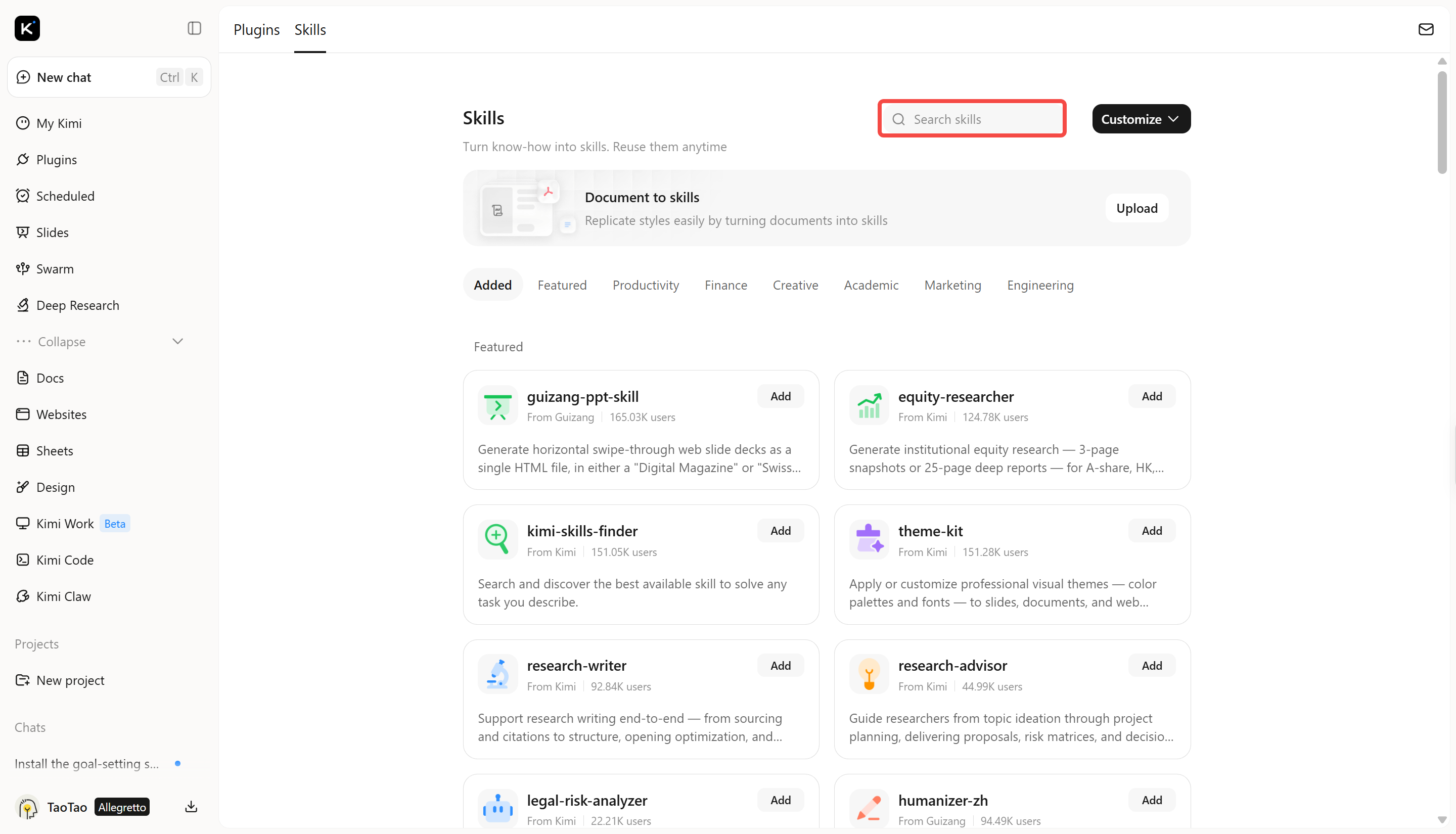
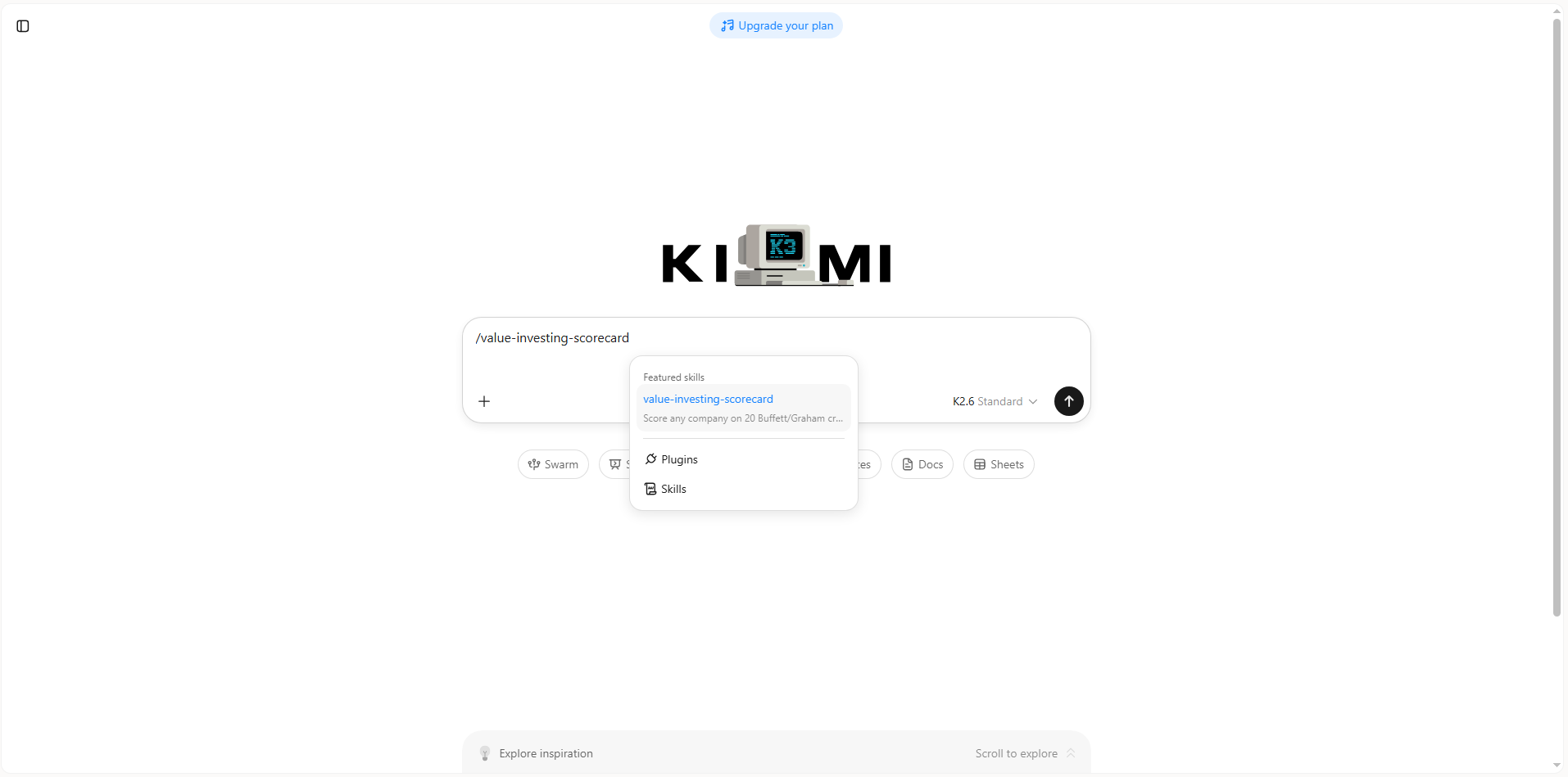
Open Kimi and type / in the input box to open the Skills store. Search for stock-signal-analyzer and click to install it. Then type /stock-signal-analyzer in the input box to activate the skill.
Step 2: Start your research task
Add your requirements, upload market data, or provide company information.
Example prompt:
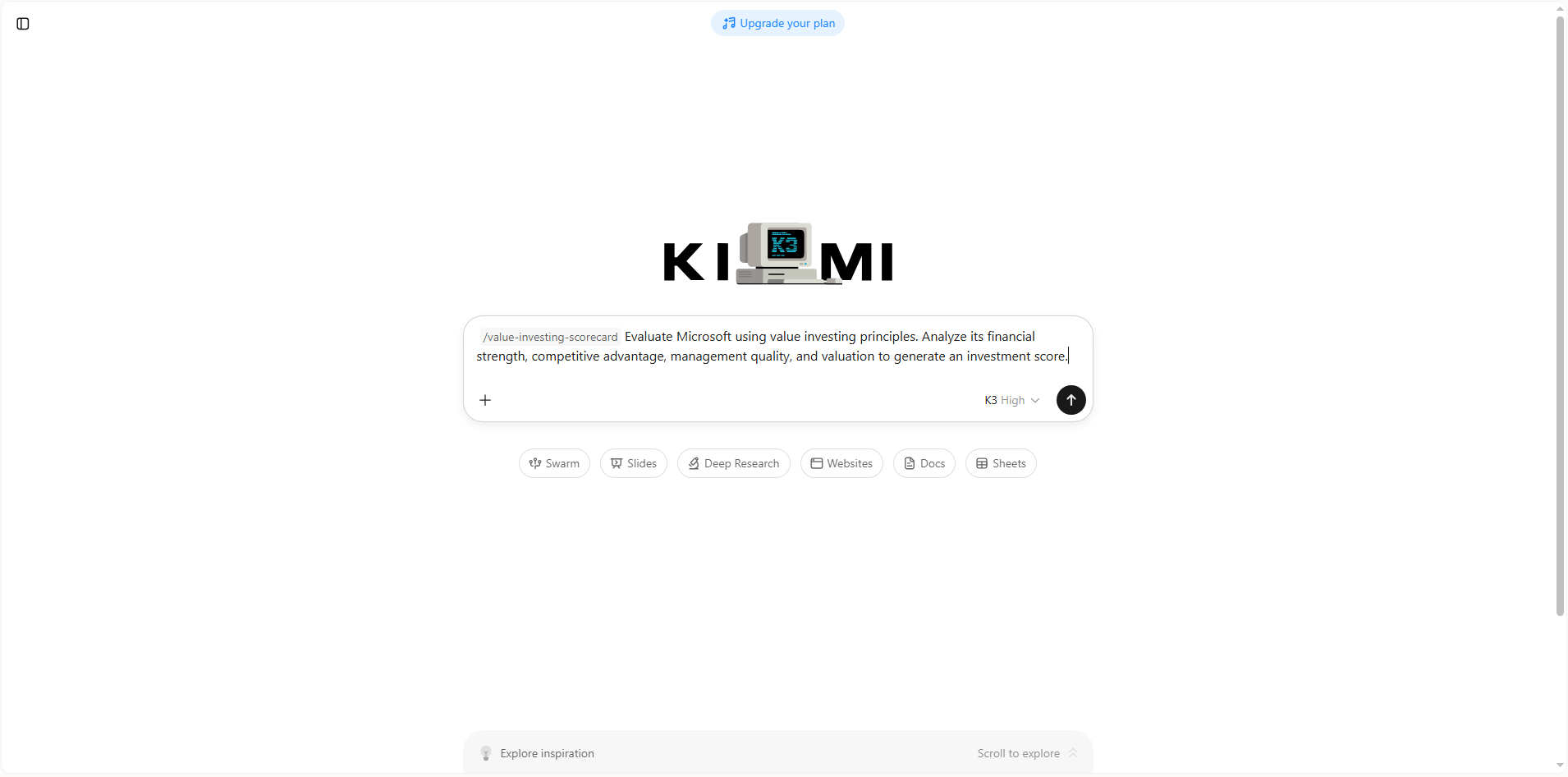
Kimi will use the selected skill to analyze trends, evaluate investment factors, or generate detailed financial insights.
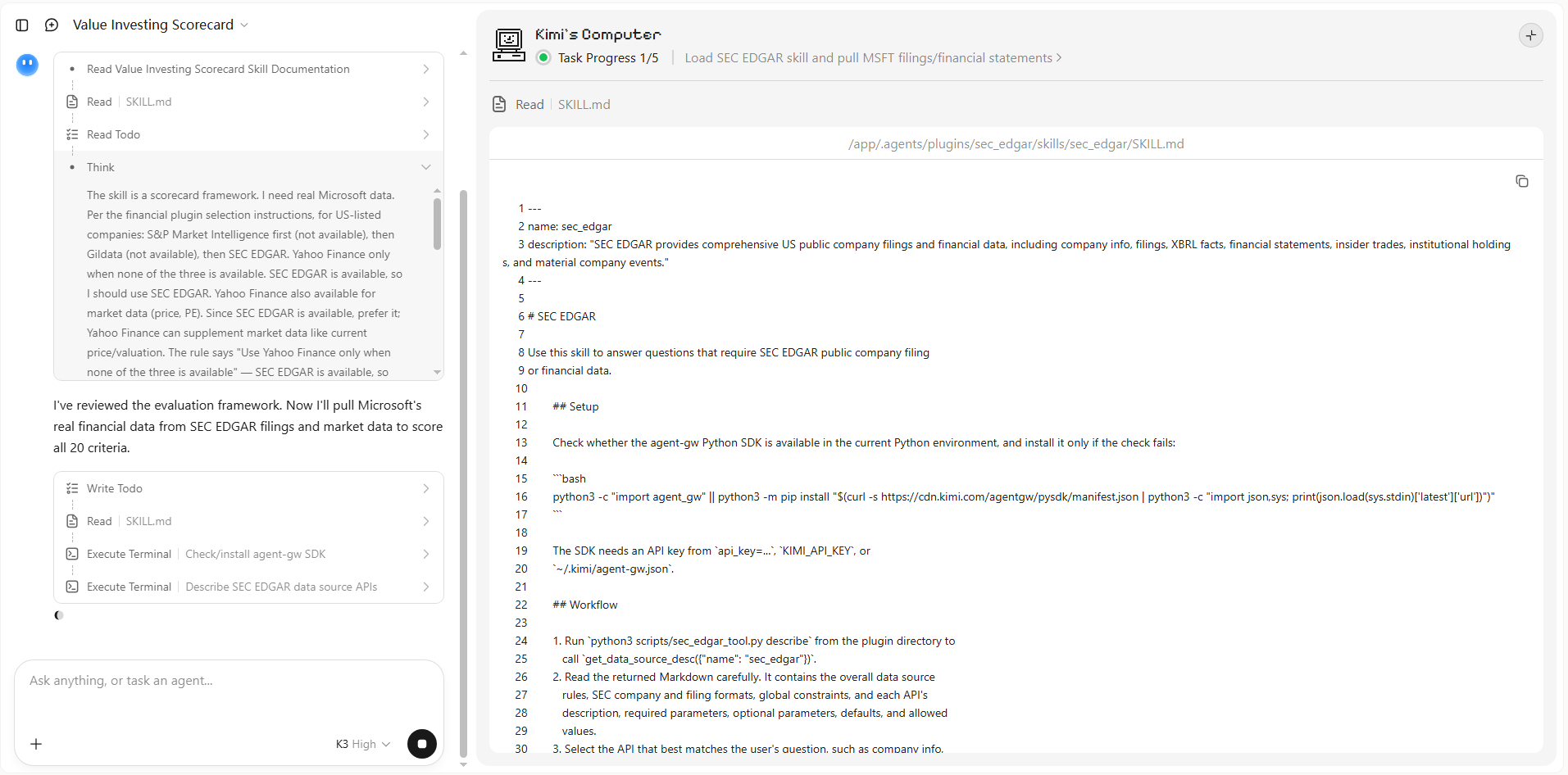
Step 3: Review the output
Kimi creates a structured analysis with relevant metrics, scores, and insights based on your selected skill. Review the results, adjust your inputs if needed, and use the findings to support investment research and financial decisions.
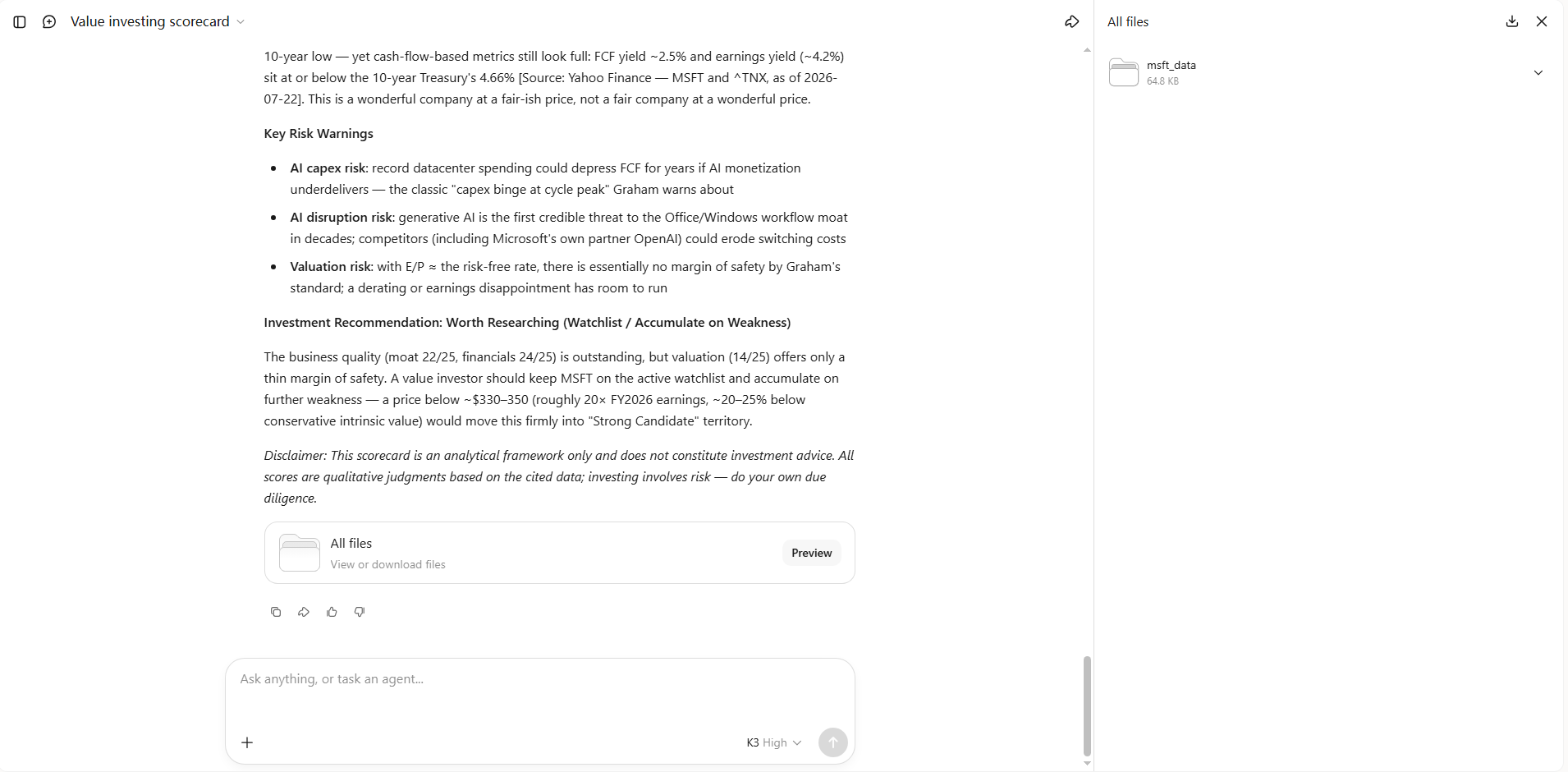
Explore open-source financial analysis skills
AI-powered financial analysis is becoming more accessible with open-source skills that help automate research, modeling, investment analysis, and decision-making. These community-built tools let users explore advanced workflows such as valuation, portfolio analysis, risk assessment, and financial reporting. Below are some of the useful open-source financial analysis skills to explore and integrate into your workflow:
| Skill name | Description | URL |
|---|---|---|
| financial-analysis | Institutional-grade financial analysis skills for AI agents — Comps Analysis (EV/Revenue, EV/EBITDA, P/E), DCF Model (WACC, terminal value, sensitivity), LBO Model (debt schedules, IRR & MOIC), and 3-Statements integrated modeling. Includes Excel template generator. | https://github.com/d-wwei/financial-analysis |
| quant-analyst | Build financial models, backtest trading strategies, and analyze market data. Implements risk metrics (VaR, Sharpe ratio, max drawdown), portfolio optimization (Markowitz, Black-Litterman), time series analysis, and options pricing with Greek calculation. | https://github.com/agent-skills-hub/agent-skills-hub/blob/main/skills/quant-analyst/SKILL.md |
| personal-finance-skill | AI-powered personal finance skill with 75 tools across 7 extensions for banking (Plaid), trading (Alpaca), portfolio monitoring (IBKR), tax optimization, market intelligence, and social sentiment. Built for the Agent Skills Protocol with risk and policy guardrails. | https://github.com/6missedcalls/personal-finance-skill |
| openaccountant-skills | 44 open-source financial skills for AI agents covering P&L, budgeting, tax prep, debt payoff, and more. Includes transaction search, spending summary, and anomaly detection tools. | https://github.com/openaccountant/skills |
| buffett-skills | Collection of AI skills built on Warren Buffett's investing framework. Covers thinking frameworks, investment philosophy, business moat analysis, management governance, financial metrics, valuation, risk behavior, and industry playbooks with 8 reference modules. | https://github.com/agi-now/buffett-skills |
| financial-red-flag-auditor-skill | Reusable agent skill for auditing listed-company financial reports, scoring financial quality across 15 domains on a 100-point scale, and producing structured red-flag analysis reports. Validates structured data against official filings with deterministic screening rules. | https://github.com/noahnan-max/financial-red-flag-auditor-skill |
| nse-stock-analysis-skills | Modular AI stock-analysis skills for NSE/BSE Indian equities. Covers business quality, financials, news, valuation, technicals, risks, investor mental models, and 1-year price scenarios with multibagger screening capabilities. | https://github.com/gnkbhuvan/nse-stock-analysis-skills |
| a-stock-data | China A-share full-stack data toolkit with 10-layer architecture, 40 endpoints, 13 data sources. Covers market data, research reports (individual + industry), capital flow, chip distribution, announcements, ETF options, and sentiment interaction. Includes valuation checking and technical analysis. | https://github.com/simonlin1212/a-stock-data |
| earnings-analysis | Quick earnings analysis with consensus Wall Street forecast, past guidance, and peer industry trends. Appends the "Fund Manager Questions" section to surface gaps and forces analysts to defend conclusions. Supports uploaded filings and web search data. | https://github.com/HHFinAi/earnings-analysis |
| awesome-finance-skills | Curated collection of awesome finance agent skills including alphaear-news (real-time financial news), alphaear-stock (A-share/HK/US market data), alphaear-sentiment (FinBERT/LLM sentiment analysis), alphaear-predictor (time series forecasting), and alphaear-reporter (professional research report generation). | https://github.com/rkiding/awesome-finance-skills |
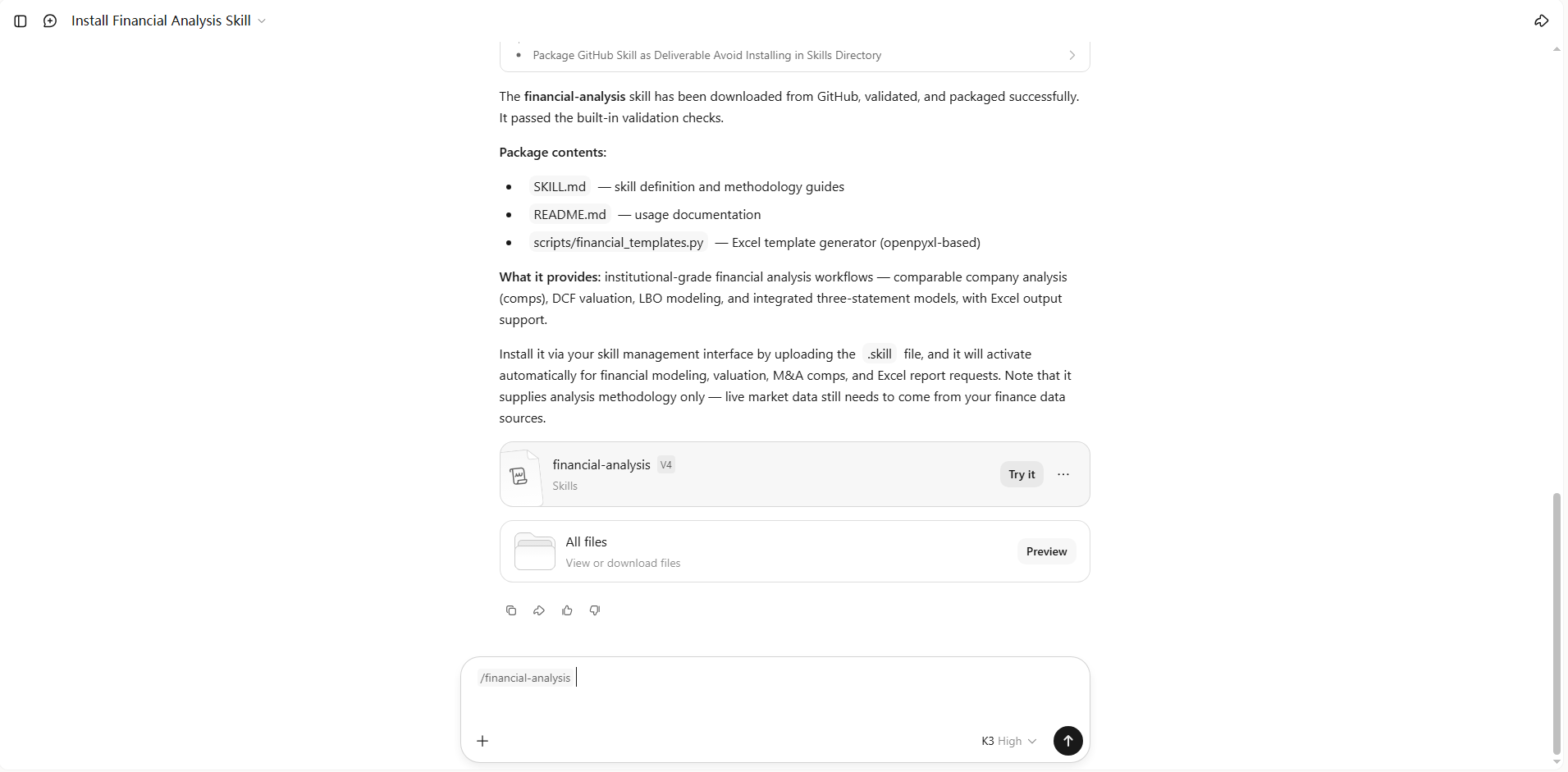
How to start using open-source AI skills in Kimi?
Open-source AI skills allow you to expand Kimi's capabilities by adding specialized tools for financial analysis, research, coding, and other workflows. You can install these skills directly from their GitHub URLs and use them within Kimi to handle more advanced tasks. Follow these steps to get started:
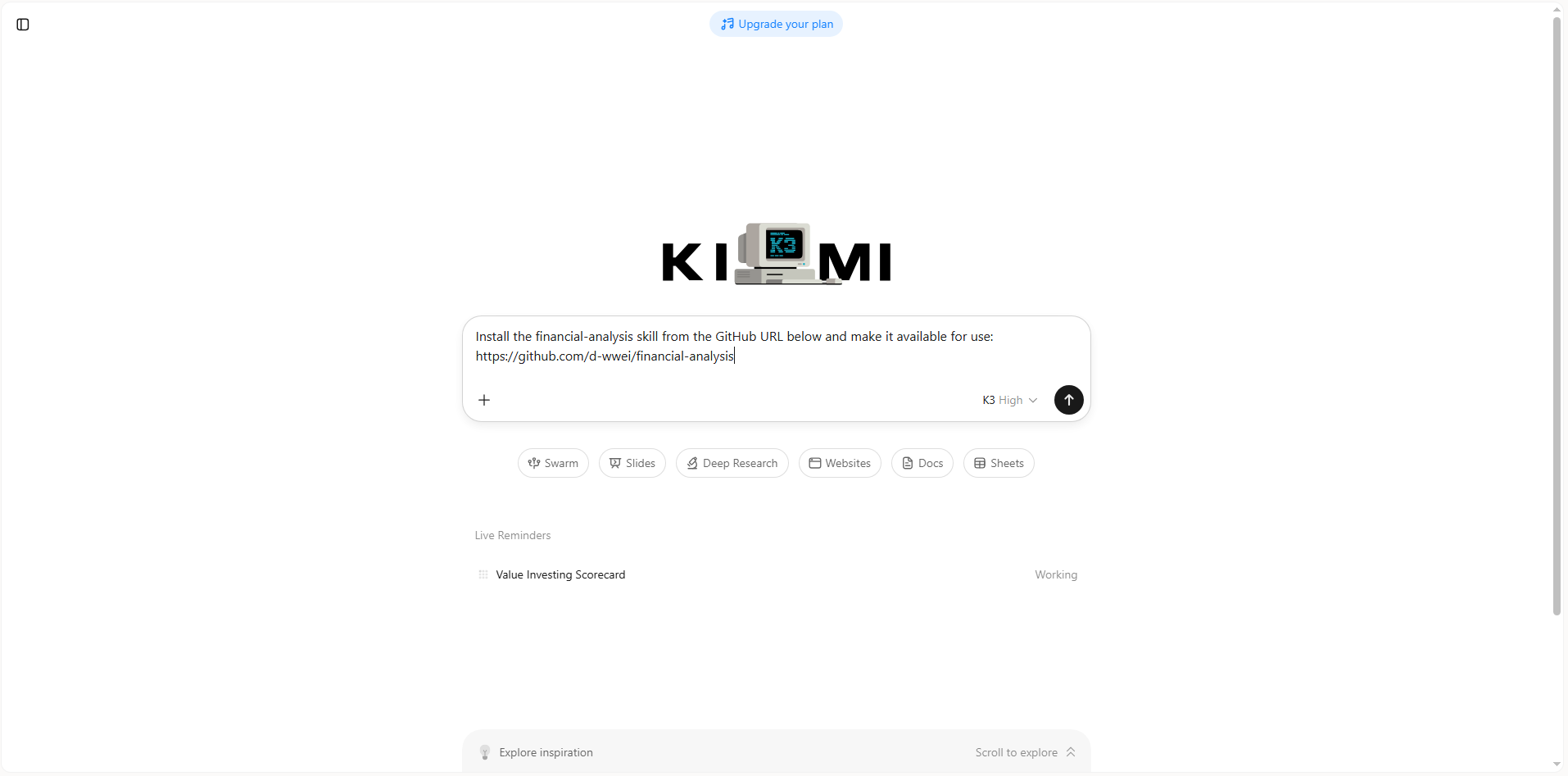
Step 1: Enter a prompt
Open Kimi and provide a prompt that includes the GitHub URL of the open-source skill you want to add. Clearly mention the skill you want to install, so Kimi can identify and prepare it for your workspace.
Example prompt:
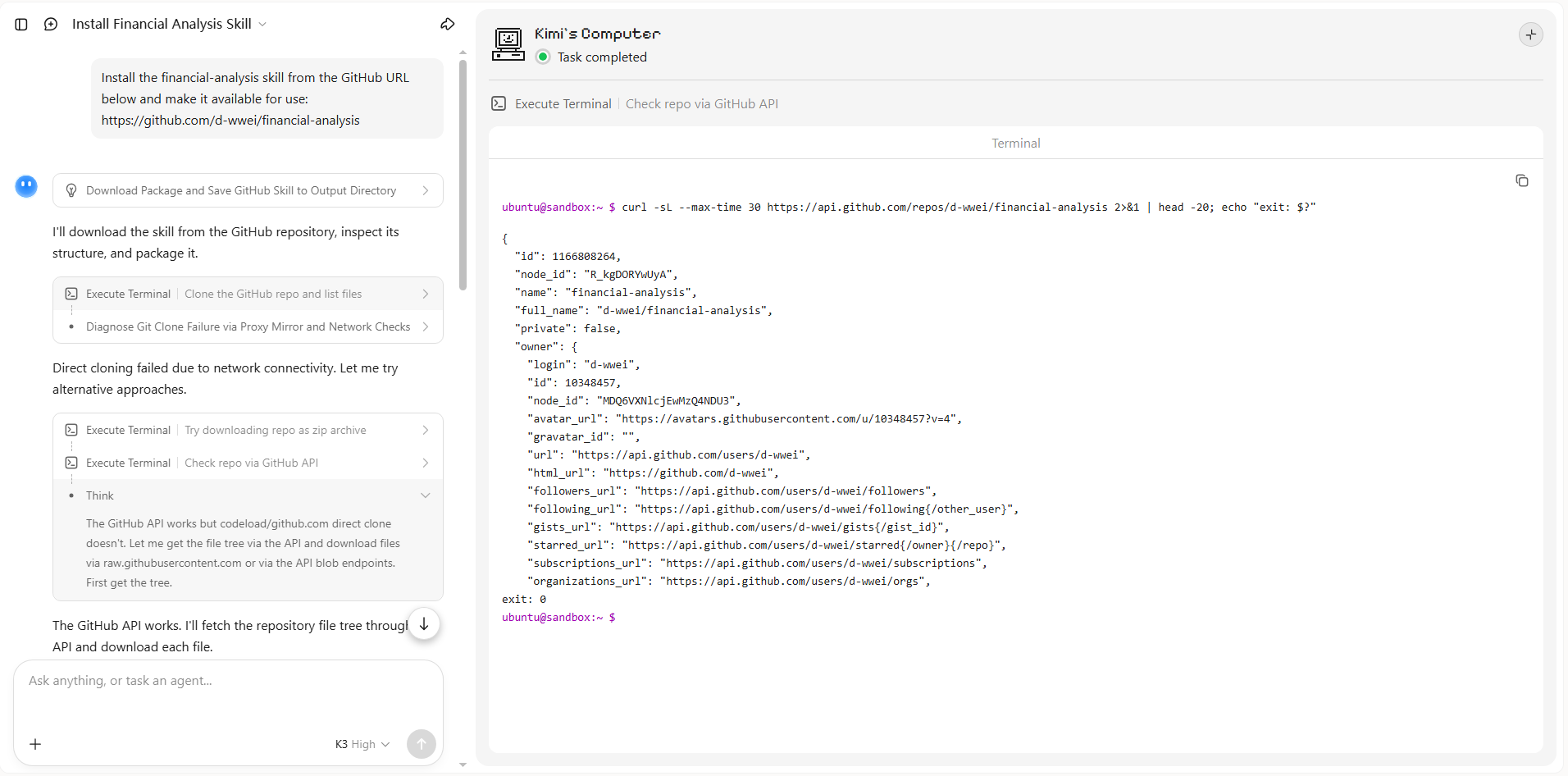
Step 2: Let AI install the skill automatically
Kimi processes the provided URL, downloads the required files, and configures the open-source skill automatically. After installation, the skill becomes available for your future financial analysis tasks.
Step 3: Use the skill
Once the skill is installed, activate it in Kimi and start your task by entering relevant instructions. You can use it for tasks like financial modeling, stock analysis, valuation research, or other specialized workflows.
Build your own AI skills for financial analysis in Kimi
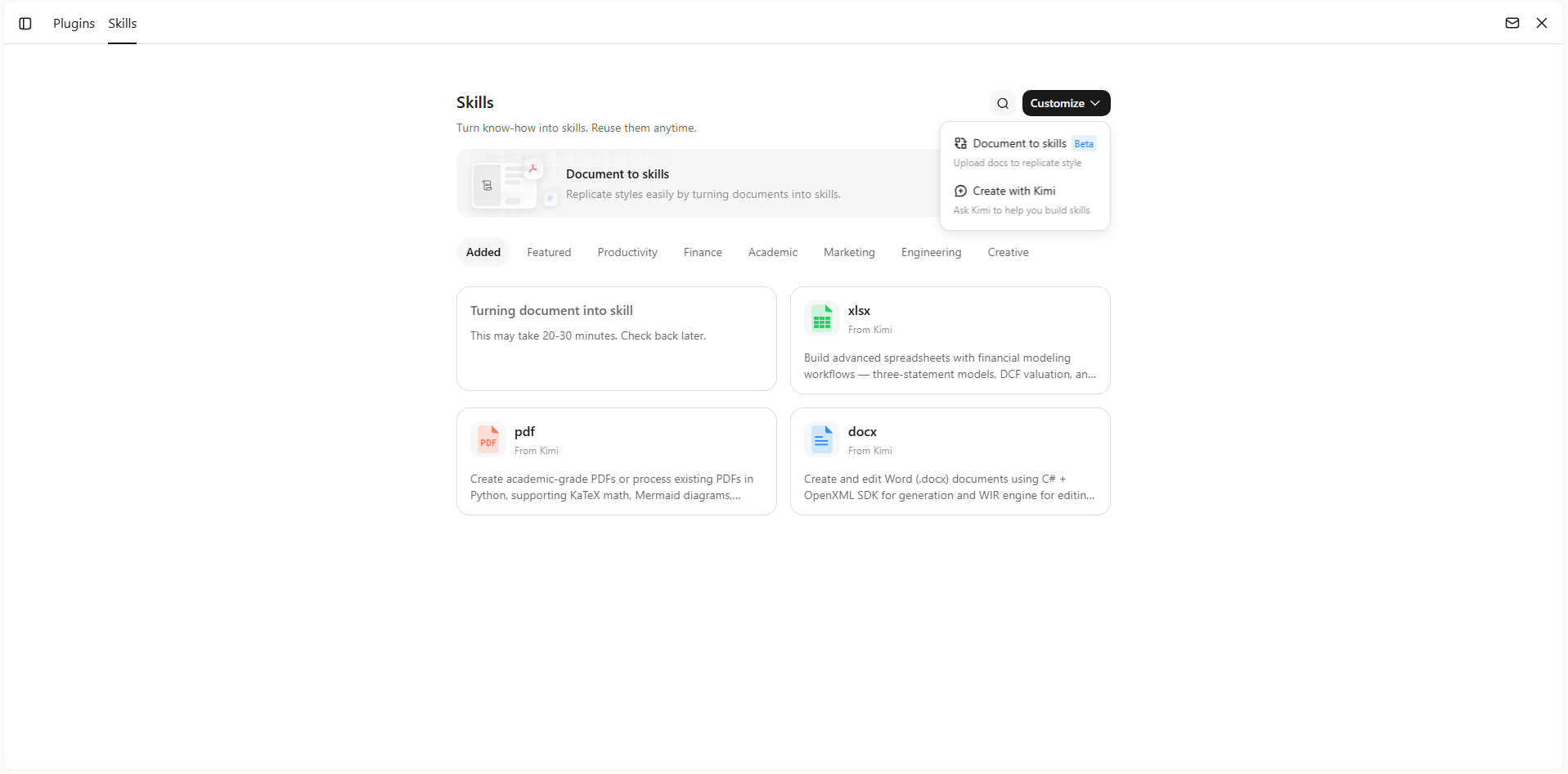
Kimi lets you create personalized skills by converting your own documents, templates, and frameworks into reusable AI tools. This helps you build custom workflows based on your preferred methods for valuation, reporting, and investment research. Here's how to generate custom skills in Kimi:
Step 1: Access the "Document to skills" tool
Open the Kimi Skills section, then choose "Document to skills". This allows you to start building a custom AI skill based on your financial resources.
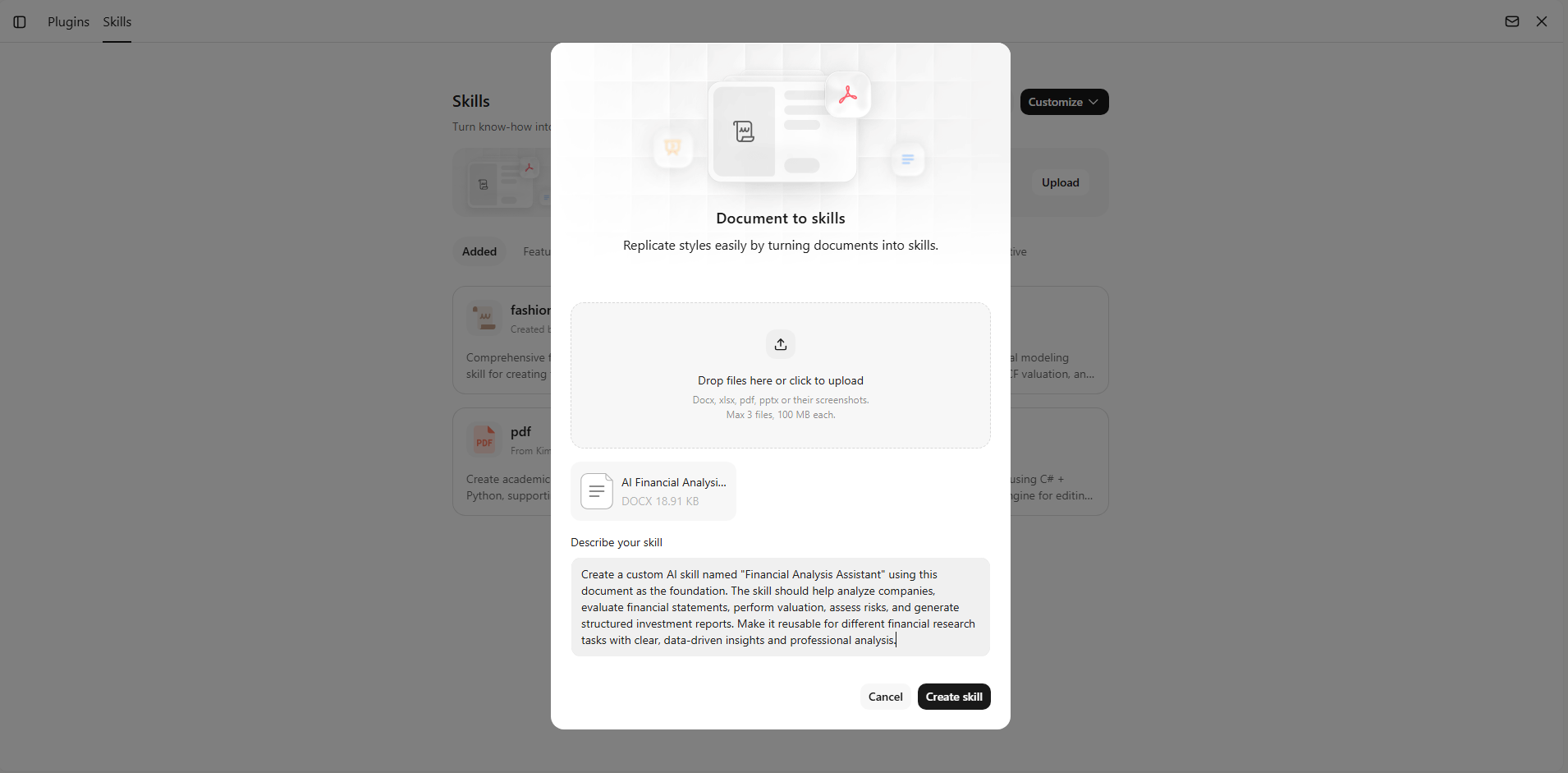
Step 2: Upload the files
Add your financial documents, such as valuation templates, research reports, analysis frameworks, spreadsheets, or investment notes. Kimi will analyze the files and convert their structure into a reusable skill for future financial tasks.
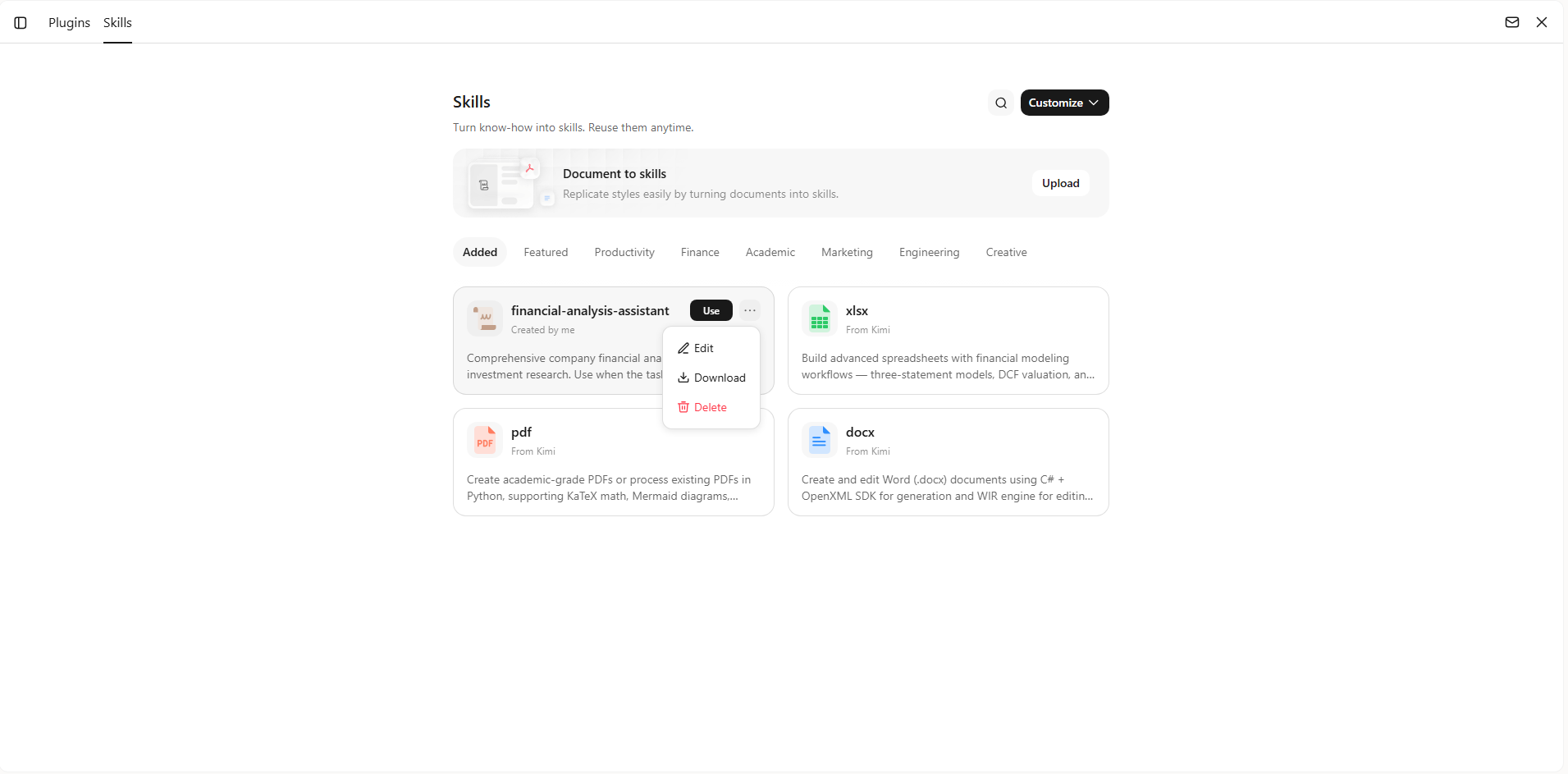
Step 3: Create and use your skills
After processing, Kimi creates the personalized financial skill that you can use for tasks like company analysis, financial modeling, report generation, or investment research.

You can refine the skill over time to match your preferred workflow, or edit and download it whenever needed.
Tips for using financial analysis skills
Financial analysis skills simplify complex tasks by automating research, calculations, and reporting. Use them with the right strategy and inputs to get more accurate and valuable results. Here are some tips to use these skills effectively:
Define the analysis goal before reviewing financial data
Clarify whether you need valuation analysis, performance tracking, investment research, or risk assessment before creating or applying a financial analysis skill. A clear objective helps the skill provide more targeted guidance to the AI agent, allowing it to focus on relevant financial signals and generate more useful insights.
Combine multiple financial indicators for deeper insights
Go beyond individual metrics by analyzing revenue growth, profitability, cash flow, valuation ratios, and market trends together for a more complete view. Combining different indicators provides a stronger understanding of overall company performance.
Use scenario analysis to test financial assumptions
Apply financial analysis skills to explore how changes in revenue, costs, interest rates, or market conditions may affect future performance. Testing different scenarios helps prepare better strategies for uncertain financial situations.
Customize skills around your investment or reporting framework
Build AI skills with your preferred analysis methods, financial models, industry metrics, and reporting formats to create consistent outputs. Personalized frameworks help maintain accuracy and match your specific decision-making process.
Turn financial analysis into actionable recommendations
Ask AI skills to summarize key findings, highlight potential risks, compare alternatives, and translate complex financial data into clear decisions. Actionable recommendations make financial insights easier to apply in real-world situations.
Conclusion
Financial decisions often depend on understanding the right data at the right time. AI-powered workflows can simplify complex analysis by helping organize information, evaluate opportunities, and support better decision-making. With Kimi, you can use financial analysis skills to guide AI agents through research, modeling, and other financial tasks more efficiently.