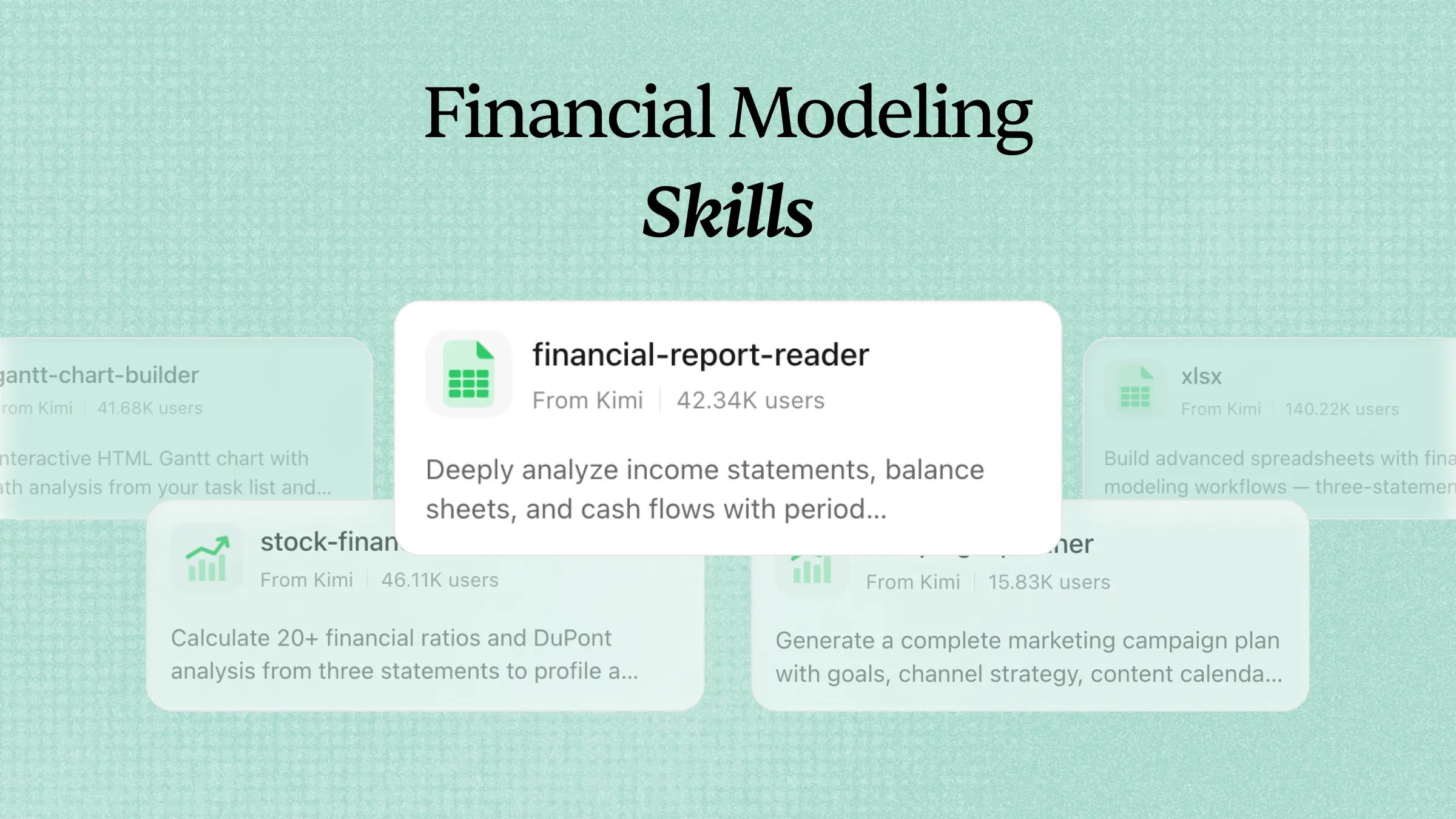
Building accurate financial models manually can be time-consuming and prone to errors. Financial modeling skills enable AI agents to automate tasks such as revenue forecasting, budgeting, company valuation, scenario analysis, and financial report generation. By reducing manual calculations and improving consistency, these AI skills help agents produce reliable financial models more efficiently. Explore the AI skills in this article to find the right ones for automating your financial modeling workflows.
What are financial modeling skills?
Financial modeling skills enable AI agents to create financial models for forecasting, valuation, budgeting, and business analysis. They automate calculations, generate structured spreadsheets, and perform scenario analysis using financial data. This helps analysts, investors, and businesses make faster, more informed, and data-driven financial decisions.
AI financial modeling skills worth exploring in Kimi
Kimi also offers customizable AI financial model skills that simplify complex financial analysis and automate repetitive modeling tasks with greater speed and accuracy. From company valuation to financial statement analysis, these skills help streamline workflows and deliver more reliable insights. Explore these useful financial modeling skills in Kimi:
| Skill name | Description |
|---|---|
| discounted-cashflow-model | Builds a discounted cash flow valuation model that calculates enterprise value, equity value, and per-share price, with a growth rate and discount rate sensitivity analysis matrix. |
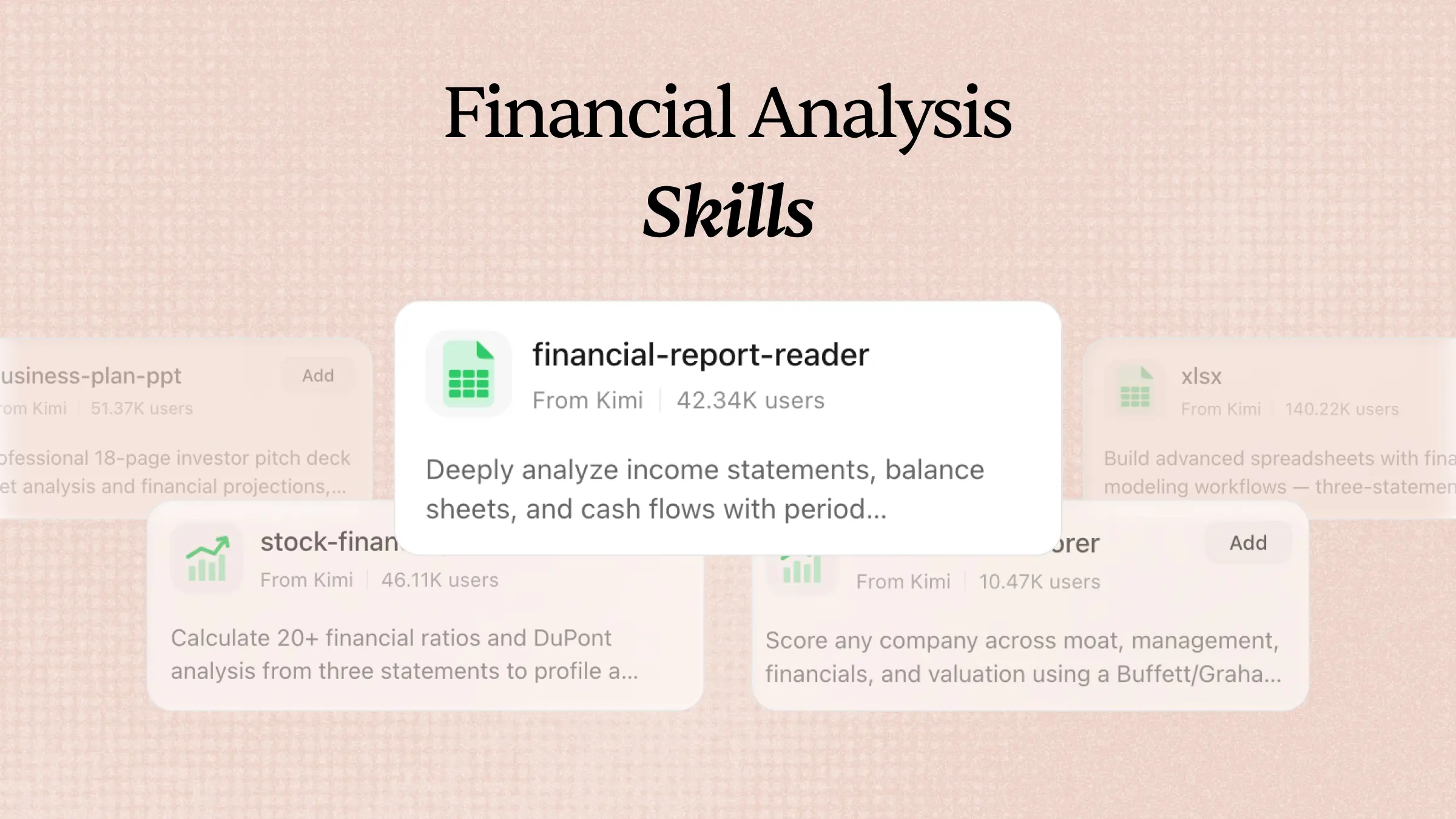
| financial-ratio-toolkit | Analyzes company fundamentals by computing over 20 financial ratios across profitability, solvency, liquidity, efficiency, and growth, plus DuPont analysis, from user-provided financial statements. |
| financial-statement-analyzer | Analyzes income statement, balance sheet, and cash flow statement data to generate year-over-year and quarter-over-quarter trend analysis and flag anomalies such as receivables surges or cash flow divergence. |
| value-investing-scorecard | Score any company on 20 Buffett/Graham criteria across moat, management, financials, and valuation for a 0-100 value-investing verdict. |
Use AI financial modeling skills in Kimi
Kimi lets you activate financial modeling skills in just a few steps. Choose the right skill, provide your financial task, and let Kimi generate structured models, calculations, and insights automatically. Here's how to get started:
Step 1: Install the skill and input its command
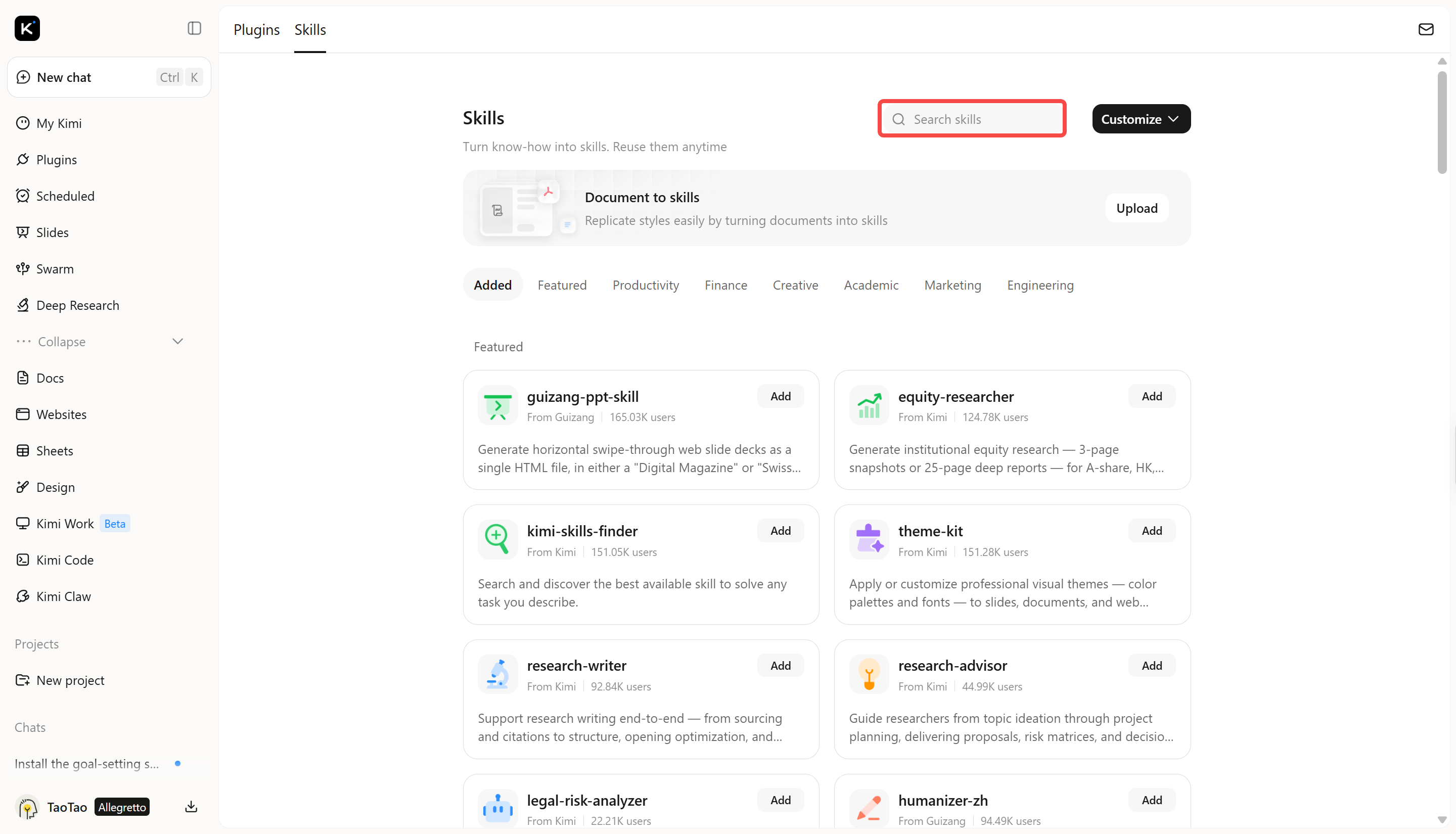
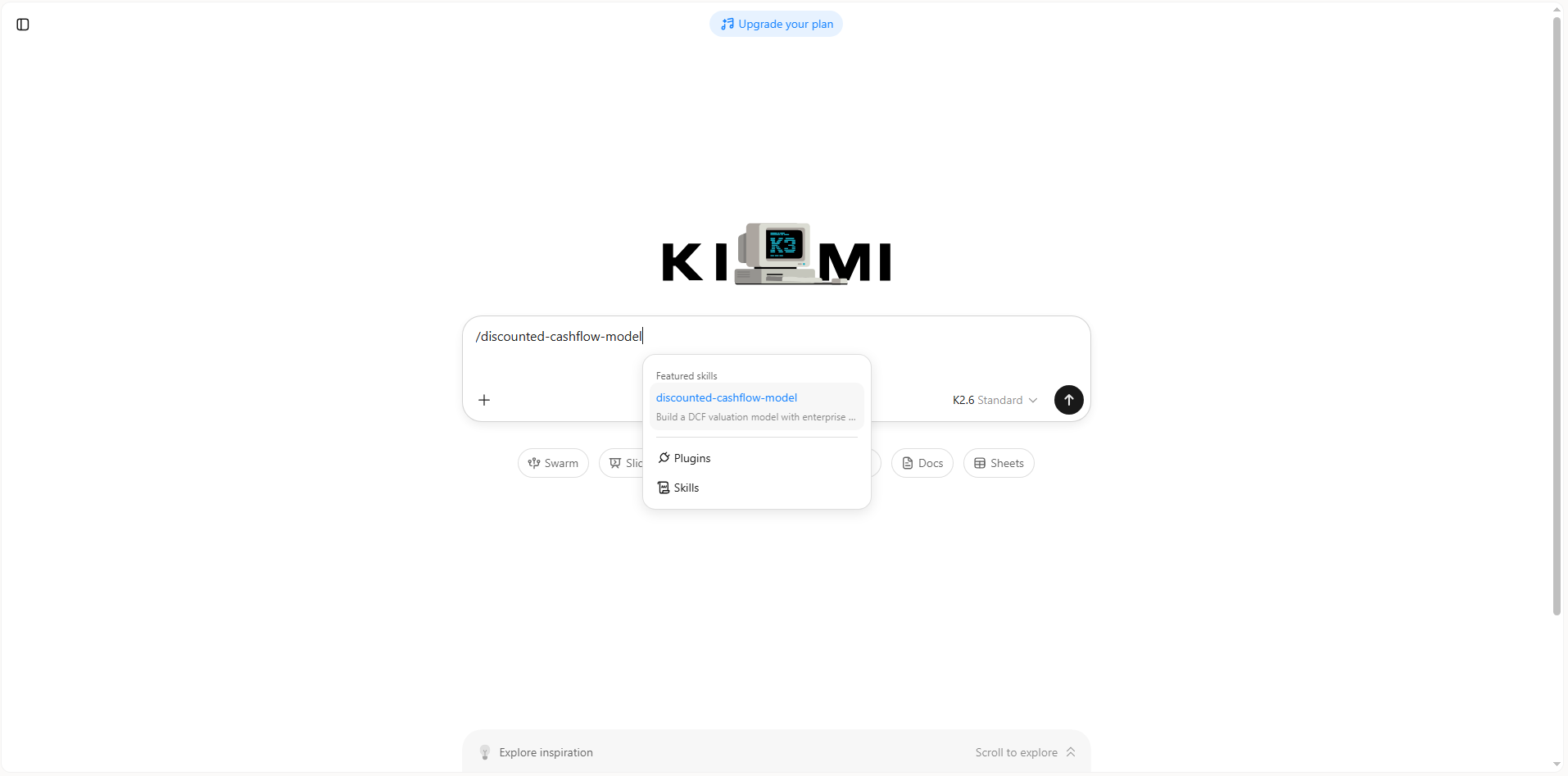
Open Kimi and type / in the input box to open the Skills store. Search for discounted-cashflow-model and click to install it. Then type /discounted-cashflow-model in the input box to activate the skill.
Step 2: Start your research task
Describe your requirements, and Kimi will apply the selected skill to perform calculations, analyze financial data, and generate a structured financial model.
Example prompt:

Step 3: Review the output
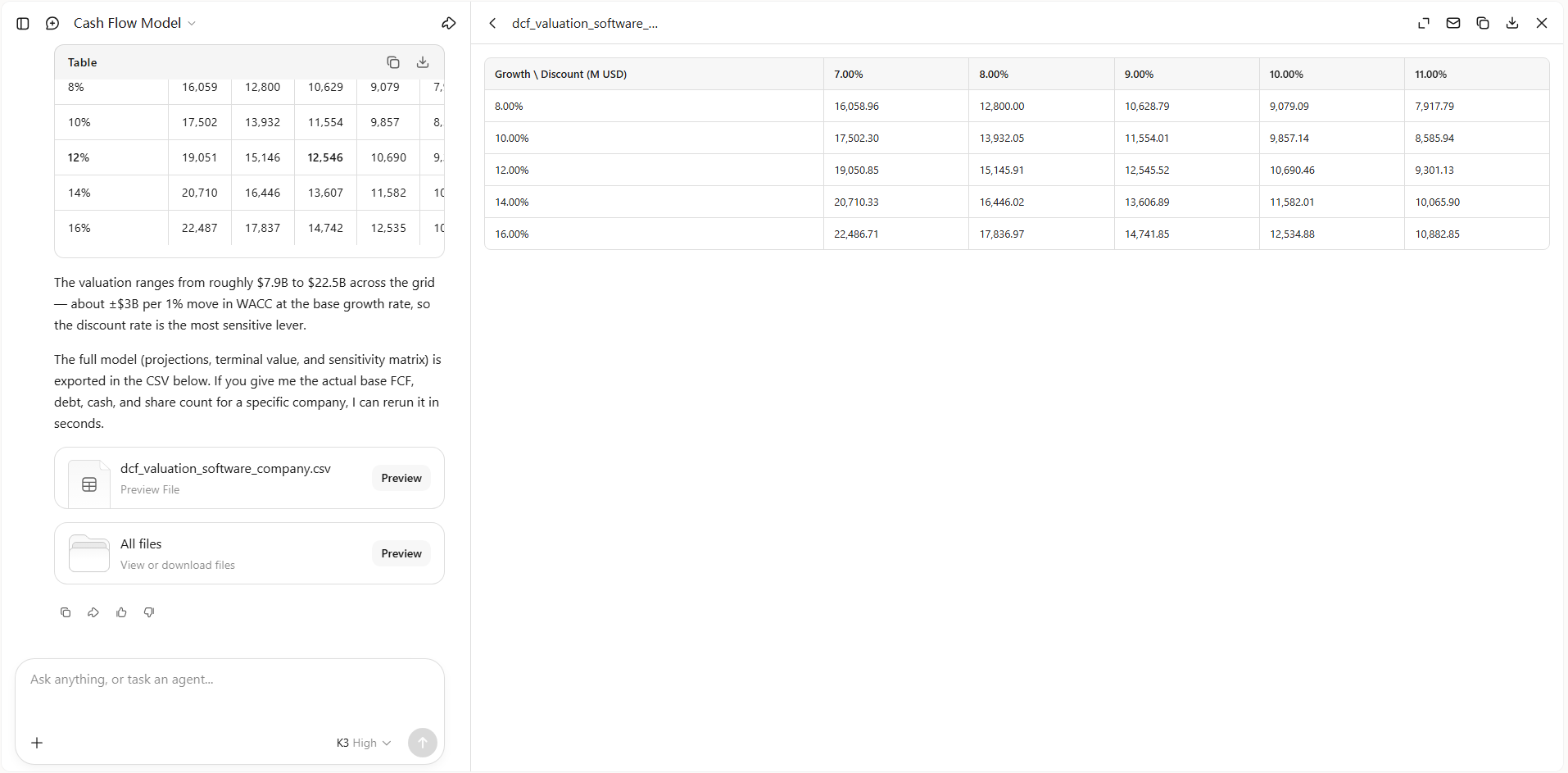
Review the generated financial model, validate the assumptions, adjust any inputs if needed, and export the results for reporting, presentations, or further analysis.
Explore open-source financial modeling skills
Many developers and finance professionals also share powerful AI skills as open-source projects, making them easy to explore, customize, and build upon. These skills cover a wide range of financial tasks, from forecasting and valuation to investment analysis and accounting workflows. Below are open-source financial modeling skills worth checking out:
| Skill name | Description | URL |
|---|---|---|
| quant-analyst | Build financial models, backtest trading strategies, and analyze market data. Implements risk metrics (VaR, Sharpe ratio, max drawdown), portfolio optimization (Markowitz, Black-Litterman), time series analysis, and options pricing with Greek calculation. | https://github.com/agent-skills-hub/agent-skills-hub/blob/main/skills/quant-analyst/SKILL.md |
| financial-analysis | Institutional-grade financial analysis skills for AI agents — Comps Analysis (EV/Revenue, EV/EBITDA, P/E), DCF Model (WACC, terminal value, sensitivity), LBO Model (debt schedules, IRR & MOIC), and 3-Statements integrated modeling. Includes an Excel template generator. | https://github.com/d-wwei/financial-analysis |
| excel-analyst-pro | Professional financial modeling toolkit with auto-invoked Skills and Excel MCP integration. Build DCF models, LBO analysis, variance reports, and pivot tables using natural language. Produces multi-sheet Excel workbooks with assumptions, projections, and sensitivity analysis. | https://github.com/jeremylongshore/excel-analyst-pro |
| financial-red-flag-auditor-skill | Reusable agent skill for auditing listed-company financial reports, scoring financial quality across 15 domains on a 100-point scale, and producing structured red-flag analysis reports. Validates structured data against official filings with deterministic screening rules. | https://github.com/noahnan-max/financial-red-flag-auditor-skill |
| openaccountant-skills | 44 open-source financial skills for AI agents covering P&L, budgeting, tax prep, debt payoff, and more. Works with Claude Code, Wilson, Cursor, Codex, and Paperclip. Includes transaction search, spending summary, and anomaly detection tools. | https://github.com/openaccountant/skills |
| personal-finance-skill | AI-powered personal finance skill with 75 tools across 7 extensions for banking (Plaid), trading (Alpaca), portfolio monitoring (IBKR), tax optimization, market intelligence, and social sentiment. Built for the Agent Skills Protocol with risk and policy guardrails. | https://github.com/6missedcalls/personal-finance-skill |
| buffett-skills | Collection of AI skills built on Warren Buffett's investing framework. Covers thinking frameworks, investment philosophy, business moat analysis, management governance, financial metrics, valuation, risk behavior, and industry playbooks with 8 reference modules. | https://github.com/agi-now/buffett-skills |
| earnings-analysis | Quick earnings analysis with consensus Wall Street forecast, past guidance, and peer industry trends. Appends the "Fund Manager Questions" section to surface gaps and forces analysts to defend conclusions. Supports uploaded filings and web search data. | https://github.com/HHFinAi/earnings-analysis |
| a-stock-data | A full-stack A-share data toolkit featuring a 10-layer architecture, 40 endpoints, and 13 data sources. It covers market data, research reports (both individual stocks and industries), capital flows, chip distribution, announcements, ETF options, and sentiment analysis. It also includes valuation assessment and technical analysis capabilities. | https://github.com/simonlin1212/a-stock-data |
Install open-source financial modeling skills in Kimi
Kimi can install compatible open-source skills directly from GitHub, making it easy to expand its capabilities for valuation, forecasting, portfolio analysis, and other finance-related tasks. Follow these steps to use open-source skills in Kimi:
Step 1: Enter a prompt
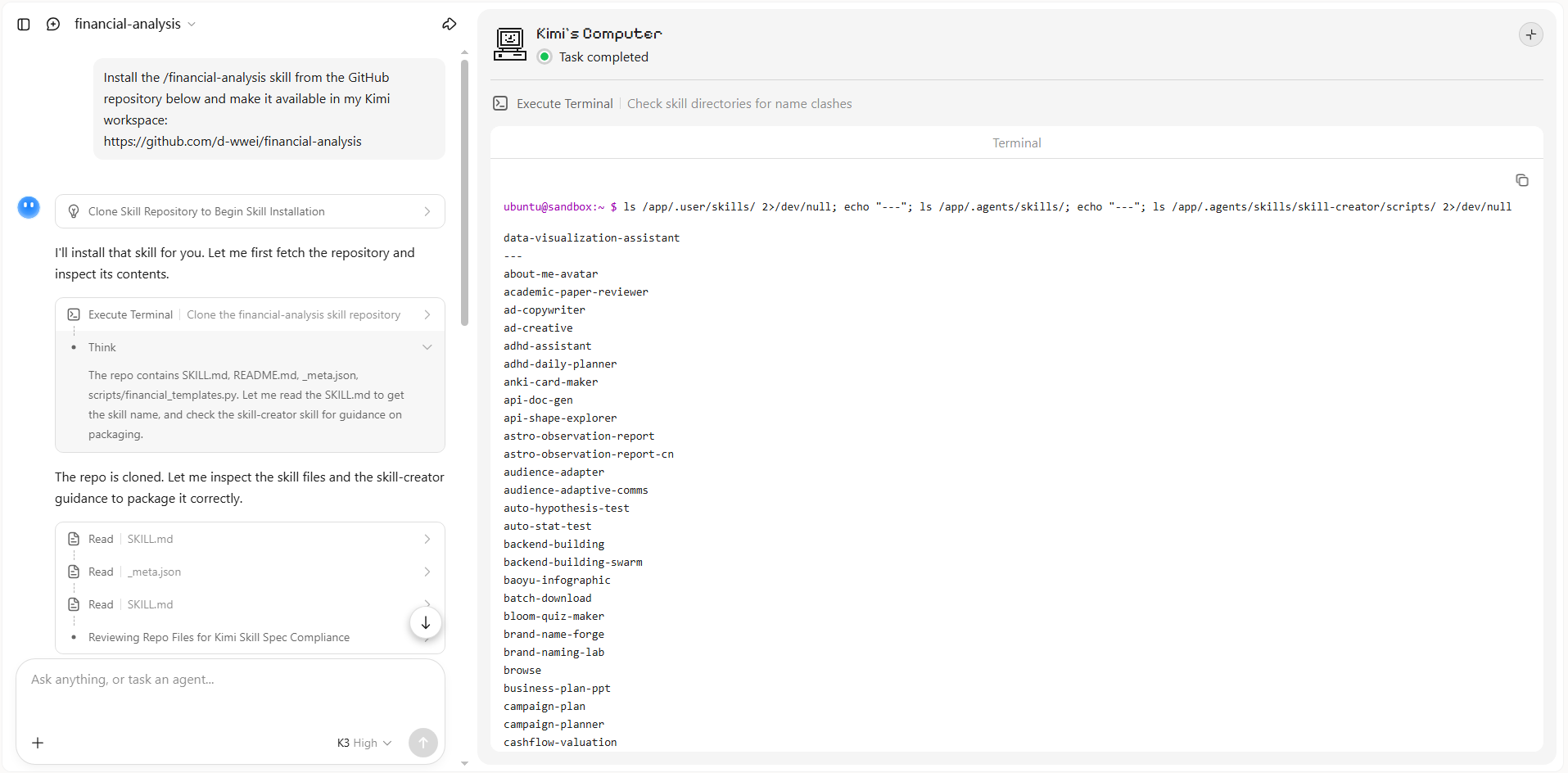
Open Kimi and ask it to install an open-source financial modeling skill by providing the GitHub repository URL.
Example prompt:

Step 2: Let AI install the skill automatically
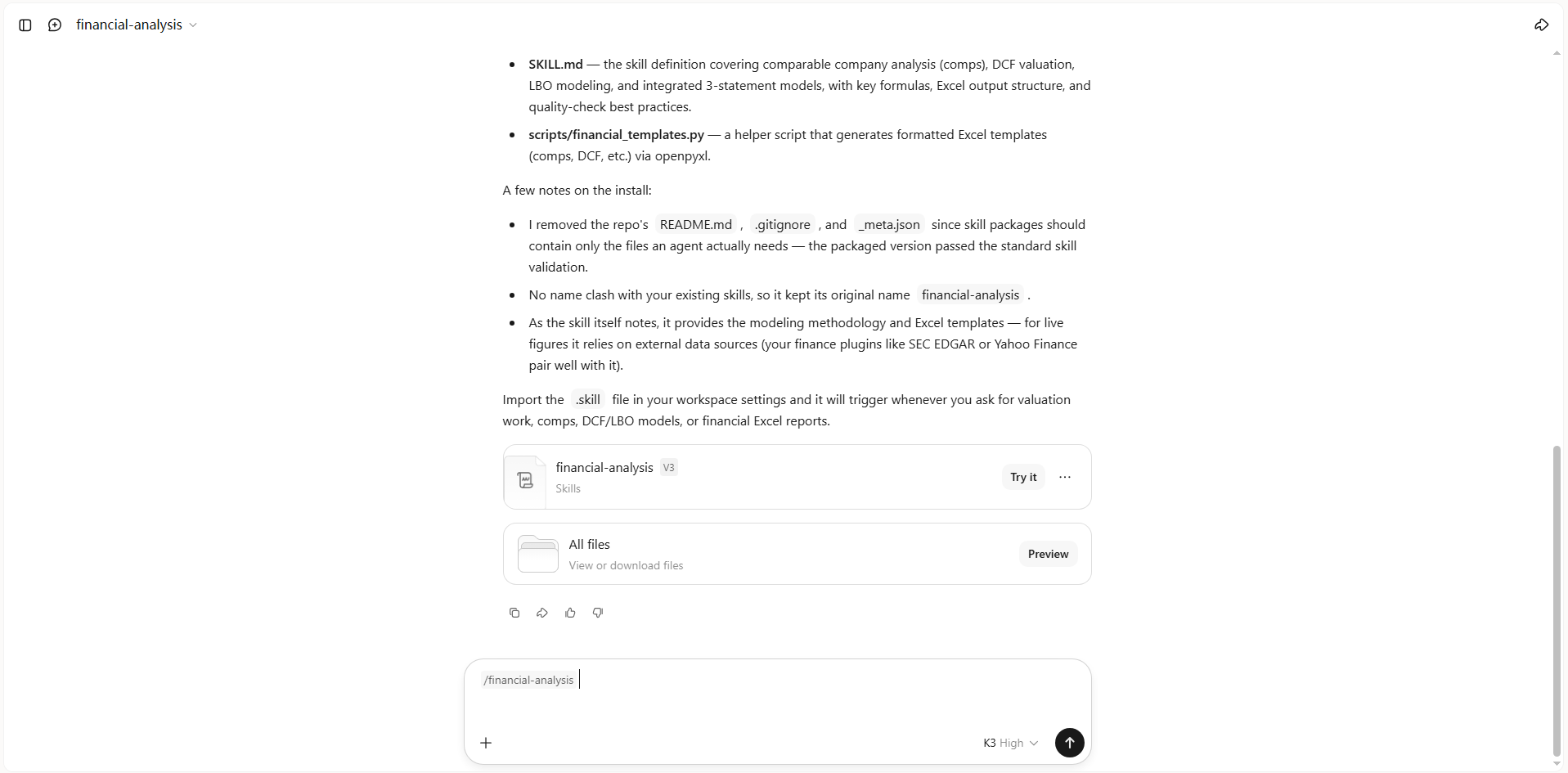
Kimi downloads the selected skill, configures the required files, and prepares it for use without requiring any manual setup from you.
Step 3: Use the skill
After the installation is complete, activate the new skill and enter your financial modeling task. Kimi will use the installed skill to perform calculations, generate reports, or analyze financial data based on your request.
Create custom AI financial modeling skills that fit your workflow
Kimi also lets you build your own skills using your existing spreadsheets, reports, templates, and financial documents. This makes it easy to create reusable AI tools that match your organization's workflows and analysis methods. Here's a step-by-step guide to create custom skills in Kimi:
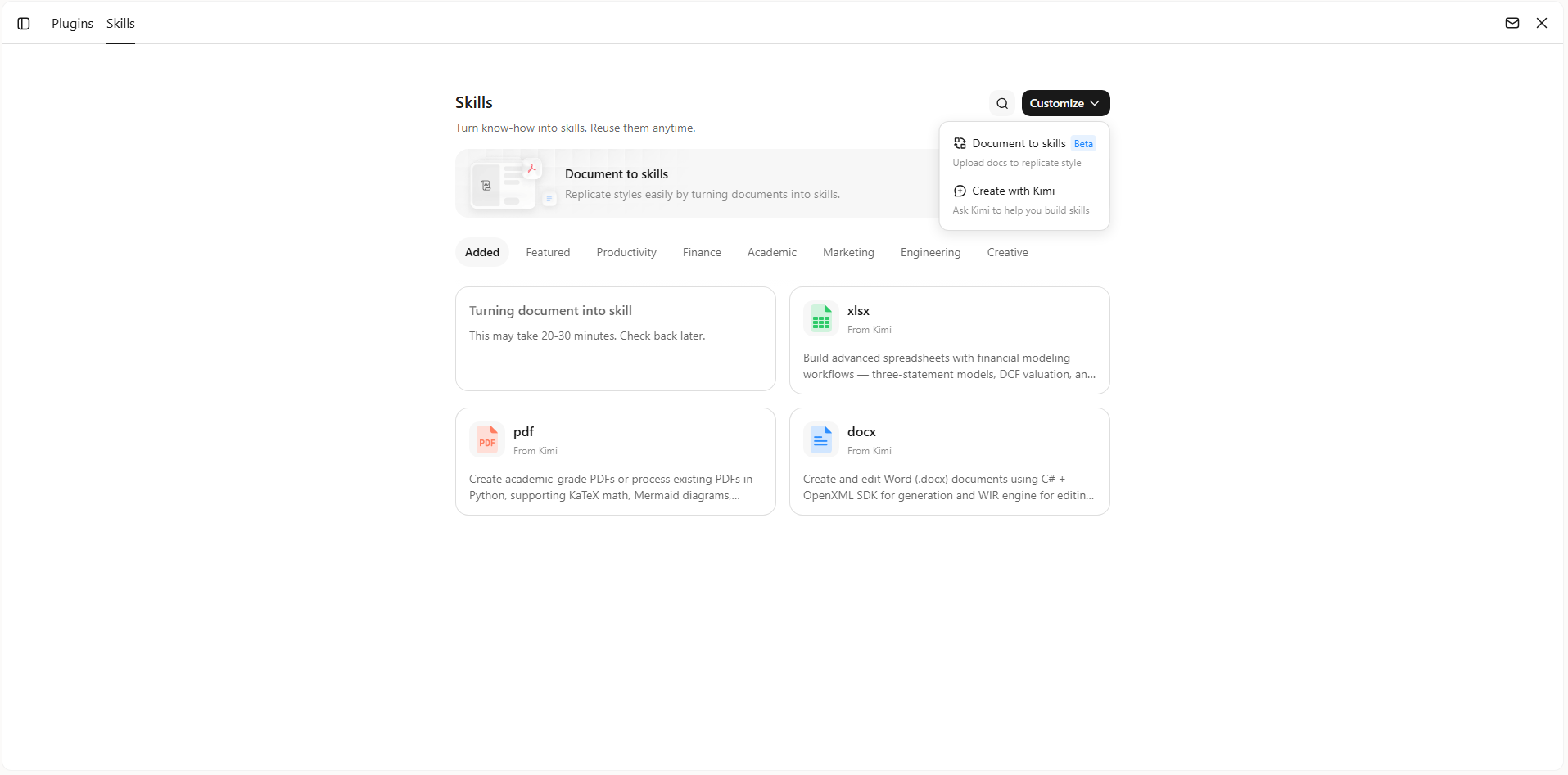
Step 1: Access the "Document to skills" tool
Launch Kimi Skills and select "Document to skills" to create a tailored financial modeling skill from your documents.
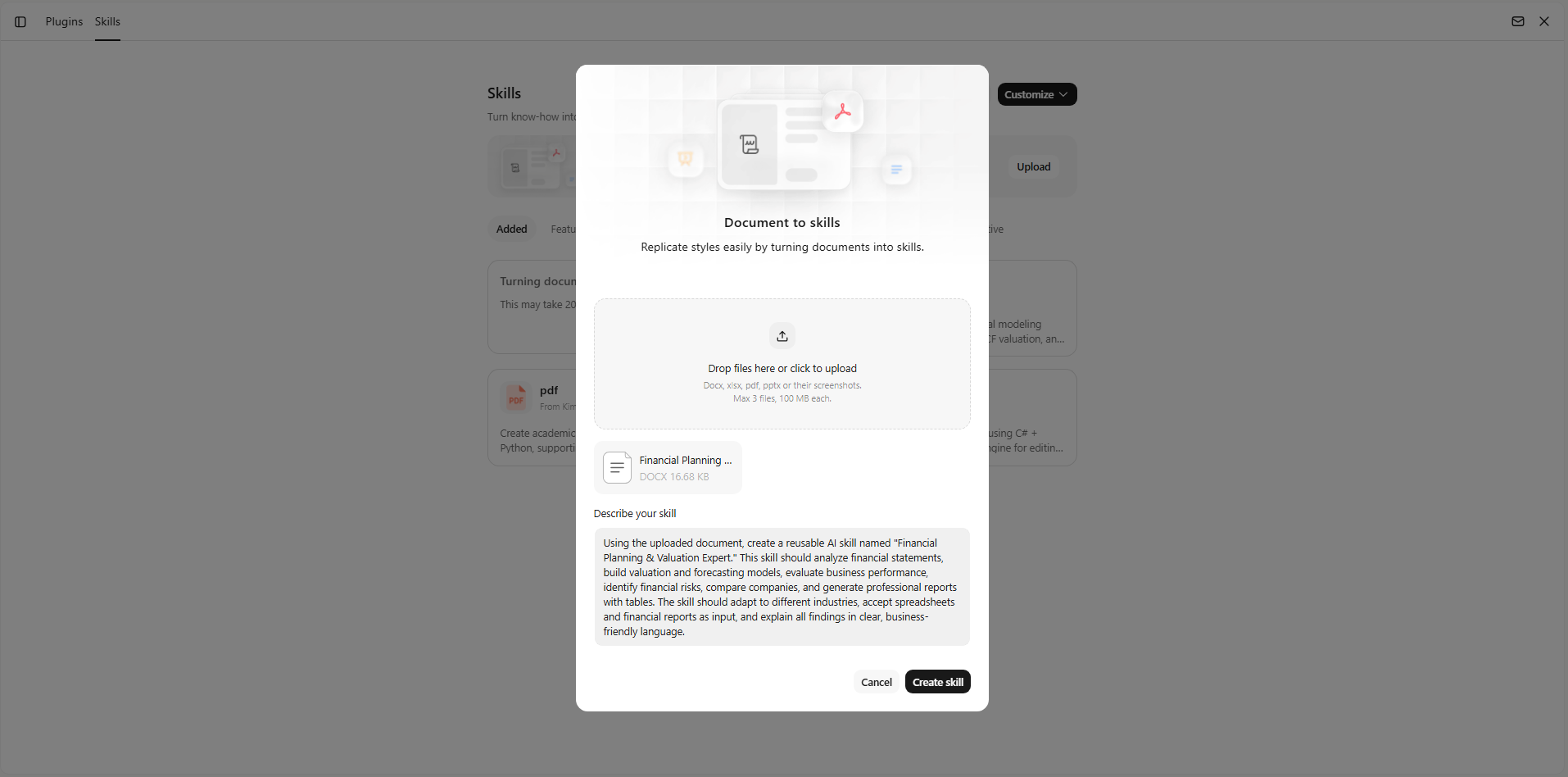
Step 2: Upload the files
Upload financial documents such as valuation models, budgeting templates, Excel workbooks, financial statements, forecasting models, or investment frameworks. Kimi will organize the content into reusable AI skills.
Step 3: Create and use your skills
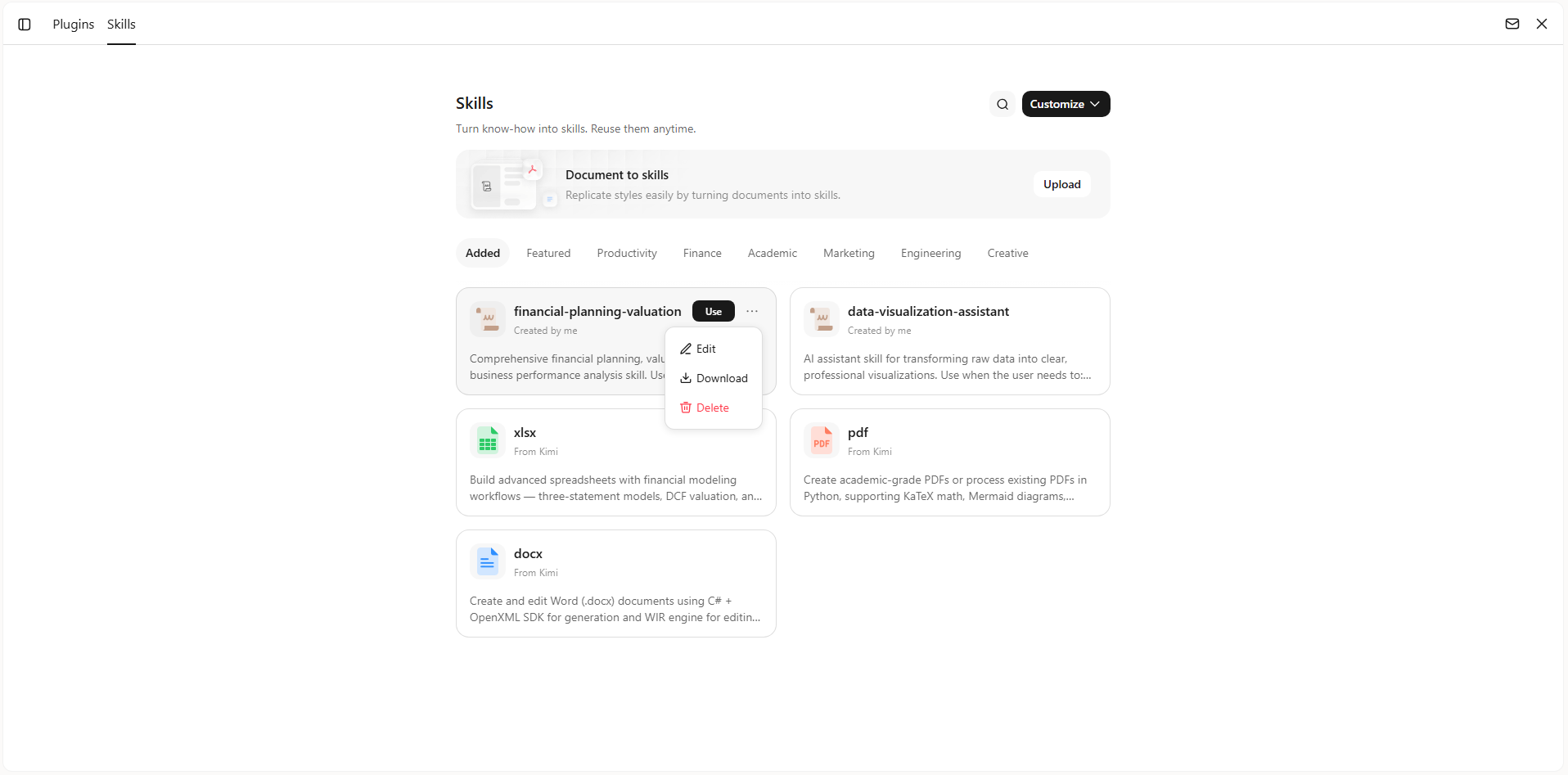
Once processing is complete, your custom skill is ready to generate financial models, analyze reports, automate calculations, and support similar finance tasks.
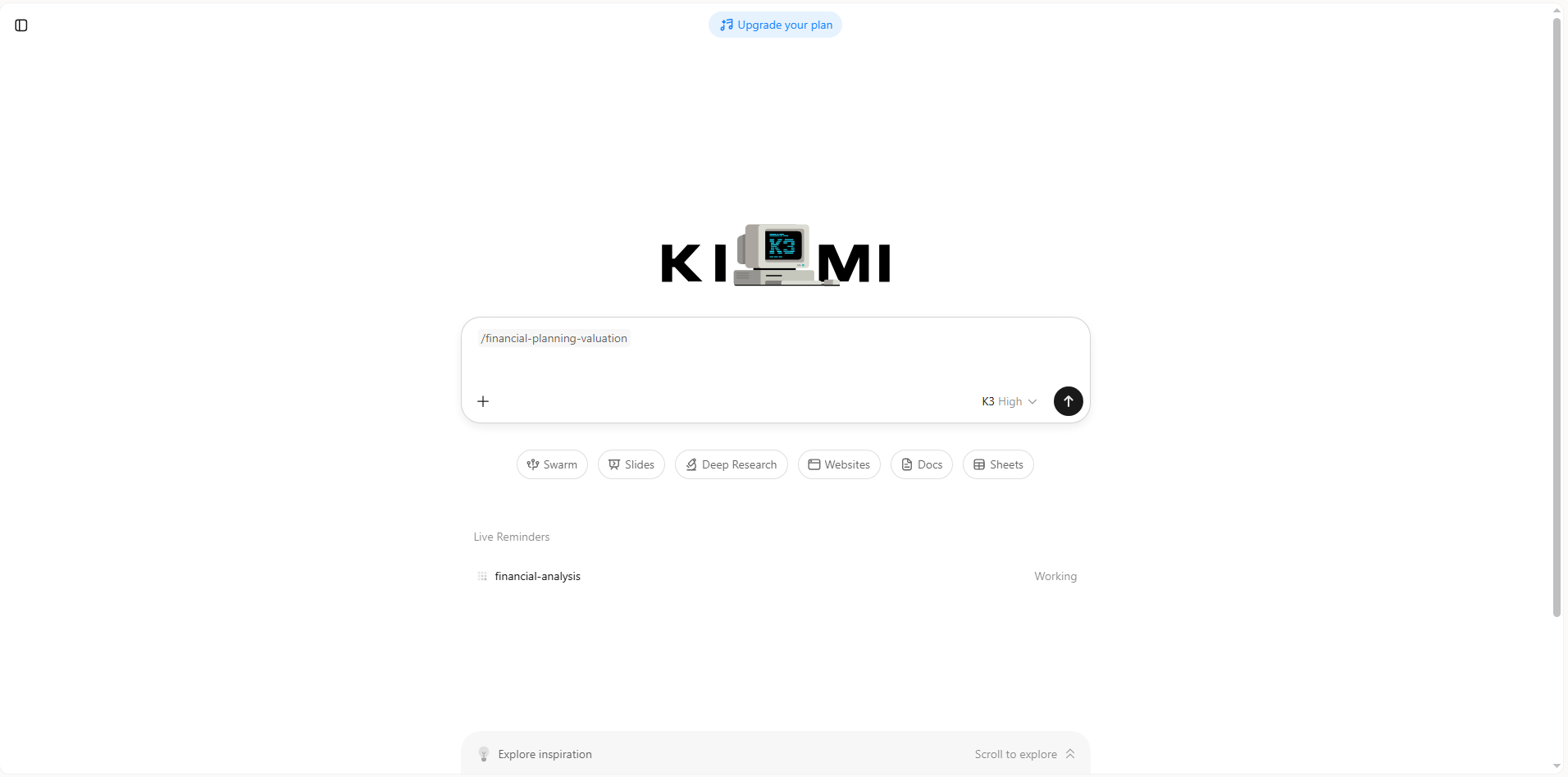
You can refine the skill anytime, reuse it across future projects, or edit and download it whenever needed.
Helpful tips for using financial modeling skills
Using financial modeling skills effectively is about more than creating spreadsheets and forecasts. Following a few practical techniques can improve accuracy, make your models easier to maintain, and produce more reliable financial insights. The tips below will help you get better results from every financial skill:
Start with clear financial assumptions
Begin by defining important assumptions such as revenue growth, operating costs, market conditions, and expected business performance. Clear inputs help financial modeling skills generate more consistent forecasts and reduce uncertainty throughout the model.
Build models with flexible scenarios
Create multiple scenarios, including best-case, base-case, and downside cases, to understand how different assumptions affect financial results. Financial model skills make it easier to compare these outcomes and prepare for changing business conditions.
Link related financial statements properly
Connect the income statement, balance sheet, and cash flow statement so every update flows through the entire model automatically. Proper links allow financial modeling skills to produce accurate and reliable financial projections.
Automate repetitive calculations and updates
Use financial modeling skills to handle recurring calculations, update forecasts, and generate formulas automatically. This reduces manual work, saves valuable time, minimizes calculation errors, and improves overall modeling efficiency.
Validate models with real-world data and checks
Always review assumptions, verify formulas, and compare results with historical performance or market benchmarks. Regular validation helps financial skills produce dependable outputs, identify potential issues early, and improve confidence in financial decisions.
Conclusion
Strong financial decisions start with clear analysis, reliable data, and efficient workflows. Financial modeling skills make it easier to organize complex financial tasks and focus on insights instead of manual calculations. With Kimi, you can customize how you work by combining skills from the Skills store with your own AI-powered skills. Explore Kimi today and create a financial modeling workflow that grows with your needs.