AI agents can help turn ideas into achievable results, but completing goal-driven tasks consistently requires the right guidance and structure. Without clear instructions and workflows, agents may struggle to prioritize tasks, track progress, or maintain consistency. AI goal-setting skills provide agents with structured frameworks for handling goal-oriented work, helping them organize objectives, define milestones, and follow reliable processes. In this article, you'll discover practical goal-setting skills that can help you build more effective agent workflows for personal or professional goals.
What is the goal-setting skill for agents?
A goal-setting skill for AI agents is a structured workflow that helps agents understand objectives, define priorities, and execute tasks toward a desired outcome. It provides guidance on how to break complex goals into smaller steps, organize actions, evaluate progress, and adjust plans when conditions change. By applying goal-setting skills, AI agents can handle multi-step tasks more systematically instead of only responding to individual instructions.
Explore Kimi's goal-setting skills in the Skills store
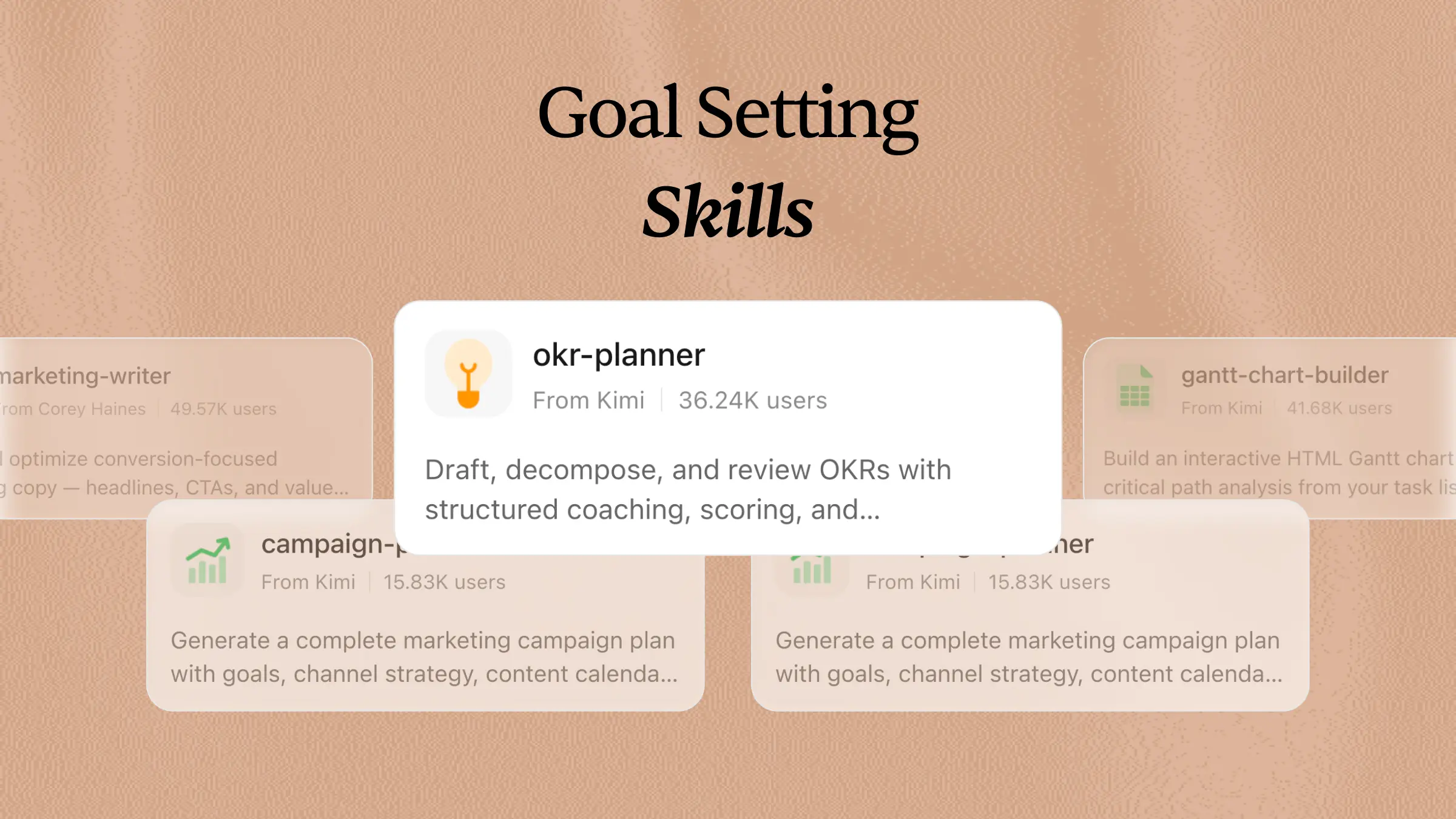
Kimi's AI goal-setting skill in the Skills store can break complex objectives into actionable steps, track progress, and keep you focused throughout the process. Below is Kimi's goal-setting skill in the Skills store to help you get started.
| Skill name | Description |
|---|---|
| okr-strategist | Coaches users through OKR drafting, breakdown, and retrospectives, helping craft high-quality objectives and key results, decompose goals into actionable layers, and conduct periodic reviews for goal alignment. |
| gantt-planner | Generate interactive HTML Gantt charts with Critical Path Method analysis, highlighting critical tasks and float times. |
| sprint-plan-builder | Build actionable Sprint plans by scoping stories to team capacity, estimating tasks, and balancing workloads. |
Using Kimi AI goal-setting skills from the Skills store
Follow these simple steps to use Kimi's AI goal-setting skill from the Skills store to create structured plans, define objectives, and track progress more effectively.
Step 1: Install the skill and input its command
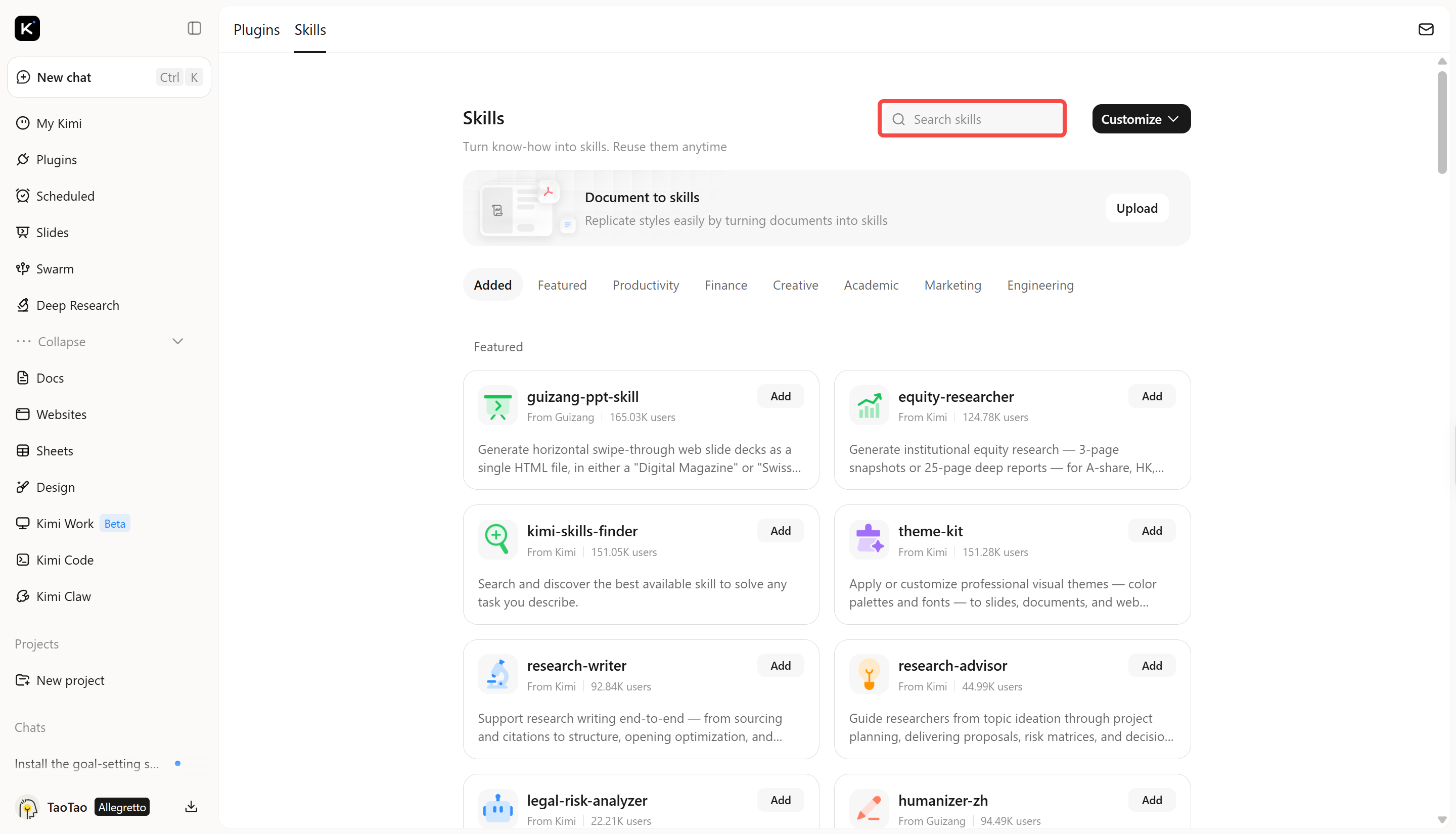
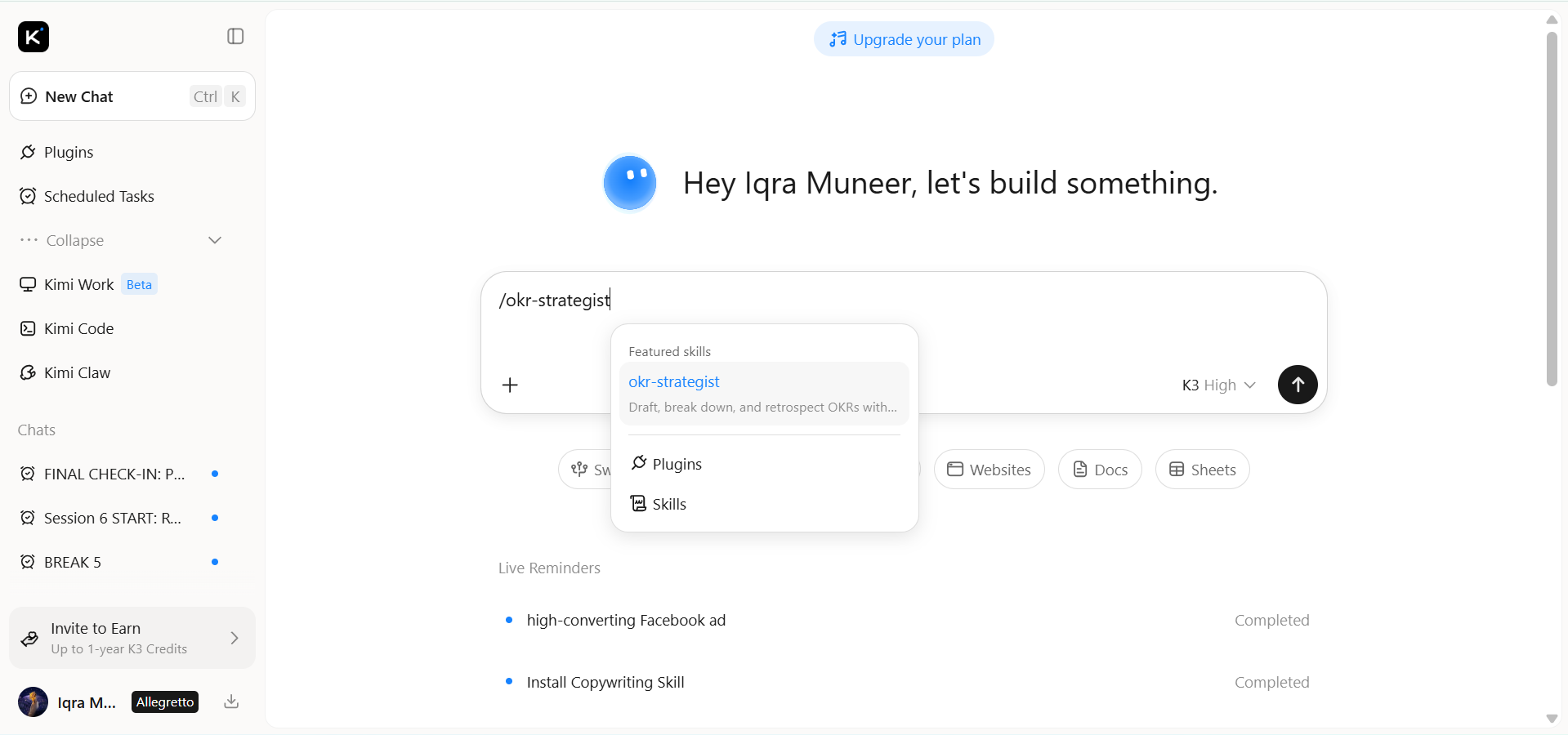
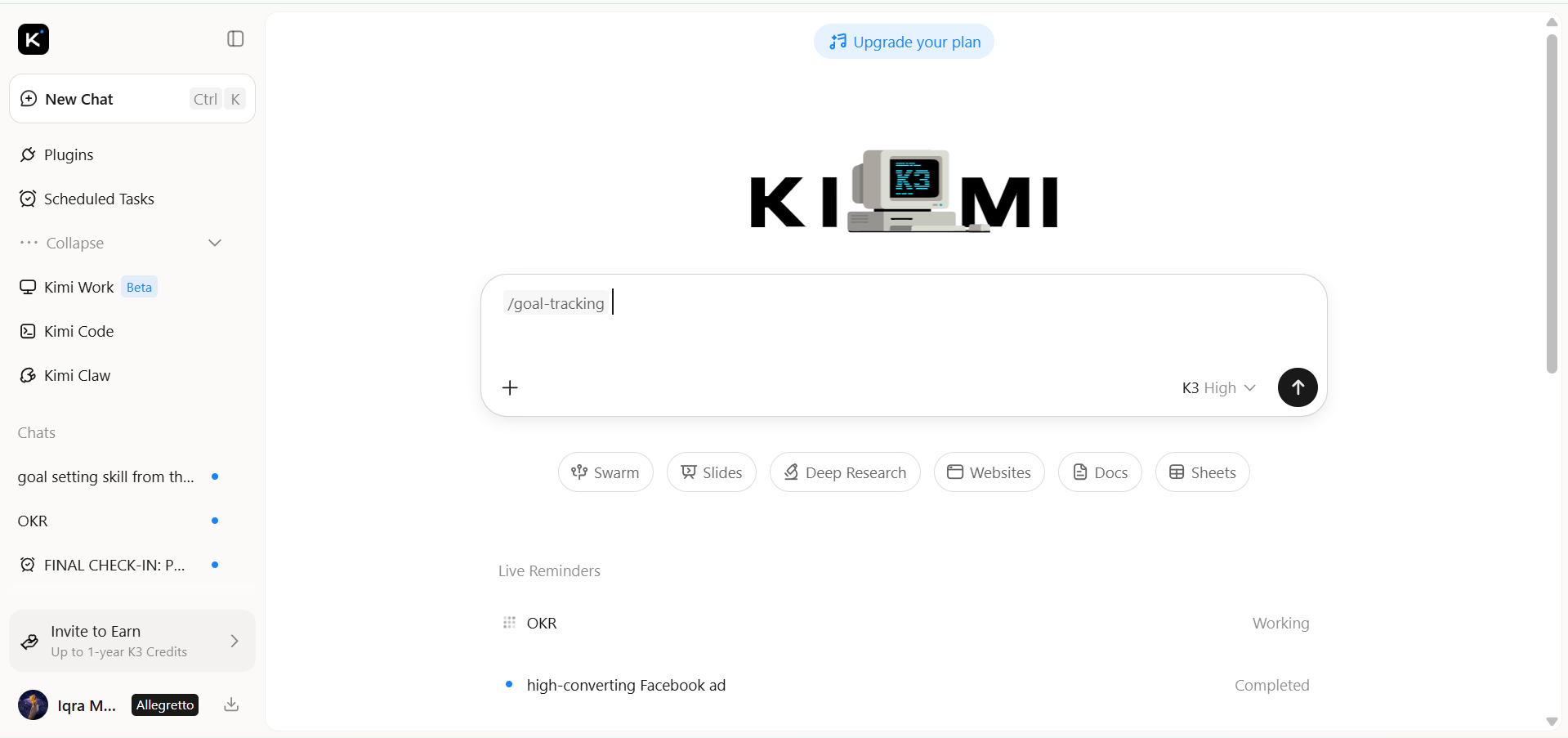
Open Kimi and type / in the input box to open the Skills store. Search for okr-strategist and click to install it. Then type /okr-strategist in the input box to activate the skill.
Step 2: Start your research task
Describe the goal you want to achieve, including your objectives, timeline, priorities, and any constraints.
Example prompt:
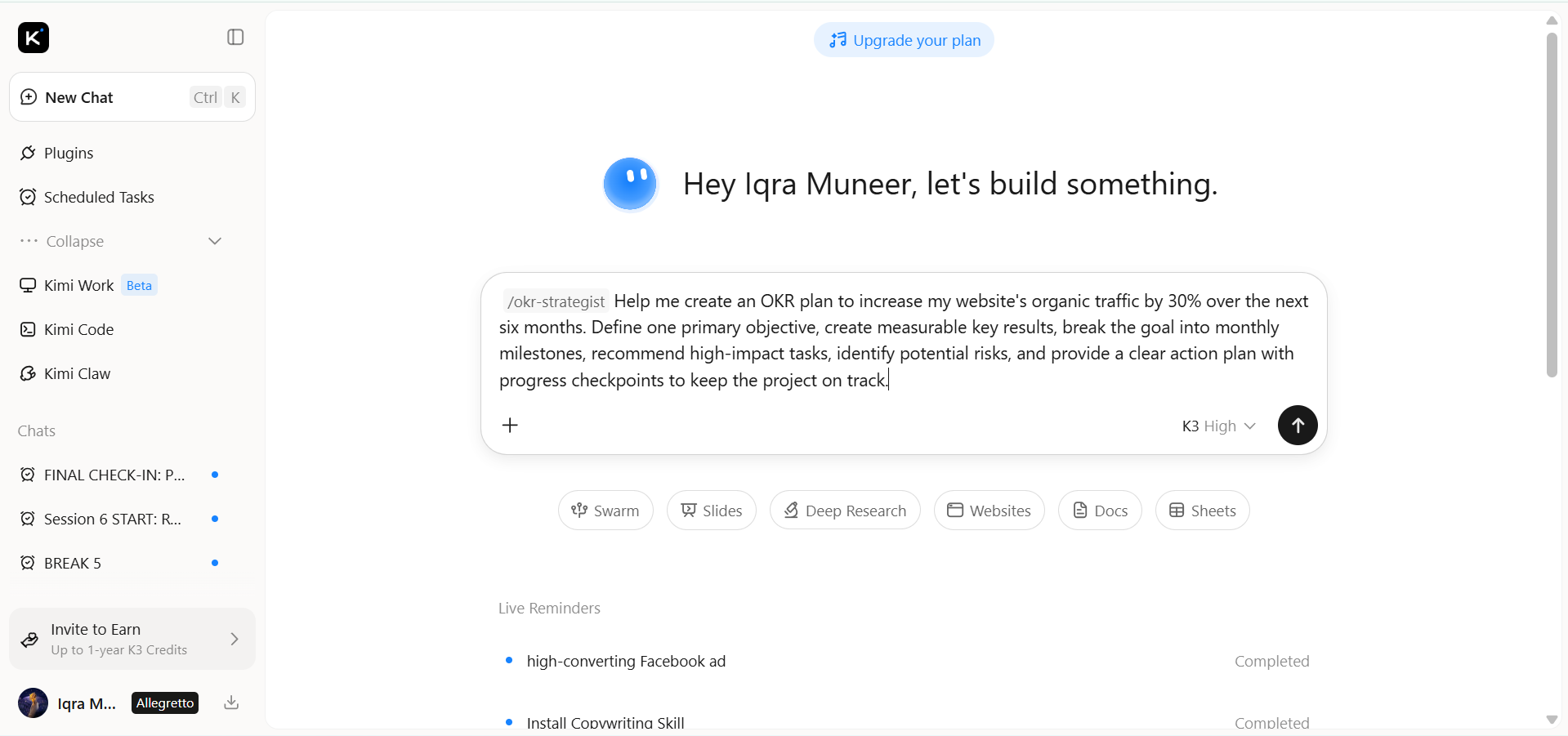
Kimi automatically creates a structured goal plan with objectives, key results, milestones, and recommended actions.
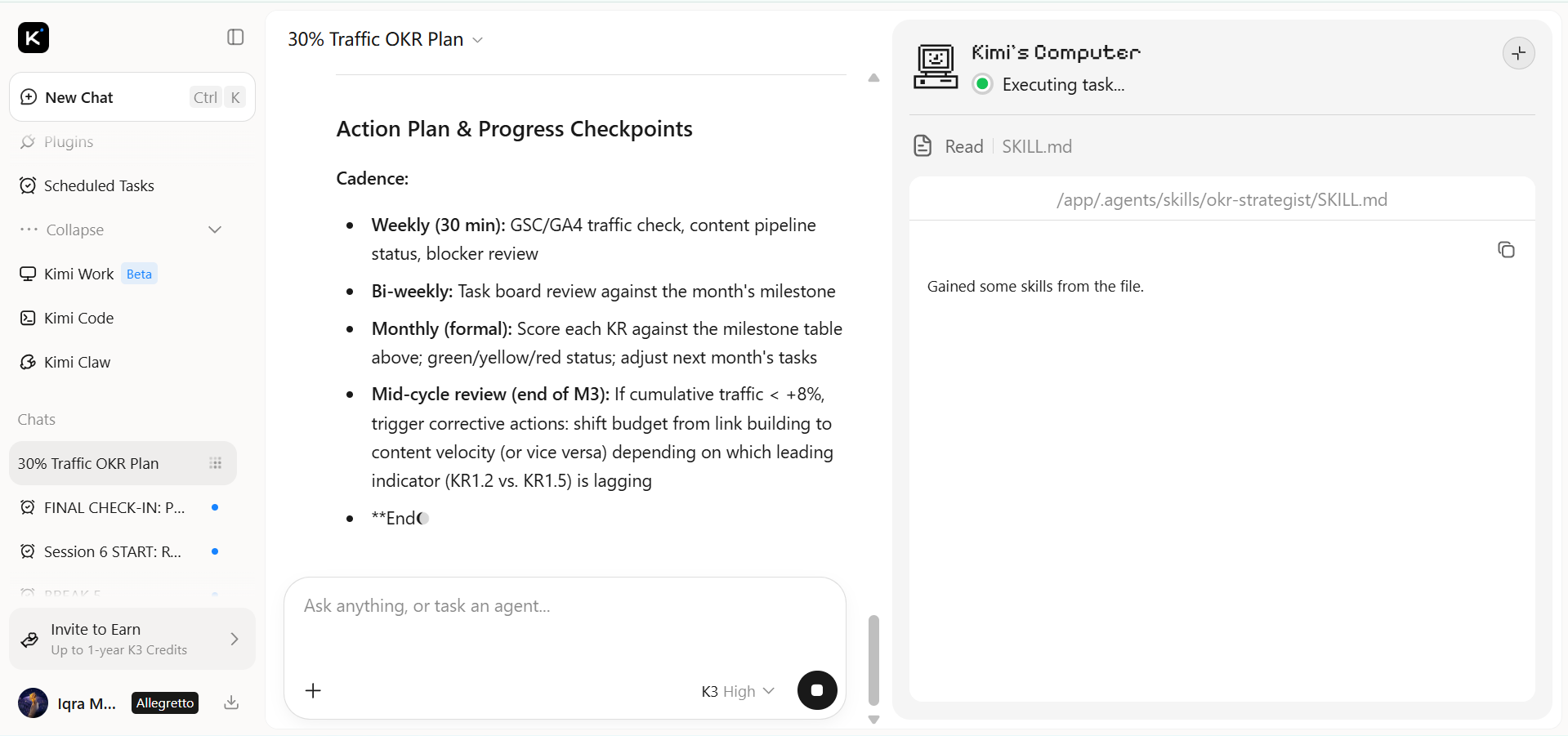
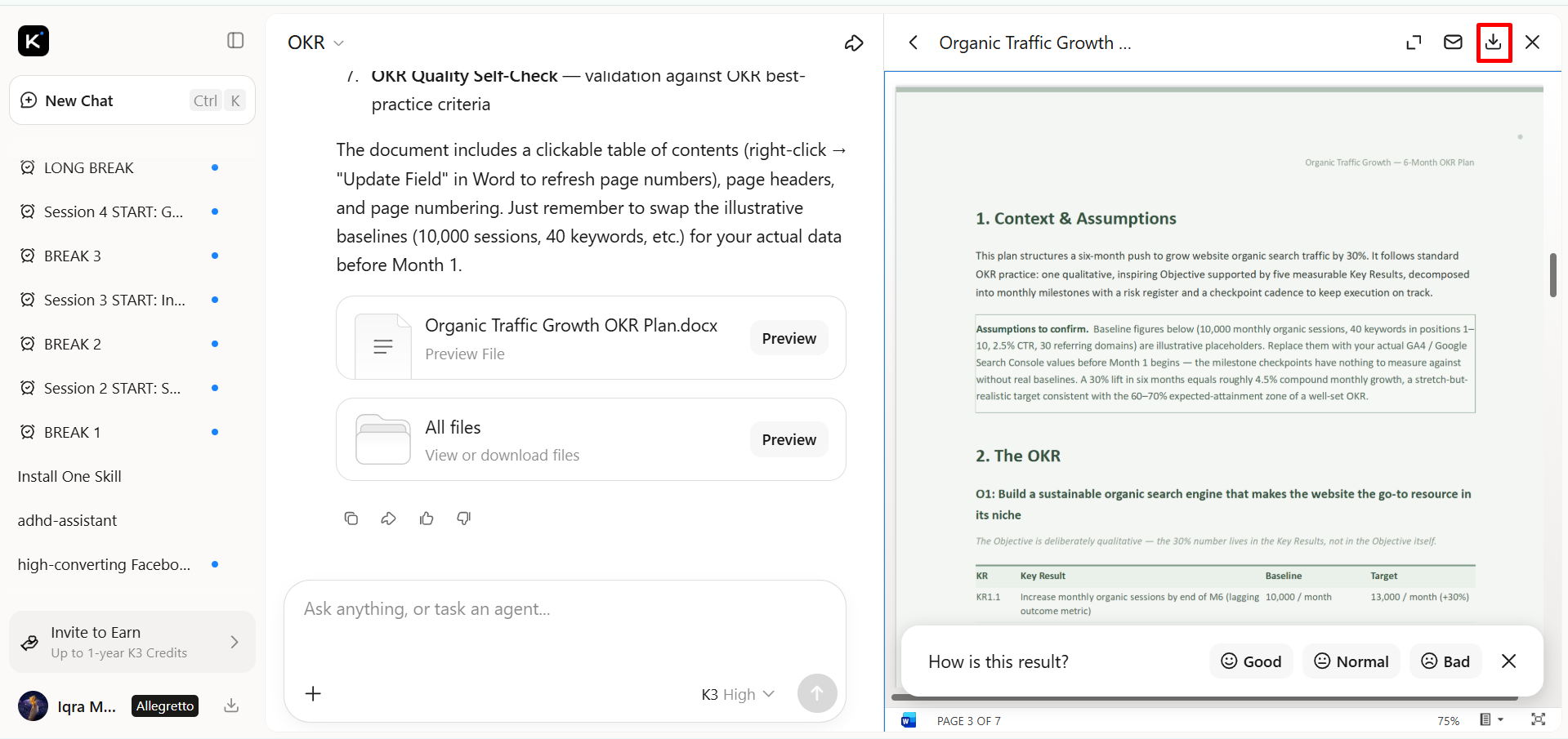
Step 3: Review and download your document
Review the generated goal plan, make any necessary refinements, and use it to track progress and achieve your objectives.
Explore open-source goal setting skills you need to try
If you need more flexibility, open-source AI skills are a great option. They can be installed, customized, and adapted to different planning workflows, making them useful for personal productivity, business planning, and goal setting skills for students. Below are open-source goal setting skills worth exploring.
| Skill name | Description | URL |
|---|---|---|
| qiaomu-goal-meta-skill | Turns vague or complex tasks into strong, copy-ready goal commands with outcome, verification evidence, constraints, write boundaries, iteration policy, and pause/stop conditions; supports Chinese output. Primary use case: task planning and defining verifiable objectives before execution | https://github.com/joeseesun/qiaomu-goal-meta-skill |
| goal-setter | Converts rough long-running work into a compact goal that fixes the result, evidence for success, boundaries, and stop rules, favoring verification targets over rule-heavy procedures. Primary use case: workflow automation for multi-step tasks with a clear finish line | https://github.com/gotalab/goal-setter-skill |
| goal-creator | Compiles plain-language work into durable, verifiable goal contracts covering done state, proof, constraints, operating loop, review depth, stop policy, and completion receipt; includes a goal linter script. Primary use case: risk tracking and evidence-based task acceptance | https://github.com/mysticaltech/goal-creator-skill |
| write-goal | A host-aware goal compiler that turns a plain-language task into a concise, auditable goal with a definition of done, proof surface, constraints, bounded stop conditions, and risk-based review depth, or explains when a normal prompt fits better. Primary use case: task planning with auditable completion criteria | https://github.com/petekp/agent-skills/tree/main/skills/write-goal |
| define-goal | Helps define a concrete, measurable goal before starting work, shaping fuzzy intentions into quantitative outcomes with explicit evidence and bounded scope. Primary use case: setting success criteria and measurable objectives for projects | https://github.com/openai/skills/blob/main/skills/.curated/define-goal/SKILL.md |
| copilot-goal-skill | Runs a Builder plus Inspector loop: asks clarifying questions until the goal is clear, writes a goal file, then iterates implementation against independent verification until acceptance criteria pass. Primary use case: sprint-style execution with independent quality review | https://github.com/gsemet/copilot-goal-skill |
| goal-forge | Turns a rough coding idea into a SPEC.md, GOAL.md, and a goal-ready contract, with a config inspector that checks whether the environment is ready for long autonomous goal sessions. Primary use case: project scoping and timeline management for long-running work | https://github.com/michaelpersonal/goal-forge |
| goal-planner | A thinking partner that pulls you away from implementation details, helps articulate the desired outcome, and files it as a GitHub issue with success criteria, duplicate checks, sub-issue links, and blocked-by relationships. Primary use case: project reporting and backlog structuring via issue tracking | https://github.com/recallnet/goal-planner |
| goal-tracking | Manages a cascading goal system from a three-year vision down to daily tasks in plain Markdown, computing progress with checklists, metrics, and time-based formulas, and flagging stalled goals. Primary use case: progress tracking and weekly or monthly project reviews | https://github.com/ballred/obsidian-claude-pkm/blob/main/vault-template/.claude/skills/goal-tracking/SKILL.md |
| goal-prompt-builder | Builds precise goal prompts using a five-section template to ensure audit-friendly execution and efficient token usage. Primary use case: standardizing goal definitions for consistent task delegation | https://github.com/quiescencycommonrush642/goal-prompt-builder |
Connect open-source skills with Kimi
Follow these simple steps to install an open-source AI goal-setting skill in Kimi and use it for smarter planning and goal management.
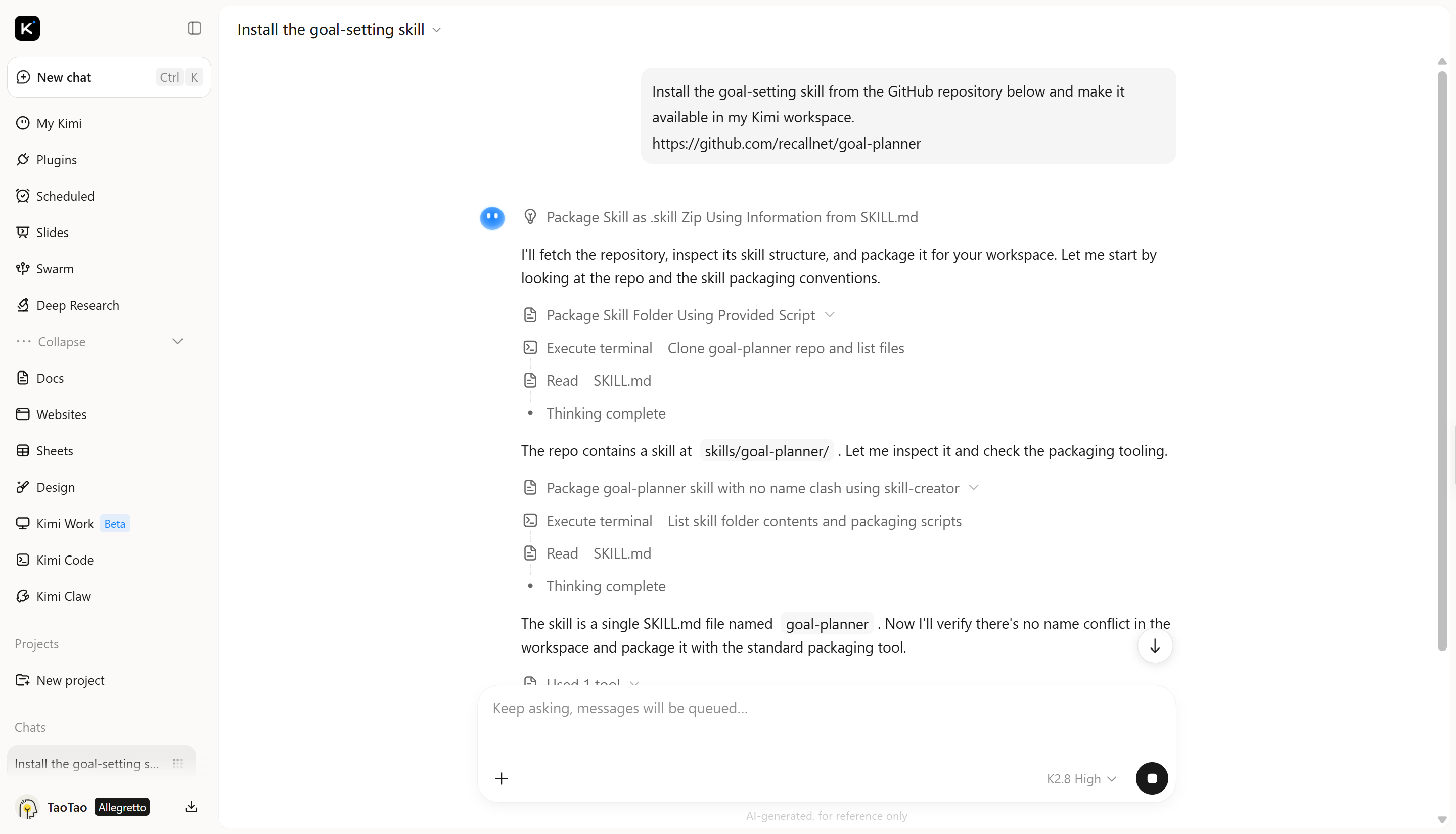
Step 1: Enter a prompt
Open Kimi and provide a prompt with the GitHub URL of the open-source goal-setting skill you want to install.
Example prompt:
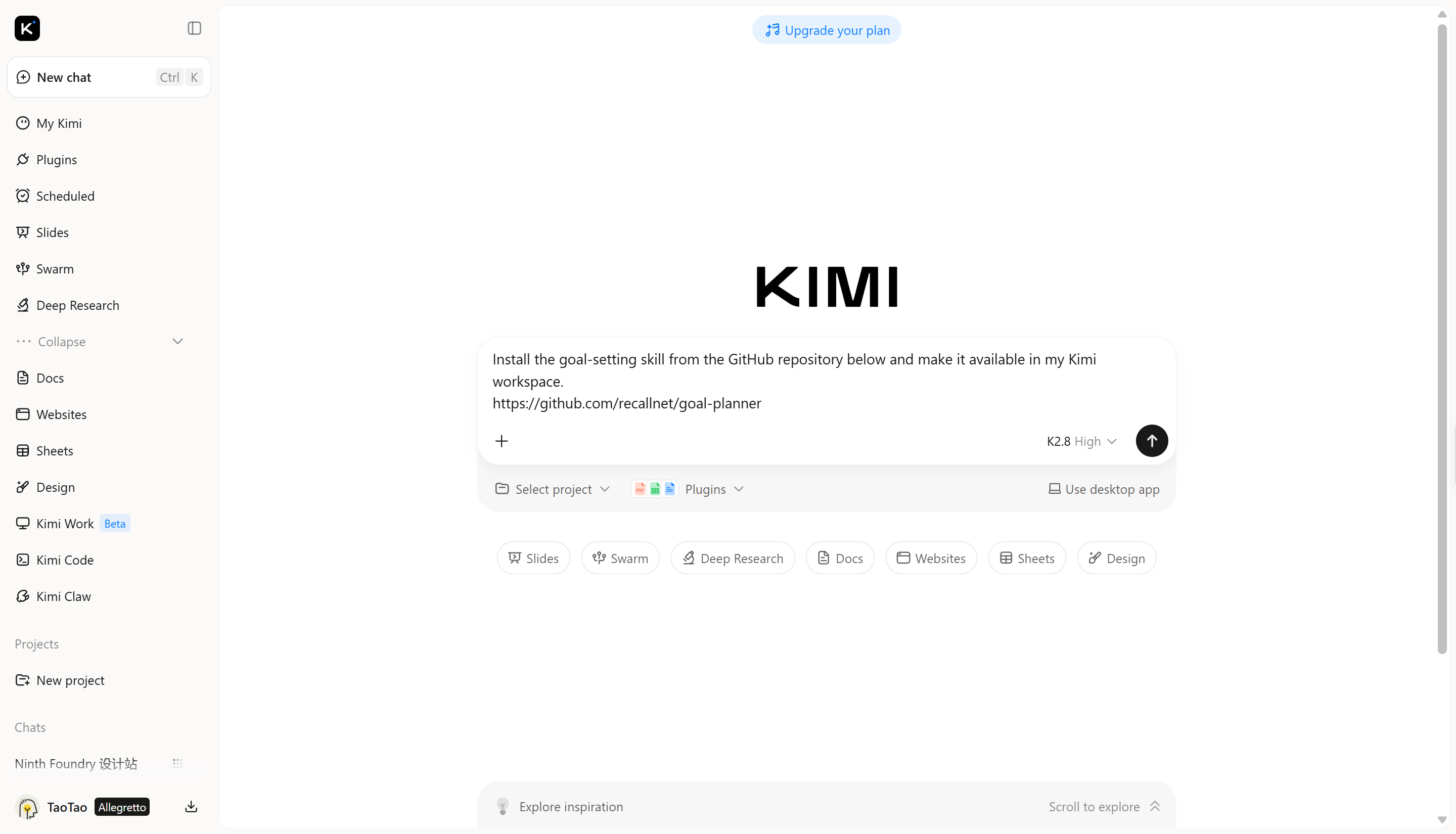
Step 2: Let AI install the skill automatically
Kimi automatically downloads, configures, and prepares the skill from the provided GitHub repository. Once the installation is complete, it becomes available in your workspace.
Step 3: Use the skill
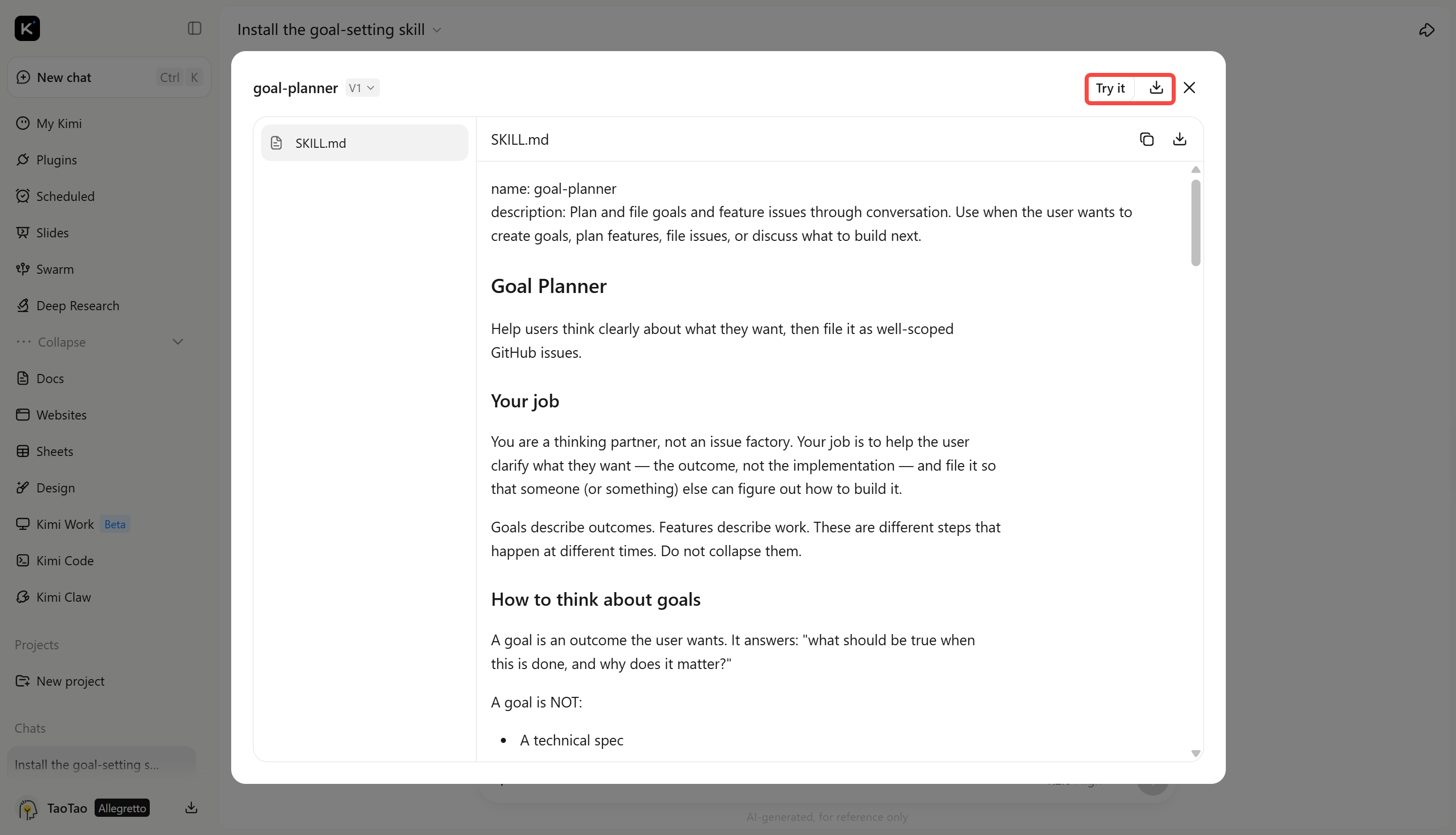
Click "Add to my skills" to save the installed skill, then select "Try it" to activate it. Once enabled, describe your goal or planning task, and the skill will help create objectives, milestones, action plans, and progress tracking.
Go beyond limits: Build reusable custom goal setting skills
Create a custom AI goal-setting skill from your own planning resources to automate recurring workflows. This helps Kimi understand your preferred planning methods, templates, and objectives, making future goal management faster and more consistent. Here is how to build reusable custom goal-setting skills in Kimi:
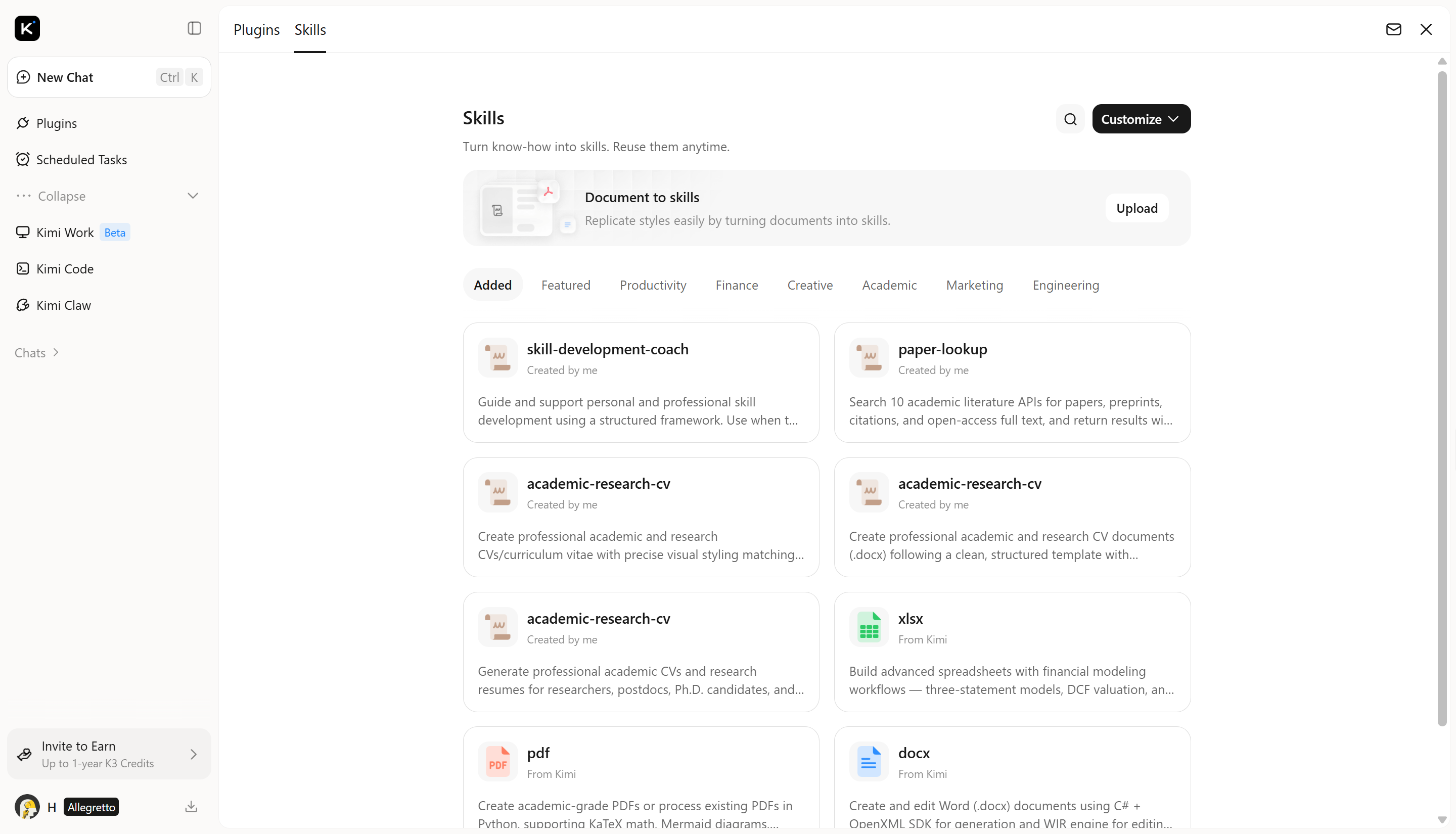
Step 1: Access the document to the skills tool
Open Kimi Skills > "Customize" > "Document to skills" to start building your custom goal-setting skill.
Step 2: Upload the files
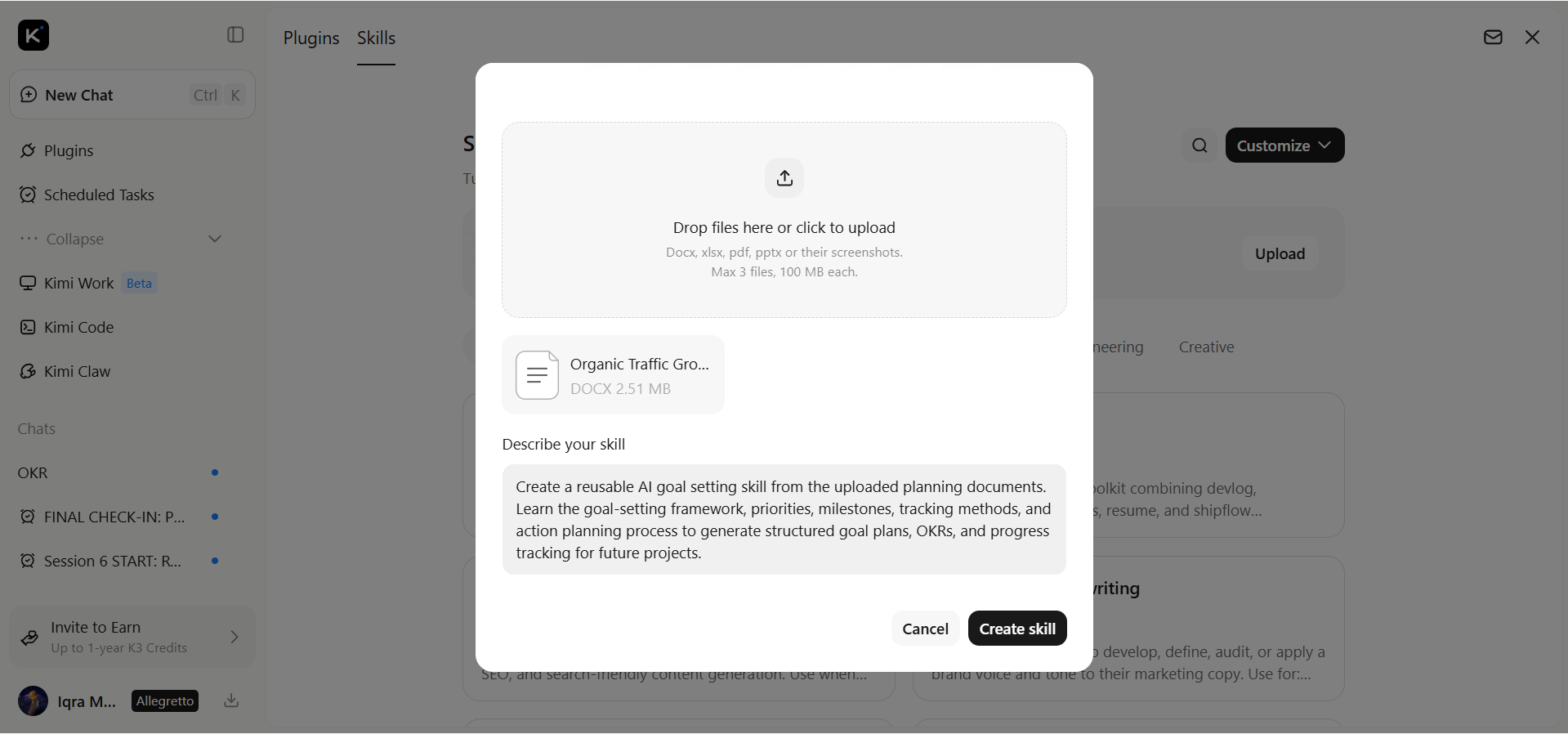
Upload planning templates, OKRs, goal trackers, project plans, productivity frameworks, or other documents you want Kimi to learn from. Kimi analyzes the content and creates a structured AI skill.
Step 3: Create and use your skills
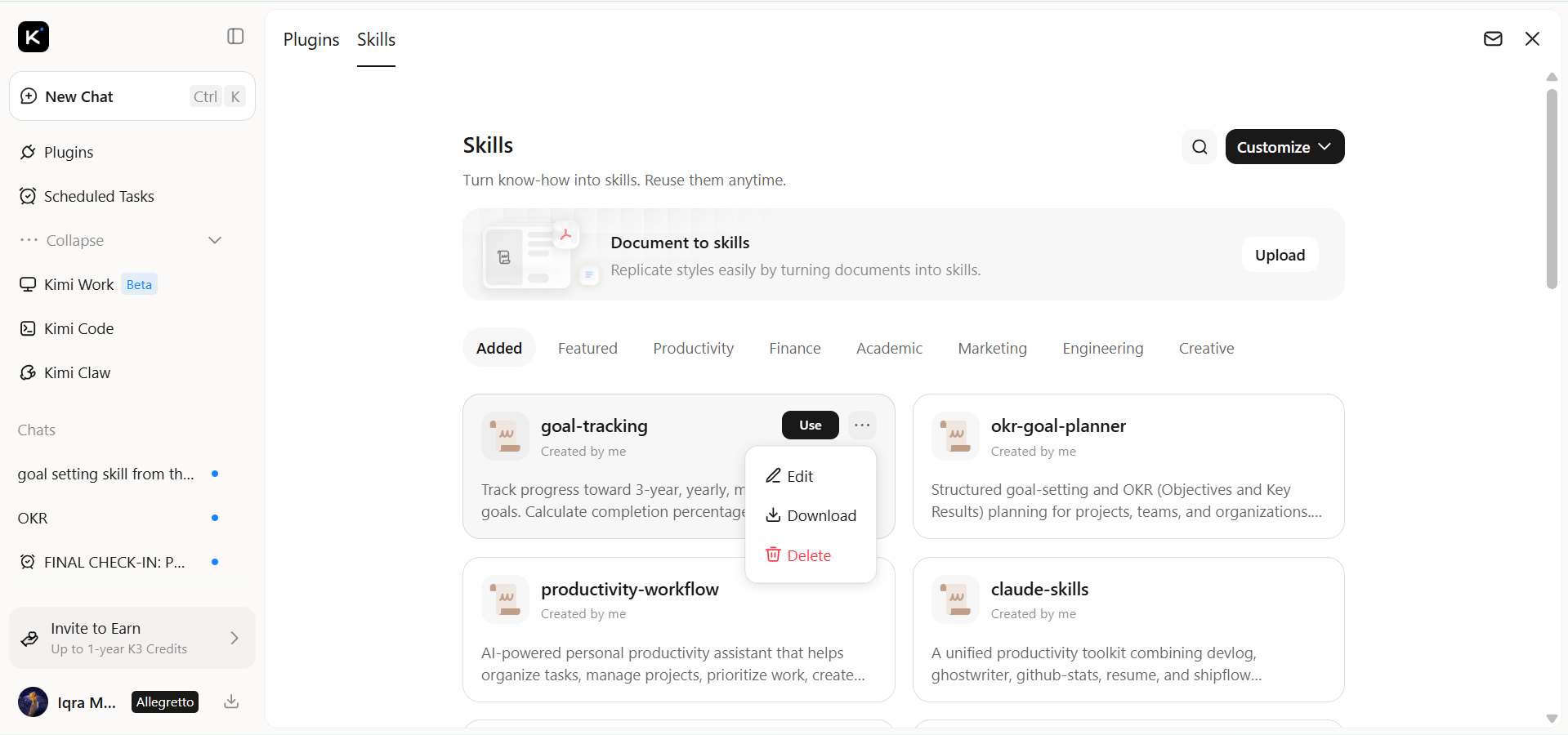
Review the generated AI skill, refine it if needed, and save it to your workspace. Start using it right away to plan, organize, and track future goals more efficiently.
You can also edit the skill anytime or export it as an .md file for reuse in future projects.
Expert practices for using goal-setting skills
The right goal-setting skills do more than help you define objectives; they keep you focused, organized, and accountable throughout the process. Here are some practical best practices to help you plan effectively and achieve your goals more consistently.
Set specific and measurable targets
Define clear objectives with measurable outcomes instead of vague intentions. Well-defined goals make it easier to track progress, evaluate success, and stay motivated throughout the project.
Break goals into smaller tasks
Divide large objectives into manageable milestones and actionable tasks. This approach reduces overwhelm, creates steady progress, and helps you complete complex projects more efficiently.
Track progress with clear metrics
Use measurable indicators such as deadlines, completion percentages, or key performance metrics to monitor progress. Regular tracking helps identify obstacles early and keeps your plan on course.
Review and adjust plans regularly
Evaluate your progress at regular intervals and update your action plan as priorities or circumstances change. Flexible planning helps ensure your goals remain realistic and achievable.
Prioritize goals based on impact
Focus on the tasks and objectives that deliver the greatest value first. Prioritizing high-impact activities helps you make better use of your time and resources.
Use automated reminders for consistency
Set reminders, recurring check-ins, or automated follow-ups to maintain momentum. Consistent reminders reduce the chance of missing deadlines and help build productive habits.
Apply skills across multiple projects
Reuse your AI goal-setting workflows for personal plans, business initiatives, or goal-setting skills for students. Standardized planning methods improve consistency and save time across different projects.
Conclusion
AI goal-setting skills provide a smarter way to define objectives, create action plans, and track progress toward personal and professional goals. From Kimi's goal-setting skill in the Skills store to customizable and open-source options, these workflows help AI agents break complex goals into manageable steps and improve execution. By using Kimi Skills, you can create reusable AI workflows that make goal planning more structured, efficient, and easier to achieve.