Water-Moon Guanyin 3D Model
A floating sacred island pairs a colossal weathered statue with dense grey temple roofs. Volumetric clouds wrap the island and veil the statue’s lower body. Generated by Kimi K3.1 Pro.
Loading preview...
Start from this prompt
A floating island with a colossal stone statue, dark temple roofs and a surrounding sea of clouds.
Try 3D MakeUsing Blender Python, create a regenerable, editable and exportable 3D scene and produce the final still render. The overall result must strictly follow the primary reference: a high-altitude top-down view, the floating island on the right, the colossal statue on its north edge, a sea of clouds on the left, and cool grey-blue lighting. The final image must come from a real 3D scene — never fake it with reference-image patches or 2D-generated pictures. Use display mode with main, architecture, statue and top inspection cameras for orbiting and zoom checks; no real-time interaction is required. Reference pictures is the sole authority for overall effect (camera, composition, island shape, statue placement, architecture extent, cloud occlusion and tonal values); the three guide images may each contribute only one aspect — traditional Chinese architectural detail, statue-to-city scale logic, and volumetric cloud layering with cool grey-blue light — never their composition or camera. The primary reference wins any conflict. Frame constraints: output a 1920×1080 main image plus a 2× version. High-altitude near-vertical top-down view (about 55°–70° pitch), telephoto, deep focus throughout. The island projects as a slightly tilted horizontal ellipse on the right side of the frame; the left half is a continuous cloud sea with no horizon or open sky. A giant pale weathered stone statue stands at the island's north edge, seen mostly from the back or rear-side, its tall crown and draped folds clearly readable, its lower body half-veiled by clouds. Dense dark architecture clusters occupy the island's lower half with legible roof ridges. The frame never reveals the complete underside of the floating island; the white areas are volumetric cloud — snow and ice materials are forbidden scene-wide. Architecture follows a "standard components → parametric templates → courtyard assemblies → cluster instancing" pipeline inside a dedicated collection: first build standard components (roof tiles, dougong brackets, column-beam bays, ridge beasts, railings, city-wall segments), then compose ten building templates (gate hall, main hall, side wing, multi-storey pavilion, open kiosk, gate tower, high-terrace hall, cross-ridge baosha hall, bell/drum tower, corridor courtyard). A closed wall band follows the island's edge; 12–16 courtyard units fill the middle ring via Poisson-disk distribution; the core is a symmetrical high-terrace zone with a few pavilion landmarks, leaving the central north edge clear for the statue. Materials stay desaturated: grey-green tiles, grey-black beams, dark-red columns, grey stone walls. Record the random seed so each generation is reproducible. The island is an irregular floating landmass about 200 m across in dark grey-green weathered stone; the statue is pale weathered limestone retaining crown, shoulders, drapery and carved relief — never pure white or plasticky. The cloud sea uses true volumetric materials with multi-layer noise: a continuous sea fills the left side, island-hugging flows swallow the island rim and half-veil the statue's lower body, and scattered low clouds break up the city interior; no cloud billboards or uniform white carpet. Lighting is a large soft key from upper left with low-intensity cool ambient fill; render final frames in Cycles with denoising. Previews may lower samples and volume step rates, but must not delete buildings or move the main camera. Proceed in order — environment check → island blockout → statue alignment → city generation → clouds, materials and lighting → render review — passing each stage before the next. Every major render round must produce side-by-side, overlay and difference comparisons against the primary reference, reviewed visually before further fixes; never declare completion from logs or numbers alone.
Add touch controls
Adds phone controls and layout without changing the other requirements.
Try 3D MakeUsing Blender Python, create a regenerable, editable and exportable 3D scene and produce the final still render. The overall result must strictly follow the primary reference: a high-altitude top-down view, the floating island on the right, the colossal statue on its north edge, a sea of clouds on the left, and cool grey-blue lighting. The final image must come from a real 3D scene — never fake it with reference-image patches or 2D-generated pictures. Use display mode with main, architecture, statue and top inspection cameras for orbiting and zoom checks; no real-time interaction is required. Reference pictures is the sole authority for overall effect (camera, composition, island shape, statue placement, architecture extent, cloud occlusion and tonal values); the three guide images may each contribute only one aspect — traditional Chinese architectural detail, statue-to-city scale logic, and volumetric cloud layering with cool grey-blue light — never their composition or camera. The primary reference wins any conflict. Frame constraints: output a 1920×1080 main image plus a 2× version. High-altitude near-vertical top-down view (about 55°–70° pitch), telephoto, deep focus throughout. The island projects as a slightly tilted horizontal ellipse on the right side of the frame; the left half is a continuous cloud sea with no horizon or open sky. A giant pale weathered stone statue stands at the island's north edge, seen mostly from the back or rear-side, its tall crown and draped folds clearly readable, its lower body half-veiled by clouds. Dense dark architecture clusters occupy the island's lower half with legible roof ridges. The frame never reveals the complete underside of the floating island; the white areas are volumetric cloud — snow and ice materials are forbidden scene-wide. Architecture follows a "standard components → parametric templates → courtyard assemblies → cluster instancing" pipeline inside a dedicated collection: first build standard components (roof tiles, dougong brackets, column-beam bays, ridge beasts, railings, city-wall segments), then compose ten building templates (gate hall, main hall, side wing, multi-storey pavilion, open kiosk, gate tower, high-terrace hall, cross-ridge baosha hall, bell/drum tower, corridor courtyard). A closed wall band follows the island's edge; 12–16 courtyard units fill the middle ring via Poisson-disk distribution; the core is a symmetrical high-terrace zone with a few pavilion landmarks, leaving the central north edge clear for the statue. Materials stay desaturated: grey-green tiles, grey-black beams, dark-red columns, grey stone walls. Record the random seed so each generation is reproducible. The island is an irregular floating landmass about 200 m across in dark grey-green weathered stone; the statue is pale weathered limestone retaining crown, shoulders, drapery and carved relief — never pure white or plasticky. The cloud sea uses true volumetric materials with multi-layer noise: a continuous sea fills the left side, island-hugging flows swallow the island rim and half-veil the statue's lower body, and scattered low clouds break up the city interior; no cloud billboards or uniform white carpet. Lighting is a large soft key from upper left with low-intensity cool ambient fill; render final frames in Cycles with denoising. Previews may lower samples and volume step rates, but must not delete buildings or move the main camera. Proceed in order — environment check → island blockout → statue alignment → city generation → clouds, materials and lighting → render review — passing each stage before the next. Every major render round must produce side-by-side, overlay and difference comparisons against the primary reference, reviewed visually before further fixes; never declare completion from logs or numbers alone.
Using Blender Python, create a regenerable, editable and exportable 3D scene and produce the final still render. The overall result must strictly follow the primary reference: a high-altitude top-down view, the floating island on the right, the colossal statue on its north edge, a sea of clouds on the left, and cool grey-blue lighting. The final image must come from a real 3D scene — never fake it with reference-image patches or 2D-generated pictures. Use display mode with main, architecture, statue and top inspection cameras for orbiting and zoom checks; no real-time interaction is required.

Reference pictures is the sole authority for overall effect (camera, composition, island shape, statue placement, architecture extent, cloud occlusion and tonal values); the three guide images may each contribute only one aspect — traditional Chinese architectural detail, statue-to-city scale logic, and volumetric cloud layering with cool grey-blue light — never their composition or camera. The primary reference wins any conflict.

Frame constraints: output a 1920×1080 main image plus a 2× version. High-altitude near-vertical top-down view (about 55°–70° pitch), telephoto, deep focus throughout. The island projects as a slightly tilted horizontal ellipse on the right side of the frame; the left half is a continuous cloud sea with no horizon or open sky. A giant pale weathered stone statue stands at the island's north edge, seen mostly from the back or rear-side, its tall crown and draped folds clearly readable, its lower body half-veiled by clouds. Dense dark architecture clusters occupy the island's lower half with legible roof ridges. The frame never reveals the complete underside of the floating island; the white areas are volumetric cloud — snow and ice materials are forbidden scene-wide.

Architecture follows a "standard components → parametric templates → courtyard assemblies → cluster instancing" pipeline inside a dedicated collection: first build standard components (roof tiles, dougong brackets, column-beam bays, ridge beasts, railings, city-wall segments), then compose ten building templates (gate hall, main hall, side wing, multi-storey pavilion, open kiosk, gate tower, high-terrace hall, cross-ridge baosha hall, bell/drum tower, corridor courtyard). A closed wall band follows the island's edge; 12–16 courtyard units fill the middle ring via Poisson-disk distribution; the core is a symmetrical high-terrace zone with a few pavilion landmarks, leaving the central north edge clear for the statue. Materials stay desaturated: grey-green tiles, grey-black beams, dark-red columns, grey stone walls. Record the random seed so each generation is reproducible.

The island is an irregular floating landmass about 200 m across in dark grey-green weathered stone; the statue is pale weathered limestone retaining crown, shoulders, drapery and carved relief — never pure white or plasticky. The cloud sea uses true volumetric materials with multi-layer noise: a continuous sea fills the left side, island-hugging flows swallow the island rim and half-veil the statue's lower body, and scattered low clouds break up the city interior; no cloud billboards or uniform white carpet. Lighting is a large soft key from upper left with low-intensity cool ambient fill; render final frames in Cycles with denoising. Previews may lower samples and volume step rates, but must not delete buildings or move the main camera.

Proceed in order — environment check → island blockout → statue alignment → city generation → clouds, materials and lighting → render review — passing each stage before the next. Every major render round must produce side-by-side, overlay and difference comparisons against the primary reference, reviewed visually before further fixes; never declare completion from logs or numbers alone.
You Might Also Like
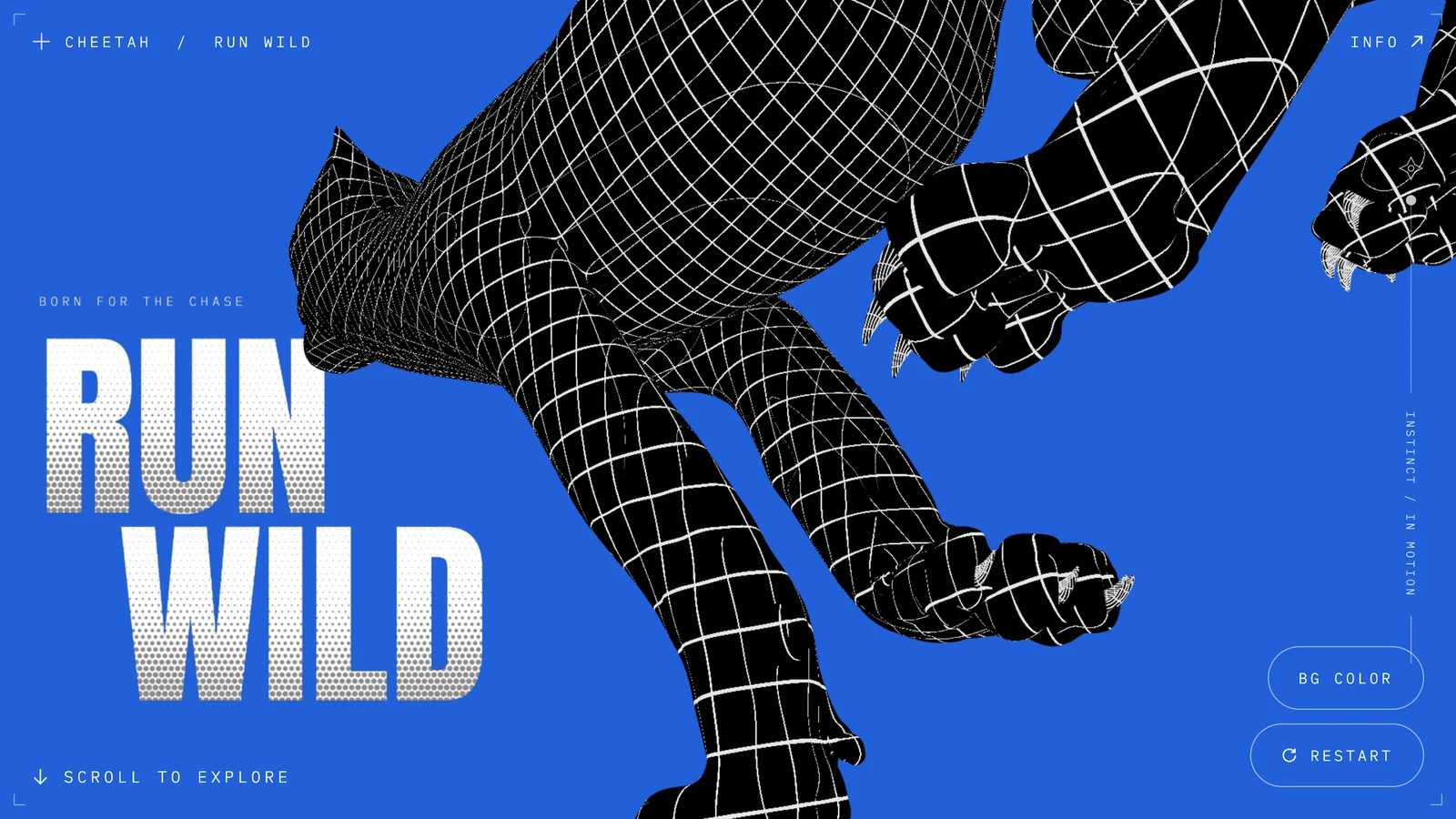
Running Cheetah 3D Model
A white wireframe cheetah sprints across a blue-violet backdrop. Scrolling follows its run through info cards, HUD panels and glass scenes before the KIMI finale. Generated by Kimi K3.1 Pro.
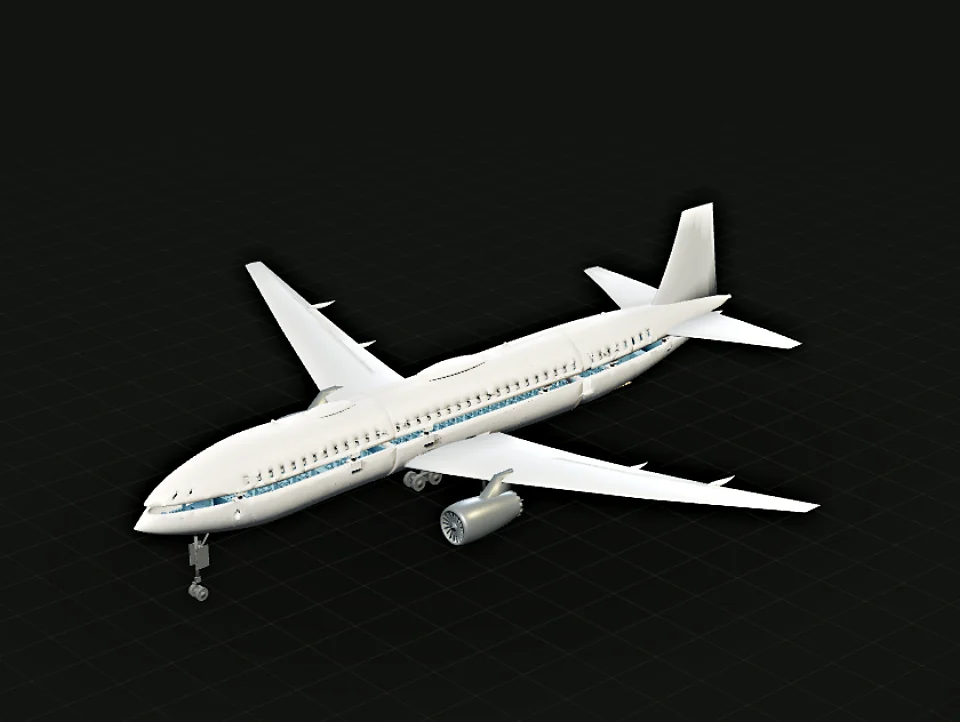
Boeing 787-8 3D Display Model
A 1:200 parametric Boeing 787-8 model — its three-section fuselage opens to reveal the cockpit, 243-seat cabin and cargo holds. Generated by Kimi K3.1 Pro.