Pocket Field Palette 3D-Printable Model
A folding watercolor palette with eight removable paint trays, three mixing wells and a removable hinge pin. Open, closed and exploded views show its assembly. Generated by Kimi K3.1 Pro.
Loading preview...
Start from this prompt
A folding travel watercolor palette with removable paint trays, mixing wells, and inspectable assembly parts.
Try 3D MakeDesign a 3D-printable Pocket Field Palette for travel watercolor painting. It must fold, open, and be cleanable, with a rounded rectangular body in mist blue and warm white. Keep the exterior simple and the mixing area clearly visible when open. Target a closed envelope of 120×78×24 mm. The lower section has eight individually removable paint trays, each targeting an 18×16×8 mm internal cavity, arranged in two rows with wall thickness and removal space accounted for. The lid has three shallow mixing wells with continuous fillets and cleanable inner surfaces. Trays must be individually reprintable and mechanically located, without relying on uncalibrated press fits. Use a removable hinge pin, defined closed alignment, and a mechanical stop; at approximately 180° open the palette rests flat on a table. Leave clear vertical space between lid and trays when closed, without crushing paint. Provide a replaceable simple latch and print orientations. Do not add a water reservoir or claim FDM parts are watertight. Parameterize the overall envelope, tray count and size, hinge-hole diameter, and clearances. Show closed, fully open, and exploded states. Include separate hinge and tray-fit test pieces. Check tray insertion/removal, collision-free lid motion, and stable support when open. Record digital checks separately from physical use tests. MANUFACTURING AND DELIVERY REQUIREMENTS Use a 220×220×250 mm build volume, 0.4 mm nozzle, and 0.2 mm layer height as the design baseline; use millimeters throughout. Model dimensions and mechanisms in parametric CAD; appearance meshes cannot replace precise assembly solids. Provide the editable native project and parameter table, plus a matching STEP assembly, per-part STL files, and a 3MF with units and placement. STEP must not merely be a converted triangle mesh. Choose feasible PLA/PETG structures and explain the material choice based on loads and assembly. Start ordinary thin walls at 1.6 mm and base plates at 2 mm, thickening locally as needed. Prefer pins, threads, or replaceable parts for moving connections; do not assume thin flexible snap fits are reliable. Parameterize all clearances, distinguish radial/one-sided and diametral values, and include 0.20 / 0.30 / 0.40 mm one-sided clearance test pieces for printer calibration. Check closed solids, normals, self-intersection, loose fragments, assembly collisions, critical wall thicknesses, and build volume. Slice using a specified printer/material profile, and provide orientation, support, layer-height, wall, infill, and assembly instructions. Report material and time only from actual slicer estimates. If slicing cannot be performed, explicitly mark it as unverified; do not fabricate screenshots or conclusions. Without physical test prints, report only design and digital checks, listing fit, strength, and handling that still need physical testing. Also deliver an exploded assembly illustration, dimension drawings, bill of parts, brief Chinese and English product descriptions, a rotatable GLB presentation model, a 1920×1080 final render cover, and the complete ZIP. The presentation model must match the printable structure; renders or a single uninspectable STL are insufficient.
Add touch controls
Adds phone controls and layout without changing the other requirements.
Try 3D MakeDesign a 3D-printable Pocket Field Palette for travel watercolor painting. It must fold, open, and be cleanable, with a rounded rectangular body in mist blue and warm white. Keep the exterior simple and the mixing area clearly visible when open. Target a closed envelope of 120×78×24 mm. The lower section has eight individually removable paint trays, each targeting an 18×16×8 mm internal cavity, arranged in two rows with wall thickness and removal space accounted for. The lid has three shallow mixing wells with continuous fillets and cleanable inner surfaces. Trays must be individually reprintable and mechanically located, without relying on uncalibrated press fits. Use a removable hinge pin, defined closed alignment, and a mechanical stop; at approximately 180° open the palette rests flat on a table. Leave clear vertical space between lid and trays when closed, without crushing paint. Provide a replaceable simple latch and print orientations. Do not add a water reservoir or claim FDM parts are watertight. Parameterize the overall envelope, tray count and size, hinge-hole diameter, and clearances. Show closed, fully open, and exploded states. Include separate hinge and tray-fit test pieces. Check tray insertion/removal, collision-free lid motion, and stable support when open. Record digital checks separately from physical use tests. MANUFACTURING AND DELIVERY REQUIREMENTS Use a 220×220×250 mm build volume, 0.4 mm nozzle, and 0.2 mm layer height as the design baseline; use millimeters throughout. Model dimensions and mechanisms in parametric CAD; appearance meshes cannot replace precise assembly solids. Provide the editable native project and parameter table, plus a matching STEP assembly, per-part STL files, and a 3MF with units and placement. STEP must not merely be a converted triangle mesh. Choose feasible PLA/PETG structures and explain the material choice based on loads and assembly. Start ordinary thin walls at 1.6 mm and base plates at 2 mm, thickening locally as needed. Prefer pins, threads, or replaceable parts for moving connections; do not assume thin flexible snap fits are reliable. Parameterize all clearances, distinguish radial/one-sided and diametral values, and include 0.20 / 0.30 / 0.40 mm one-sided clearance test pieces for printer calibration. Check closed solids, normals, self-intersection, loose fragments, assembly collisions, critical wall thicknesses, and build volume. Slice using a specified printer/material profile, and provide orientation, support, layer-height, wall, infill, and assembly instructions. Report material and time only from actual slicer estimates. If slicing cannot be performed, explicitly mark it as unverified; do not fabricate screenshots or conclusions. Without physical test prints, report only design and digital checks, listing fit, strength, and handling that still need physical testing. Also deliver an exploded assembly illustration, dimension drawings, bill of parts, brief Chinese and English product descriptions, a rotatable GLB presentation model, a 1920×1080 final render cover, and the complete ZIP. The presentation model must match the printable structure; renders or a single uninspectable STL are insufficient.
Design a 3D-printable Pocket Field Palette for travel watercolor painting. It must fold, open, and be cleanable, with a rounded rectangular body in mist blue and warm white. Keep the exterior simple and the mixing area clearly visible when open.
Target a closed envelope of 120×78×24 mm. The lower section has eight individually removable paint trays, each targeting an 18×16×8 mm internal cavity, arranged in two rows with wall thickness and removal space accounted for. The lid has three shallow mixing wells with continuous fillets and cleanable inner surfaces. Trays must be individually reprintable and mechanically located, without relying on uncalibrated press fits.
Use a removable hinge pin, defined closed alignment, and a mechanical stop; at approximately 180° open the palette rests flat on a table. Leave clear vertical space between lid and trays when closed, without crushing paint. Provide a replaceable simple latch and print orientations. Do not add a water reservoir or claim FDM parts are watertight.
Parameterize the overall envelope, tray count and size, hinge-hole diameter, and clearances. Show closed, fully open, and exploded states. Include separate hinge and tray-fit test pieces.
Check tray insertion/removal, collision-free lid motion, and stable support when open. Record digital checks separately from physical use tests.
MANUFACTURING AND DELIVERY REQUIREMENTS
Use a 220×220×250 mm build volume, 0.4 mm nozzle, and 0.2 mm layer height as the design baseline; use millimeters throughout. Model dimensions and mechanisms in parametric CAD; appearance meshes cannot replace precise assembly solids. Provide the editable native project and parameter table, plus a matching STEP assembly, per-part STL files, and a 3MF with units and placement. STEP must not merely be a converted triangle mesh.
Choose feasible PLA/PETG structures and explain the material choice based on loads and assembly. Start ordinary thin walls at 1.6 mm and base plates at 2 mm, thickening locally as needed. Prefer pins, threads, or replaceable parts for moving connections; do not assume thin flexible snap fits are reliable. Parameterize all clearances, distinguish radial/one-sided and diametral values, and include 0.20 / 0.30 / 0.40 mm one-sided clearance test pieces for printer calibration.
Check closed solids, normals, self-intersection, loose fragments, assembly collisions, critical wall thicknesses, and build volume. Slice using a specified printer/material profile, and provide orientation, support, layer-height, wall, infill, and assembly instructions. Report material and time only from actual slicer estimates. If slicing cannot be performed, explicitly mark it as unverified; do not fabricate screenshots or conclusions. Without physical test prints, report only design and digital checks, listing fit, strength, and handling that still need physical testing.
Also deliver an exploded assembly illustration, dimension drawings, bill of parts, brief Chinese and English product descriptions, a rotatable GLB presentation model, a 1920×1080 final render cover, and the complete ZIP. The presentation model must match the printable structure; renders or a single uninspectable STL are insufficient.
You Might Also Like
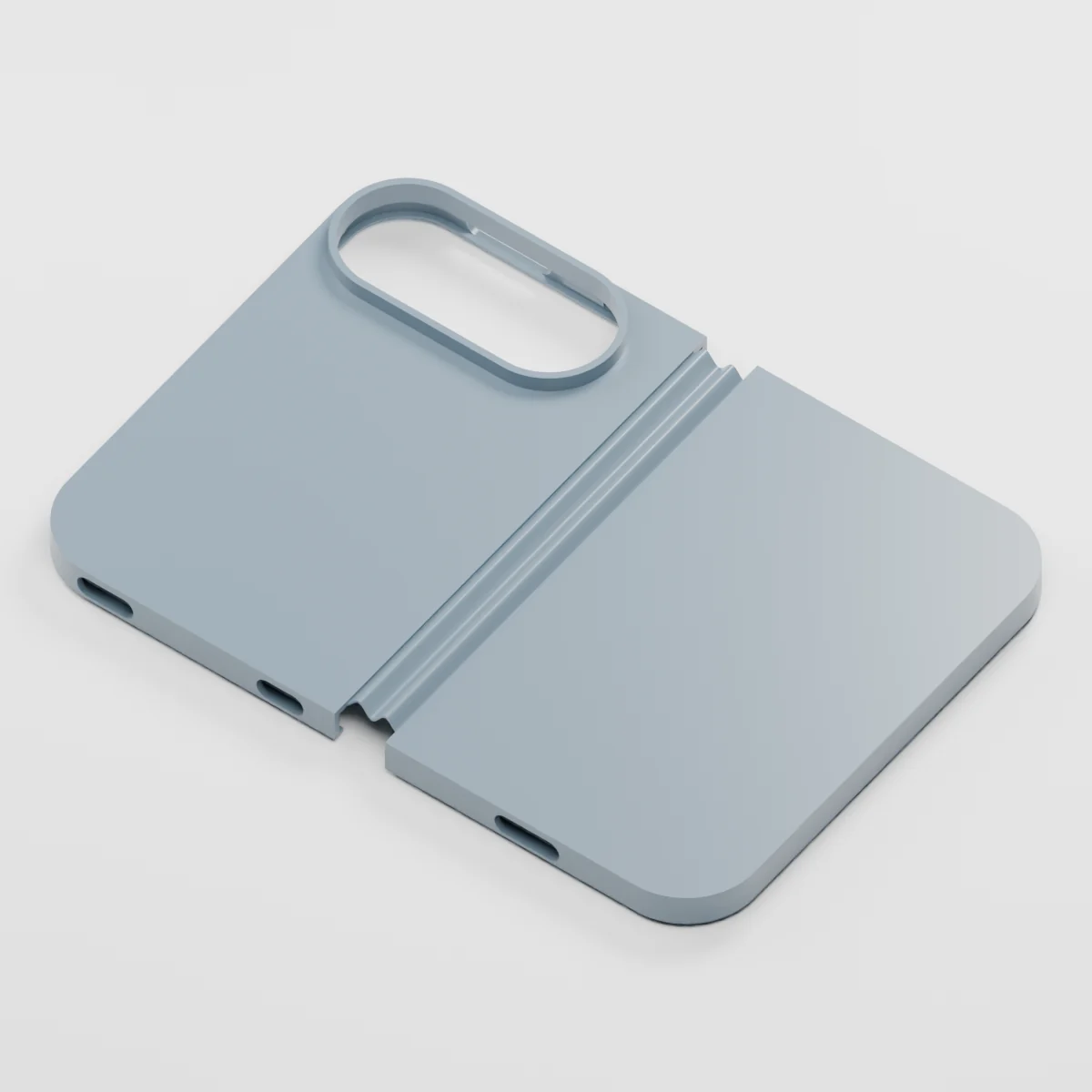
iPhone Duo Hinged TPU Case 3D-Printable Model
A one-piece TPU protective case for iPhone Duo with an integrated flexible hinge, presented as a printable model with a continuous outer shell. Generated by Kimi K3.1 Pro.
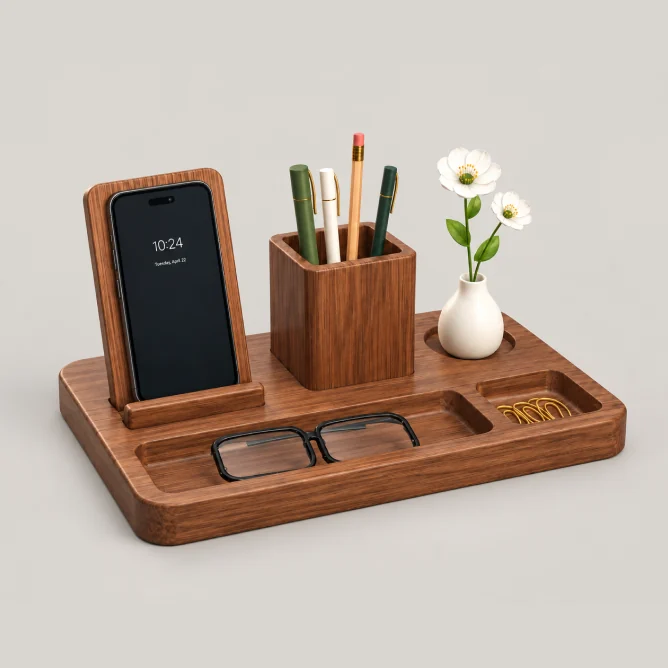
Walnut Desktop Organizer 3D-Printable Model
A walnut-based desktop arrangement combining pen holders, a phone stand, and a vase in a warm, orderly still life. Generated by Kimi K3.1 Pro.