If you have plenty of AI ideas but no clear plan to turn them into real business results, it is easy to waste time and money. A strong AI business strategy helps you find the right opportunities, understand what your business needs, and focus on what matters most. You can research use cases, assess your data and technology, set priorities, and measure results. Keep reading to learn how to build a practical business strategy that turns AI opportunities into measurable growth.
What is an AI business strategy
An AI business strategy is a clear plan for using artificial intelligence to solve business problems and reach specific goals. It helps you identify where AI can add real value, such as improving customer service, reducing costs, or automating routine work. The strategy also covers your data, technology, budget, and the skills needed to put AI into practice. Most importantly, it keeps AI efforts focused on measurable business results rather than using AI just for the sake of it.
What should an AI business strategy include
Building an AI plan involves more than picking a few tools and testing them out. You need to understand your goals, available resources, data, and the areas where AI can create the most value. This gives your business a clear path from planning to execution. Here are the key elements an AI business strategy should include.
Business goals and priorities
Start with the business outcomes you want to achieve, rather than choosing an AI tool first. Your strategy should identify the problems or opportunities that matter most to the business, such as reducing operating costs, improving customer experiences, increasing revenue, or making better decisions.
Clear priorities also help prevent AI initiatives from becoming disconnected experiments. Each proposed use case should have a clear connection to a business objective and a reason why AI is an appropriate way to address it.
AI use cases and opportunities
Once business priorities are clear, identify where AI could create measurable value. Look at existing workflows, recurring bottlenecks, customer needs, and areas where teams spend significant time on repetitive or information-heavy work.
Not every potential use case should be implemented. Evaluate opportunities based on factors such as potential business impact, implementation effort, data availability, technical feasibility, and risk. This helps you focus resources on use cases that are both valuable and realistic.
Data foundation
AI initiatives depend on reliable data. Before implementing an AI solution, assess whether the data required for the use case is:
Available: The necessary data exists and can be collected or accessed.
Accurate: The data is reliable enough to support analysis and decisions.
Accessible: Authorized teams and systems can access the data when needed.
Consistent: Data follows consistent definitions, formats, and standards across systems.
Properly governed: Data has clear ownership, security controls, privacy requirements, and usage rules.
A data audit can also reveal issues such as fragmented data sources, outdated information, or disconnected systems that could limit an AI initiative. Addressing these gaps early makes it easier to build AI workflows that can scale.
Technology and infrastructure
Your AI strategy should account for the technology required to support each priority use case. Choose an approach that fits the business problem, existing infrastructure, technical capabilities, and expected value. In some cases, an existing AI tool or integration may be sufficient. More complex use cases may require custom development, additional data infrastructure, or deeper integration with systems such as CRM and ERP platforms.
People and AI skills
AI adoption also depends on the people responsible for using, managing, and improving AI workflows. Define ownership for each initiative and identify the skills needed to support implementation. Consider whether your team has sufficient capabilities in areas such as data analysis, AI usage, process design, technology integration, and AI governance. Where gaps exist, businesses can provide training, hire specialized talent, or work with external partners.
AI literacy is important beyond technical teams. Employees who work with AI should understand how to use AI tools effectively, evaluate their outputs, recognize limitations, and follow relevant policies.
Governance, security, and responsible AI
An AI business strategy should define how AI will be used safely and responsibly. Governance becomes especially important when AI handles sensitive information, influences business decisions, or interacts directly with customers.
Your framework should address:
Data privacy: Define what information AI systems can access and how sensitive data should be handled.
Security: Protect AI systems, business data, and integrations from unauthorized access or misuse.
Compliance: Account for industry regulations and internal policies that apply to AI use.
Human oversight: Determine when employees need to review, approve, or intervene in AI-generated outputs or decisions.
Accountability: Assign clear ownership for AI systems, decisions, and outcomes.
AI risk management: Identify potential risks such as inaccurate outputs, bias, security issues, or inappropriate use, and establish controls to manage them.
These safeguards should be designed into the strategy from the beginning rather than added after an AI initiative has already been deployed.
Metrics and ROI
Finally, define how you will measure whether an AI initiative is delivering business value. Set a baseline before implementation so that changes can be compared against the original process or performance level.
Depending on the use case, relevant metrics may include:
Time saved: How much manual work or processing time has been reduced?
Cost reduction: Has the workflow reduced operating or labor costs?
Revenue growth: Has AI contributed to additional revenue or higher customer value?
Conversion rate: Has AI improved the performance of sales or marketing workflows?
Customer satisfaction: Has the customer experience improved?
Error reduction: Has AI reduced mistakes, rework, or other quality issues?
AI adoption itself is not a sufficient measure of success. A workflow being used by employees or generating a large number of AI outputs does not necessarily mean it is creating value. Connect AI metrics to business KPIs and review the results regularly to decide whether a use case should be improved, expanded, or discontinued.
How to build an AI business strategy step by step
An AI strategy becomes useful when you know how to turn it into clear, practical actions. Rather than trying to adopt AI everywhere at once, build your plan around real business needs, test your ideas, and improve them as you learn. Follow these steps to build an AI business strategy from the ground up.
Start with business goals
Define what you want AI to achieve, such as reducing costs, improving productivity, increasing revenue, or improving customer experience. Start with business needs rather than specific AI tools. Clear goals also give you a way to measure whether your AI efforts are creating real value.
Identify AI opportunities
Review existing workflows to find repetitive, time-consuming, or data-intensive tasks where AI could create value. Focus on problems where AI can produce measurable improvement. Look for areas where even a small improvement could save significant time or resources.
Assess your readiness
Check whether you have the data, technology, infrastructure, and skills required for each potential use case. Identify gaps in data quality, system integration, employee skills, or governance before moving forward. Addressing these gaps early can prevent costly problems during implementation.
Prioritize use cases
Rank potential use cases based on business impact, feasibility, implementation effort, data readiness, and risk. Start with opportunities that offer meaningful value without requiring disproportionate resources. This helps you direct your budget and team toward projects with the clearest potential.
Start with a focused pilot
Choose one or a small number of high-priority use cases and test them on a limited scale. Set clear objectives and establish a baseline so you can compare results with the existing workflow. A focused pilot lets you learn what works before making a larger investment.
Measure the results
Track business outcomes such as time saved, cost reduction, revenue, conversion rates, customer satisfaction, or error reduction. Use both performance data and employee feedback to determine whether the pilot is delivering value.
Refine and improve
Use pilot results to adjust the workflow, data, AI solution, or human review process. Address problems before expanding the use case to a larger part of the business. Continuous improvements can make the solution more accurate, useful, and easier for employees to adopt.
Scale what works
Expand successful use cases across additional teams or workflows once they have demonstrated clear value. Add the necessary integrations, training, governance, and monitoring to support broader adoption. Scaling in a controlled way helps maintain quality as more people and processes begin using AI.
Review the strategy regularly
Treat AI strategy as an ongoing process rather than a one-time project. Regularly reassess business priorities, AI opportunities, performance, risks, and new technology to keep the strategy aligned with the business. Regular reviews also help you adapt when your market, customers, or business needs change.
Use Kimi Deep Research to support your AI business strategy
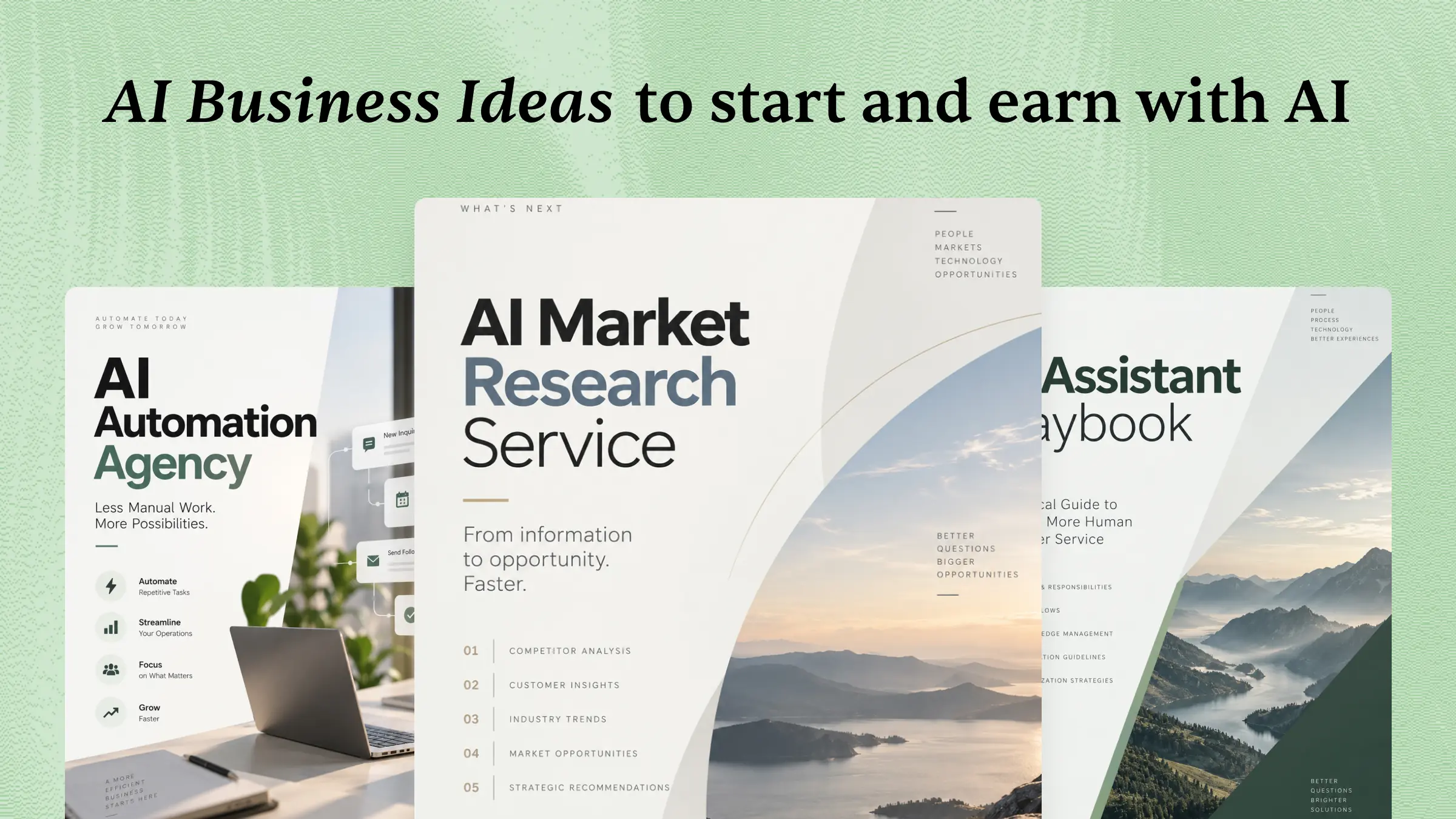
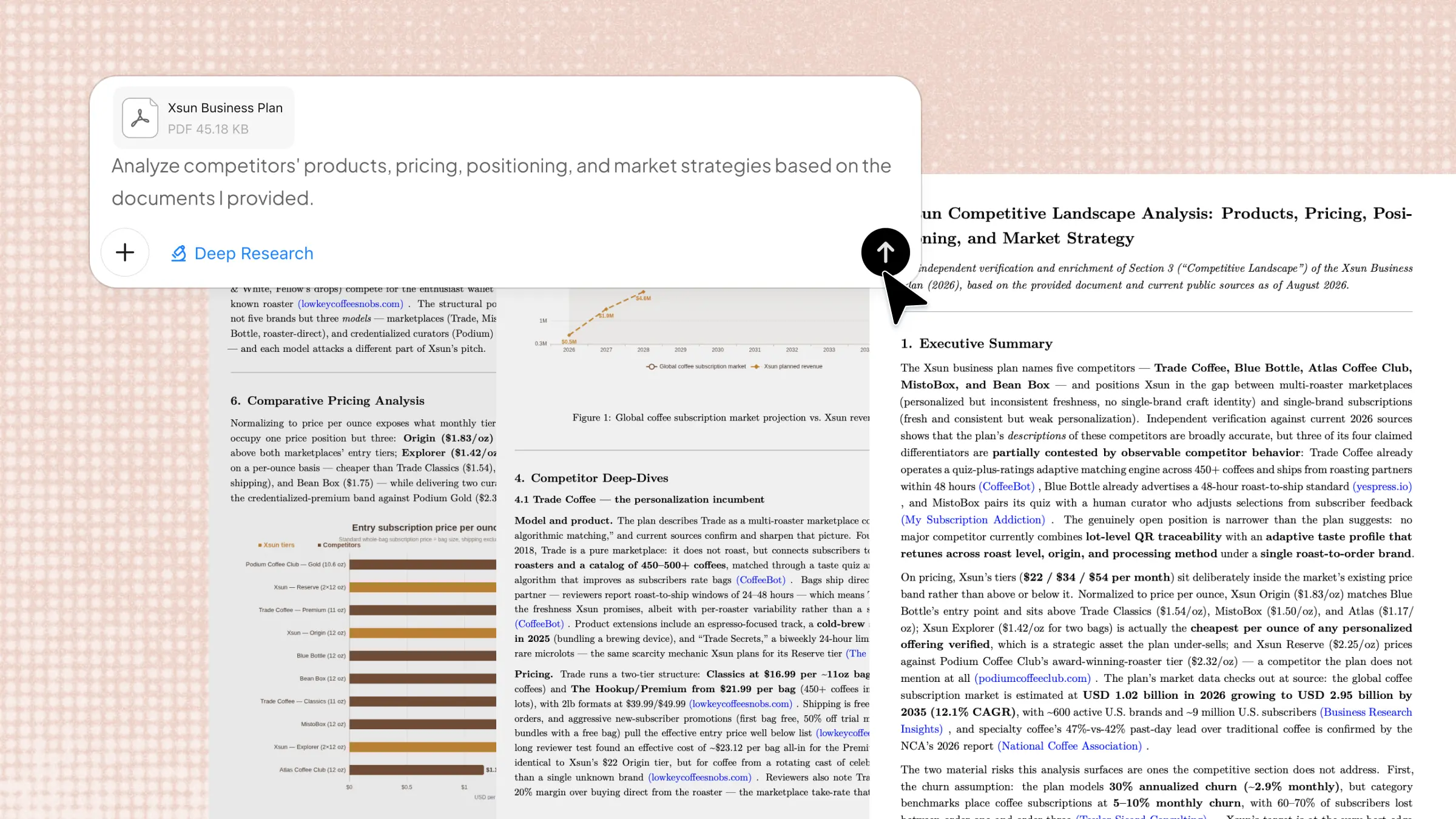
Kimi Deep Research can support your AI business strategy by researching markets, competitors, customer needs, technologies, and AI use cases. Use it to compare solutions, analyze information, identify gaps, and organize findings into structured reports. For example, you can research industry opportunities and use the findings to prioritize high-value AI use cases.
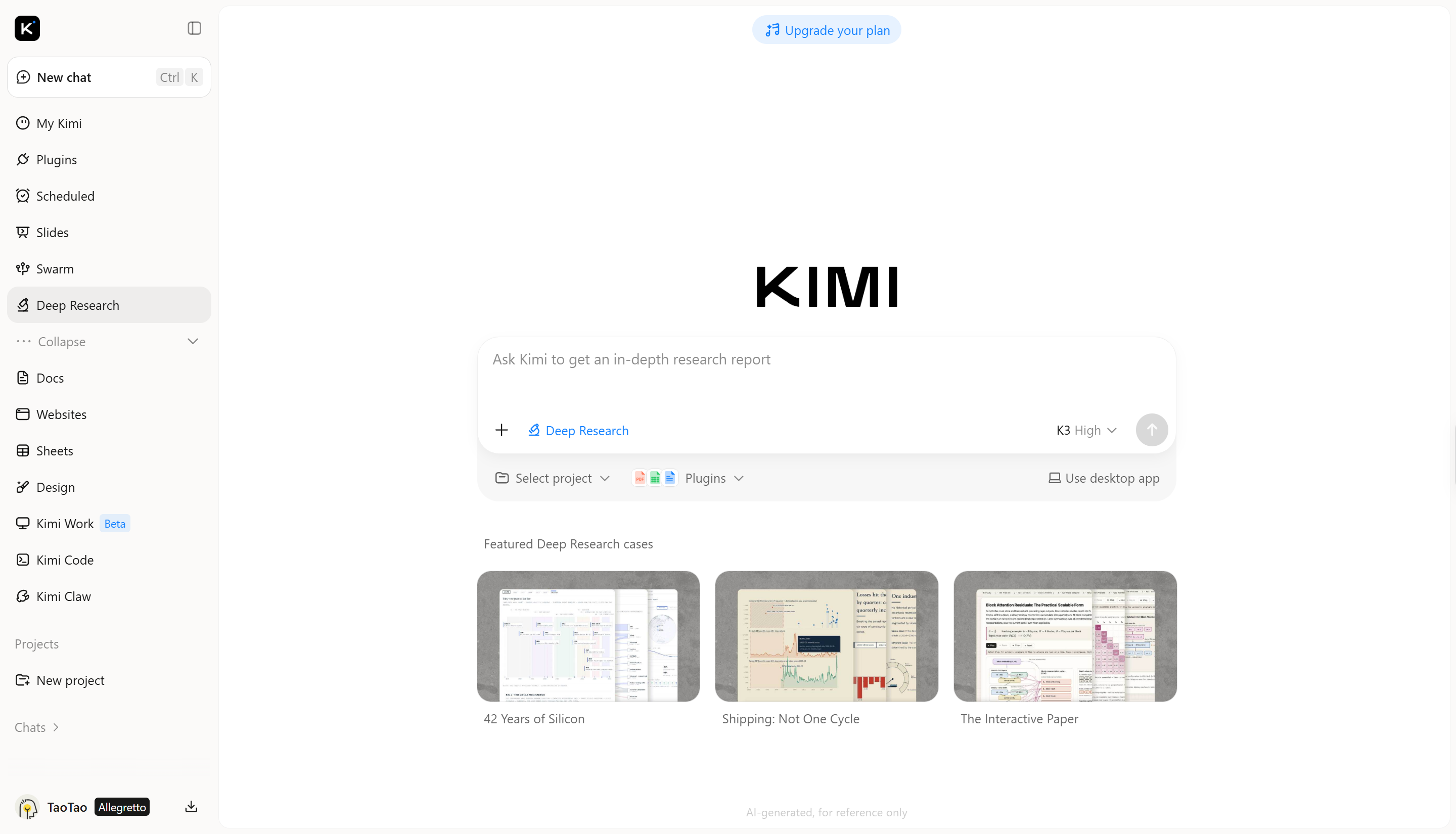
Key features
Define and structure complex business research: Kimi Deep Research can clarify a strategic question, break a broad topic into key research areas, and develop a structured research approach. It can cover multiple dimensions of a business problem, helping keep complex strategy research focused and comprehensive.
Search deeply across diverse information sources: Kimi Deep Research searches across a wide range of sources, including current news, company information, government publications, academic research, and financial and economic data. It can also incorporate your own materials, giving businesses access to broader and more relevant information for market, competitor, and opportunity research.
Turn research into business-ready deliverables: Kimi Deep Research can turn research findings into detailed reports, charts, interactive HTML pages, Word documents, PowerPoint presentations, Excel spreadsheets, and PDFs. These formats make research easier to use for business planning, analysis, presentations, and decision-making.
Explore strategic questions with continued context: Use follow-up questions to investigate findings from the same research instead of launching a separate task. Kimi Deep Research carries forward the relevant context, sources, and results, so you can challenge an assumption, examine a new perspective, or explore a specific issue in greater detail as your strategy takes shape.
For enterprise customers, submitted data and generated outputs are not used for model training. This provides greater data control for organizations working with internal documents, business information, and other sensitive company data. To get enterprise-level security, subscribe to Kimi Business.
How to plan a business strategy with Kimi Deep Research
Kimi Deep Research can help businesses research markets, analyze competitors, evaluate opportunities, and turn complex information into actionable insights. It can support key stages of business strategy, from understanding the market to assessing options and planning next steps. Here's how to use it to plan a business strategy.
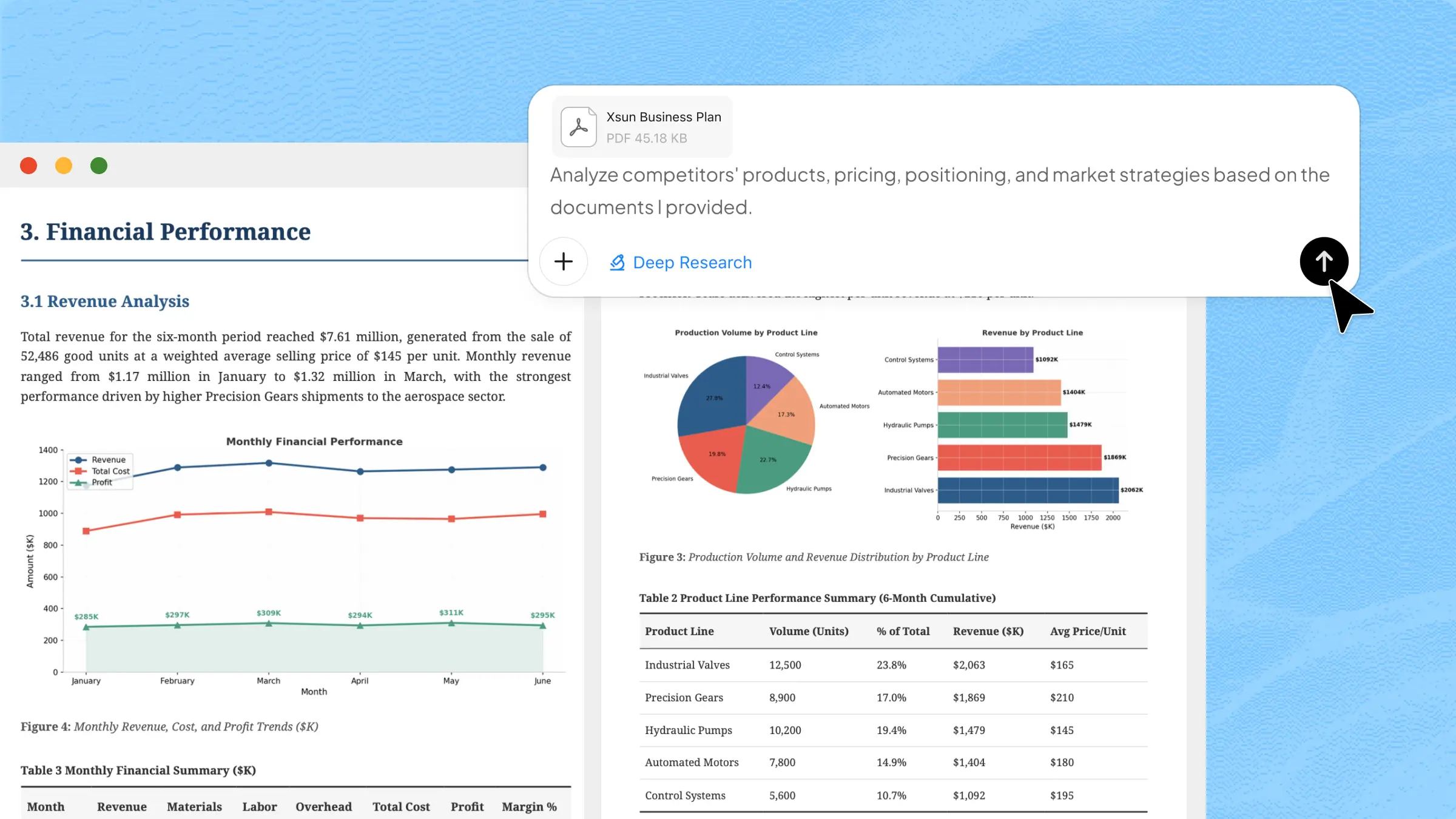
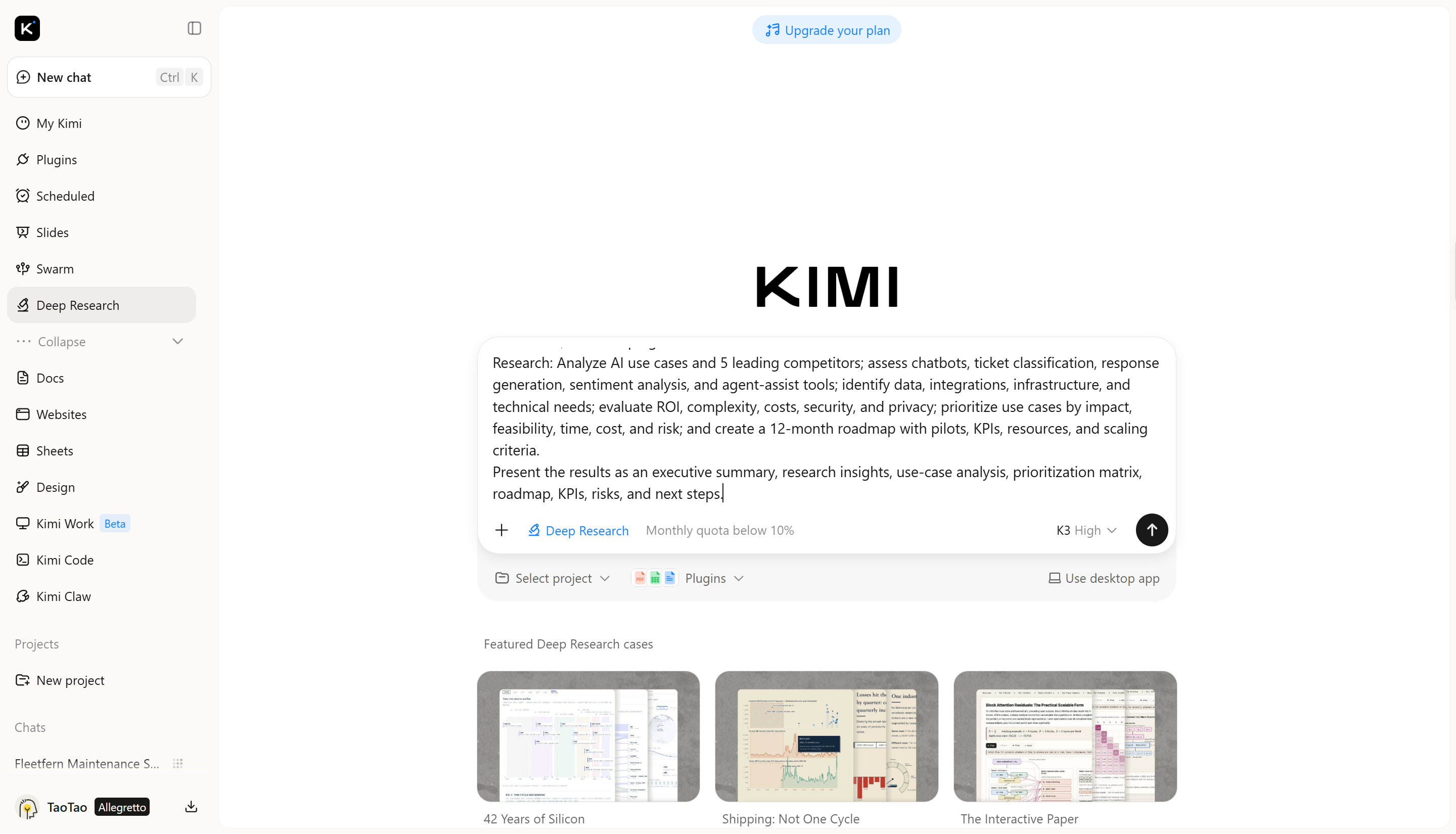
Step 1: Enter a detailed business strategy prompt
Start with a detailed prompt that gives Kimi Deep Research enough business context to produce a useful strategy. Include your target market, business model, goals, competitors, available resources, and the specific problem you want AI to solve.
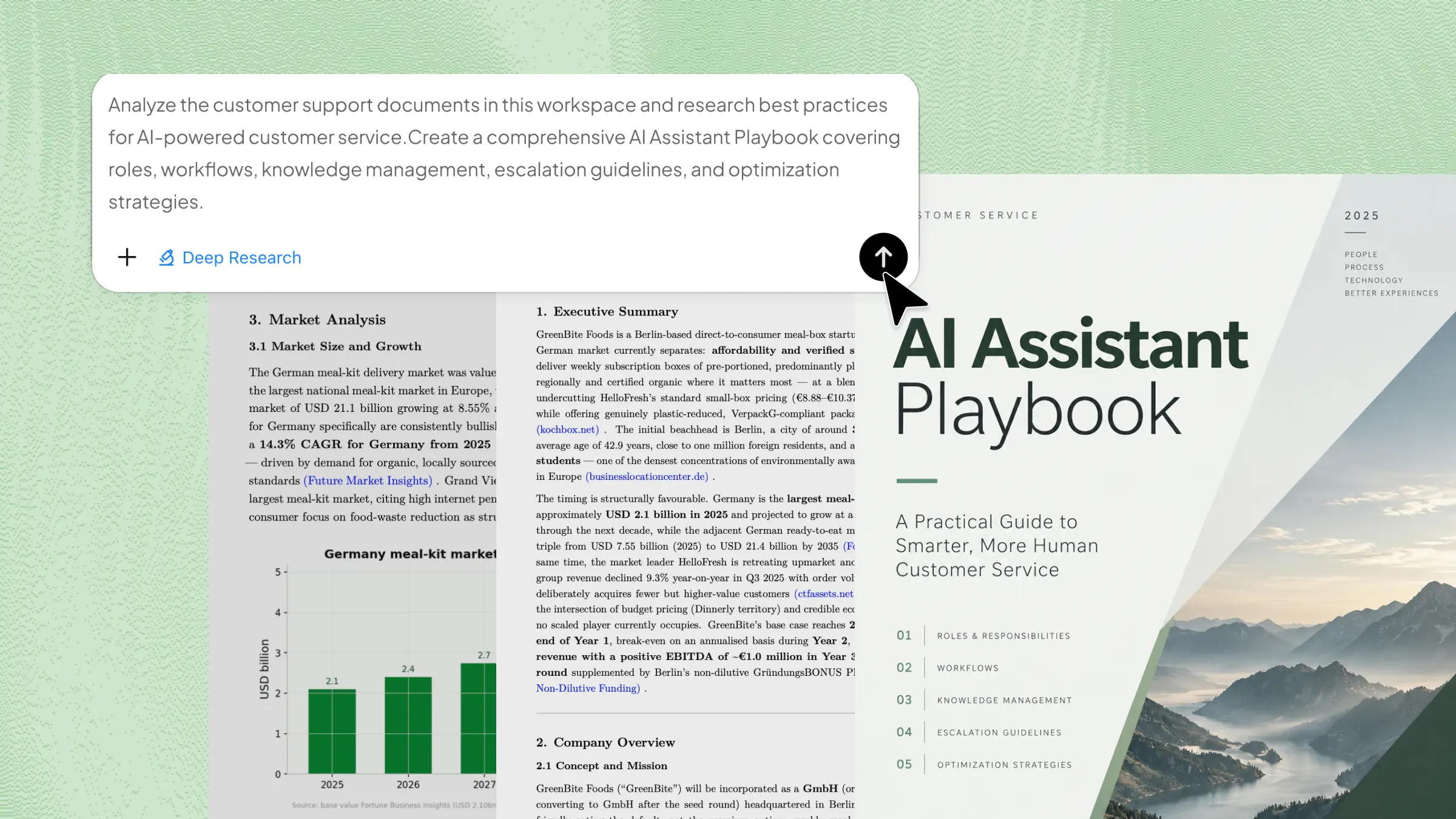
Example prompt:
Step 2: Let Kimi research and generate your business strategy
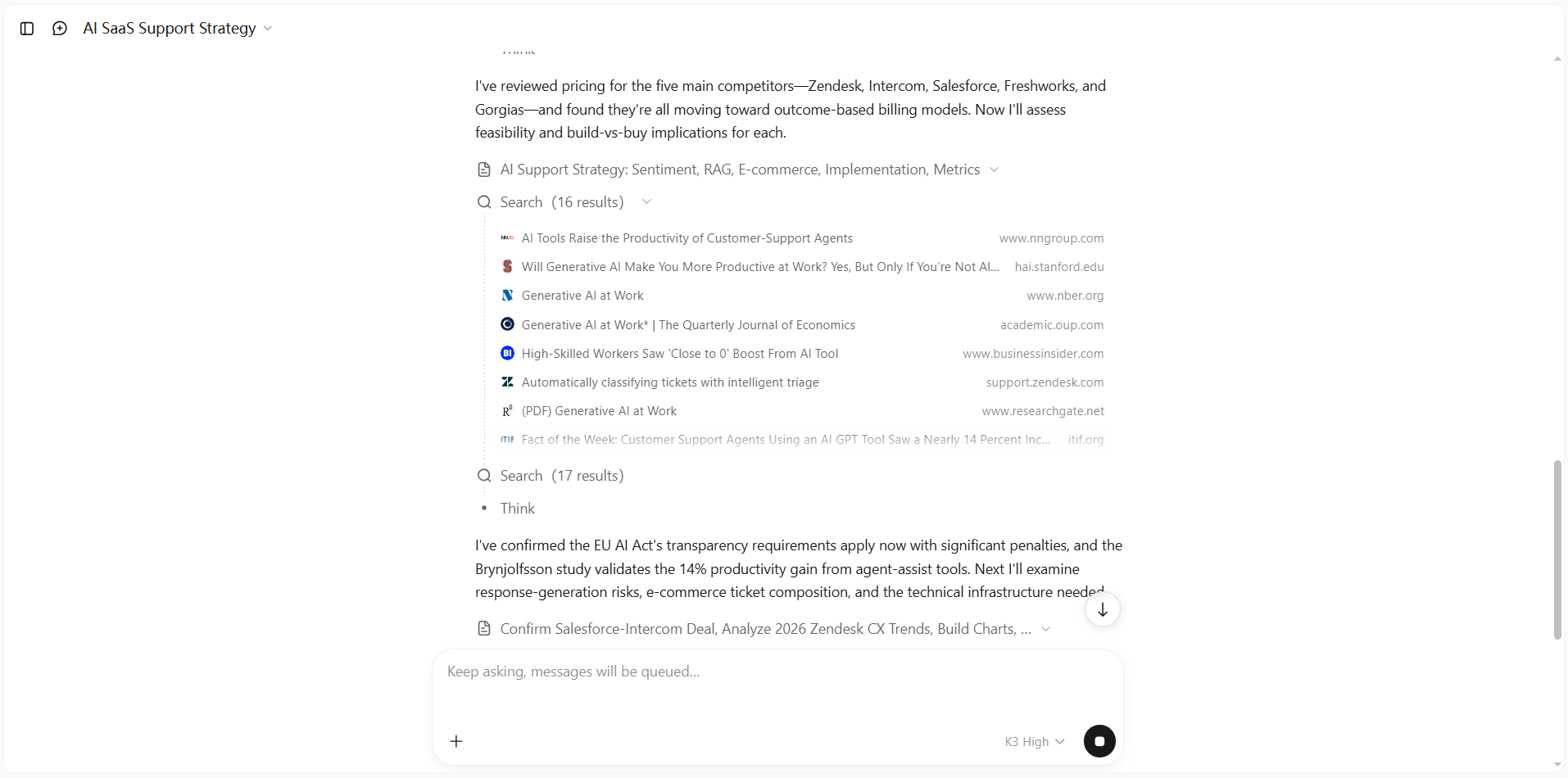
Submit the prompt and let Kimi Deep Research investigate the market, competitors, technologies, and relevant AI use cases. It can organize the research into structured findings and connect those insights to your business goals.
Step 3: Refine your business strategy
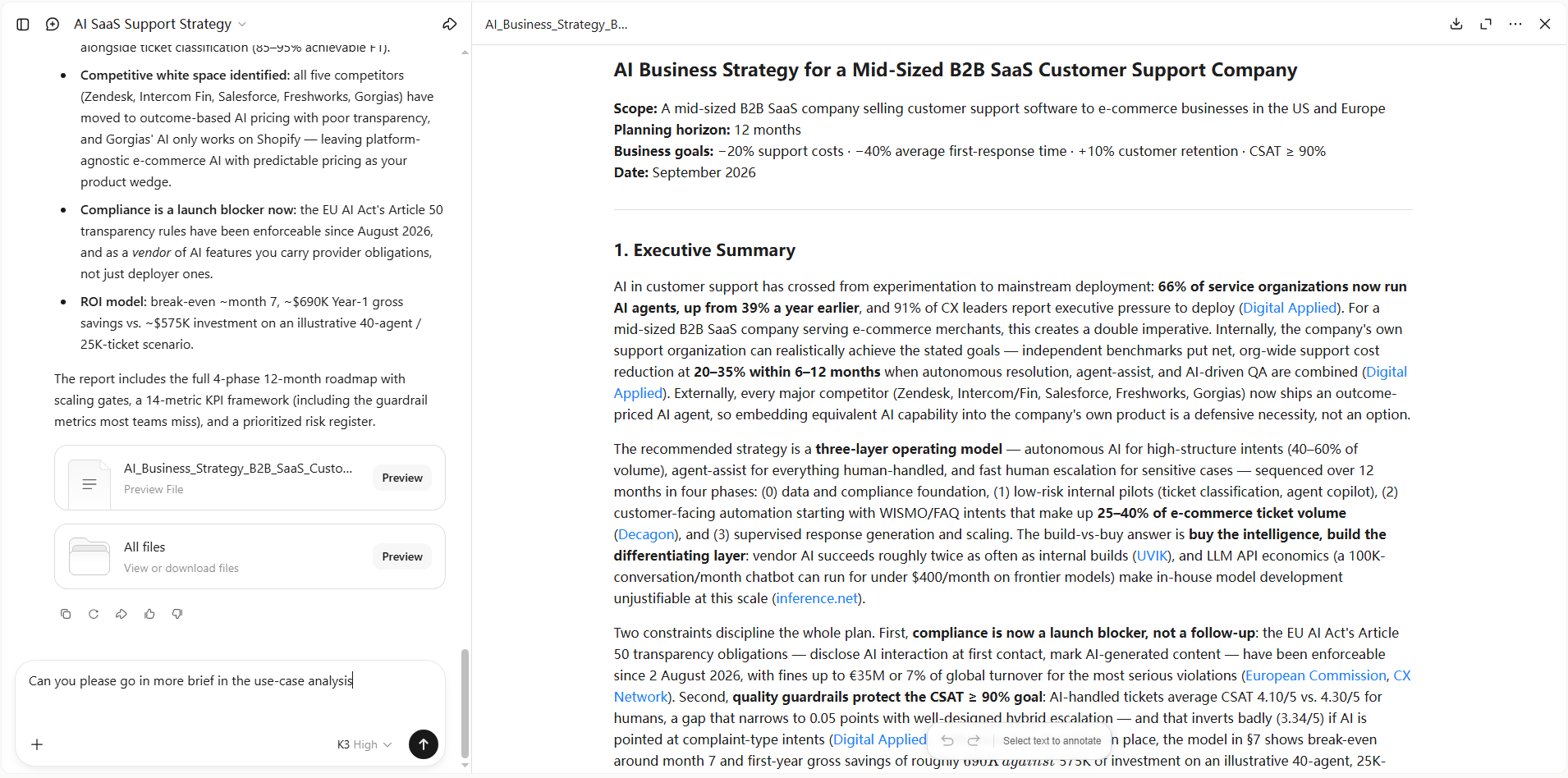
Review the initial strategy and use follow-up prompts to adjust assumptions, add missing research, or go deeper into specific areas. You can ask Kimi to refine the roadmap, expand the technical requirements, recalculate priorities, or provide more detailed ROI and risk analysis.
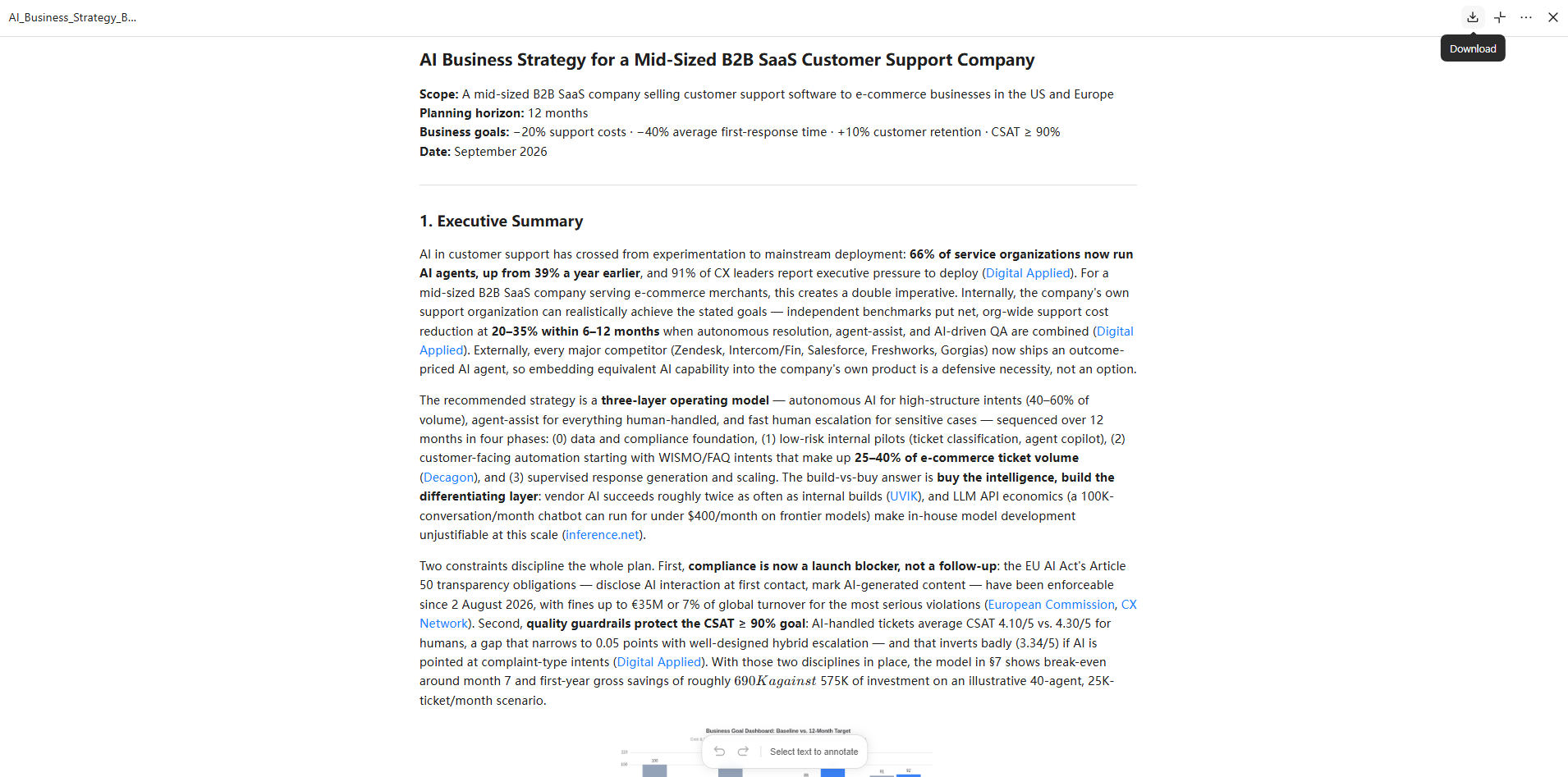
Step 4: Review and export the output
Review the final strategy to make sure the research, recommendations, KPIs, and roadmap match your business objectives. Once the content is ready, organize the findings into a format your team can use for planning, presentations, or implementation.
Why does your business need an AI strategy
An AI strategy gives your business a clear direction for using AI, where it can create meaningful value. It helps you move beyond isolated AI experiments and connect technology with measurable business goals. Here are some key reasons why an AI strategy matters.
Improve business decision-making
AI can process large amounts of business data and uncover patterns that may be difficult to spot manually. This can help teams make faster, more informed decisions based on relevant data and insights.
Identify new growth opportunities
AI can help analyze customer behavior, market trends, and competitor activity to uncover potential areas for growth. These insights can reveal new products, services, markets, or ways to better serve existing customers.
Improve operational efficiency
AI can automate repetitive tasks, streamline workflows, and reduce the time employees spend on manual processes. This allows teams to focus more on higher-value work while helping reduce operational costs.
Improve customer experiences
AI can enable faster responses, personalized recommendations, and more efficient customer service. It helps businesses understand customer needs and deliver more relevant experiences.
Build a long-term competitive advantage
A clear AI strategy helps businesses build the data, technology, skills, and processes needed for ongoing AI adoption. This makes it easier to adapt as technology and customer expectations evolve.
Common AI business strategy mistakes
Even a well-planned AI strategy can fall short if common implementation mistakes are overlooked. Avoiding these issues helps you use resources wisely, reduce unnecessary risks, and keep AI efforts connected to real business goals. Here are the common AI business strategy mistakes to avoid.
Starting with technology instead of a business problem
Choosing an AI tool before identifying a business need can lead to solutions that have little practical value. Start with a clear problem or business goal, then determine whether AI is the right way to address it.
Trying to implement AI everywhere at once
Rolling out too many AI initiatives at the same time can spread budgets, data, and employee attention too thin. Start with a small number of high-value use cases, learn from them, and expand gradually.
Ignoring data readiness
Poor-quality, fragmented, or inaccessible data can limit the effectiveness of an AI workflow. Assess data availability, quality, access, and governance before investing heavily in an AI use case.
Treating AI as a one-time project
AI strategy needs to evolve as business priorities, technology, and customer expectations change. Review performance regularly, update workflows, and look for new opportunities instead of treating implementation as the end of the process.
Leaving employees out
AI can change how employees perform their daily work, so they need to understand both how and why new workflows are being introduced. Provide appropriate training, define responsibilities, and give employees a way to provide feedback.
Measuring AI activity instead of business value
High AI usage does not necessarily mean an initiative is successful. Measure outcomes that matter to the business, such as time saved, costs reduced, revenue generated, customer satisfaction, or errors avoided.
Scaling before proving the use case
Expanding an AI workflow before confirming its value can increase costs and amplify problems. Use a focused pilot to validate performance, risks, and business impact before scaling.
Conclusion
A practical AI business strategy gives your business a clearer path from ideas to meaningful results. The key is to stay focused on real needs, test your approach, and learn from what works. As your business grows, your strategy can evolve with new goals, tools, and opportunities. Kimi Deep Research can help turn complex research into useful insights and actionable plans. For businesses seeking stronger privacy and security safeguards, subscribe to Kimi Business for more AI capabilities tailored to business needs.