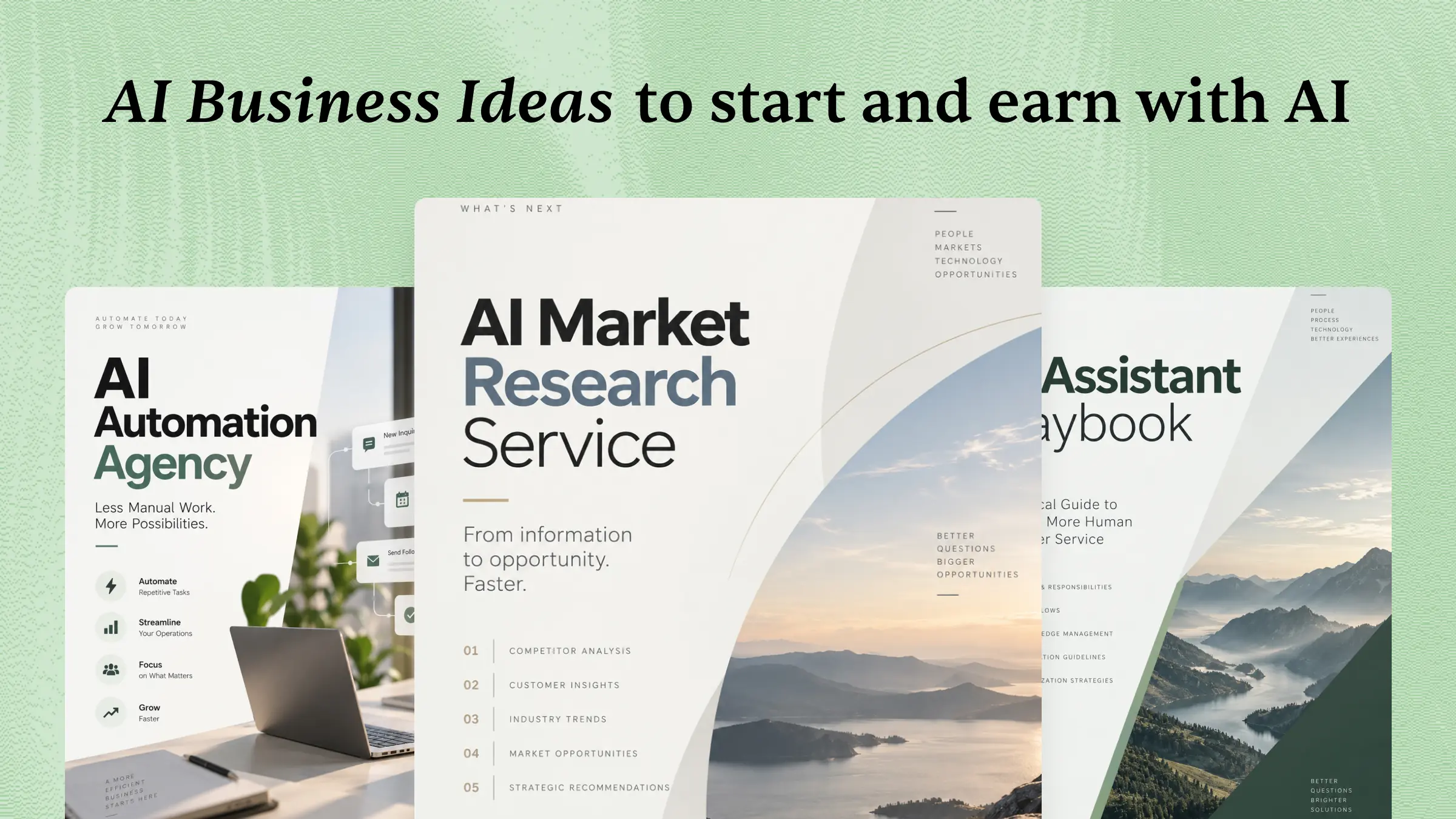
Whether you want to start a business or build a new income stream, finding an AI idea that people will actually pay for can be harder than it seems. With so many tools and trends around AI, it is easy to feel stuck between too many options and unsure where to begin. AI business ideas can turn common problems into useful services, products, or simple business opportunities without requiring a huge setup. Read on to explore practical ideas and find the one that fits your skills, goals, and market.
Overview of 20 ideas for AI businesses
The following table summarizes 20 AI business ideas across different areas, from automation and customer experience to finance, HR, and specialized industry solutions. Use it as a quick reference to explore each opportunity, its potential users, and the business model it can support.
| Category | AI business idea | What it does | Who it's for | Business model |
|---|---|---|---|---|
| AI services and automation | AI automation agency | Builds AI-powered workflows to automate repetitive business processes | Operations consultants, automation specialists, marketers, founders | Agency or service |
| AI virtual assistant service | Handles routine administrative tasks such as emails, scheduling, inquiries, and follow-ups | Virtual assistants, administrative professionals, consultants, agency owners | Service | |
| AI content creation service | Produces marketing content with AI-assisted writing, research, editing, and strategy | Writers, marketers, SEO specialists, content creators | Service or agency | |
| AI content repurposing service | Turns long-form content into articles, social posts, newsletters, and video scripts | Content marketers, social media managers, video editors, agencies | Service or agency | |
| AI social media management | Supports content planning, creation, scheduling, and performance analysis | Social media managers, marketers, creative agencies | Agency or service | |
| AI sales and customer experience | AI market research service | Researches competitors, customers, trends, pricing, and market opportunities | Researchers, consultants, journalists, analysts | Service or subscription |
| AI lead generation and sales assistant | Finds prospects, organizes lead data, personalizes outreach, and supports sales follow-up | Sales consultants, B2B marketers, lead-generation agencies, founders | Service, agency, or SaaS | |
| AI customer support agent | Answers routine questions, retrieves information, handles requests, and escalates complex issues | Ecommerce, SaaS, online services, support teams | SaaS or agency | |
| AI sales call assistant | Transcribes calls, summarizes customer needs, identifies objections, and supports follow-ups | Sales technology founders, sales consultants, high-volume sales teams | SaaS | |
| AI ecommerce personalization tool | Personalizes shopping experiences and recommends products based on customer behavior | Ecommerce founders, Shopify developers, ecommerce agencies, retail tech entrepreneurs | SaaS or agency | |
| AI finance, HR, and business operations | AI bookkeeping and financial reporting | Organizes financial documents, categorizes transactions, and prepares financial reports | Accountants, bookkeepers, finance professionals, founders | SaaS or service |
| AI financial forecasting tool | Analyzes financial data, forecasts cash flow, and models business scenarios | Finance professionals, startup operators, fractional CFOs, SaaS founders | SaaS or consulting | |
| AI recruitment and talent matching | Matches candidates with roles and helps recruiters organize and review applications | Recruiters, staffing companies, HR consultants | SaaS or service | |
| AI training and coaching platform | Provides personalized lessons, practice, feedback, and role-specific Q&A | Educators, coaches, consultants, corporate trainers | SaaS, course, or service | |
| Vertical AI copilot | Provides AI assistance tailored to the workflows of a specific profession or industry | Industry specialists and founders with domain expertise | SaaS | |
| Specialized AI software and industry solutions | AI contract and document assistant | Summarizes, compares, organizes, and drafts business documents | Legal professionals, consultants, procurement teams, real estate businesses, SMBs | SaaS or service |
| AI compliance and audit tool | Checks documents and processes against requirements and helps prepare audit evidence | Compliance specialists, legal professionals, cybersecurity experts | SaaS or consulting | |
| AI predictive maintenance service | Analyzes equipment data to identify potential failures and support maintenance planning | Engineers, manufacturers, industrial technology founders, IoT specialists | SaaS or service | |
| AI supply chain optimization | Supports demand forecasting, inventory planning, purchasing, and logistics decisions | Supply chain consultants, logistics specialists, operations professionals | SaaS or consulting | |
| AI cybersecurity service | Detects suspicious activity, analyzes security events, and helps prioritize threats | Cybersecurity professionals, managed security providers, technical founders | SaaS or managed service |
20 AI business ideas to consider
AI can solve many everyday business problems, from repetitive tasks to customer support and data analysis. The ideas for AI businesses listed below cover different ways to turn these needs into useful services, tools, or products.
AI services and automation
Many businesses spend hours on repetitive tasks that AI can handle more efficiently. These ideas focus on using AI to save time and simplify everyday work.
1. AI automation agency
An AI automation agency helps businesses identify repetitive processes and replace manual steps with AI-powered workflows. You could automate tasks such as lead follow-ups, appointment scheduling, invoice processing, customer inquiries, reporting, and internal data entry.
Who it's for: Operations consultants, automation specialists, marketers, and founders familiar with no-code or AI tools.
How to start: Choose one industry and one repetitive workflow, such as appointment management for dental clinics or lead follow-up for real estate agencies. Build a working example, then offer implementation and ongoing maintenance as a service.
Business model: Agency or service
2. AI virtual assistant service
An AI virtual assistant service helps small businesses handle routine administrative work, including email management, appointment scheduling, customer inquiries, document organization, and follow-ups. Instead of selling a general-purpose assistant, you can package specific services for a particular type of client.
Who it's for: Virtual assistants, administrative professionals, consultants, and agency owners.
How to start: Pick a niche such as real estate, consulting, ecommerce, or professional services. Define a small set of tasks you can reliably handle with AI, then offer them as a monthly service package.
Business model: Service
3. AI content creation service
Businesses need a steady stream of blog posts, product descriptions, email campaigns, social posts, video scripts, and other marketing materials. An AI content business can combine AI-assisted production with human editing, brand guidelines, research, and content strategy.
Who it's for: Writers, marketers, SEO specialists, and content creators.
How to start: Choose one content type or industry first. For example, you could create SEO content for SaaS companies or product descriptions for ecommerce brands. Build a few samples and turn the service into fixed packages.
Business model: Service or agency
4. AI content repurposing service
One piece of long-form content can become multiple marketing assets. An AI content repurposing service can turn podcasts, webinars, interviews, reports, and videos into articles, social posts, email newsletters, short-video scripts, and other formats.
Who it's for: Content marketers, social media managers, video editors, and agencies.
How to start: Choose one source format and a defined output package. For example, turn a 60-minute podcast into one article, five LinkedIn posts, three short-video scripts, and an email newsletter.
Business model: Service or agency
5. AI social media management
AI can help businesses research content ideas, create posts, adapt content for different platforms, organize content calendars, and analyze performance. You can turn these capabilities into a managed social media service for businesses that lack an in-house marketing team.
Who it's for: Social media managers, marketers, and creative agencies.
How to start: Choose a specific audience such as restaurants, fitness studios, real estate professionals, or e-commerce brands. Create a monthly package covering content planning, production, scheduling, and reporting.
Business model: Agency or service
AI sales and customer experience
AI can also help businesses find leads, support customers, and create more personalized experiences. The following ideas focus on improving how businesses attract and serve their customers.
6. AI market research service
An AI market research business helps companies collect and organize information about competitors, customers, industry trends, pricing, and emerging opportunities. AI can speed up research and synthesis while human expertise adds context and judgment.
Who it's for: Researchers, consultants, journalists, industry experts, and analysts.
How to start: Pick a niche with a strong need for current information, such as cybersecurity, ecommerce, fintech, or renewable energy. Start by publishing sample reports to demonstrate the quality of your research.
Business model: Service or subscription
7. AI lead generation and sales assistant
An AI sales assistant can research potential customers, identify relevant prospects, organize lead information, draft personalized outreach, and summarize sales interactions.
Who it's for: Sales consultants, B2B marketers, lead-generation agencies, and founders with sales experience.
How to start: Choose a specific customer segment, such as SaaS companies selling to small businesses. Build a workflow that goes from prospect research to personalized outreach rather than offering another generic lead database.
Business model: Service, agency, or SaaS
8. AI customer support agent
An AI customer support agent can answer routine questions, retrieve information, classify requests, check order details, and hand complicated issues to human agents.
Who it's for: Ecommerce companies, SaaS businesses, online services, and customer support teams.
How to start: Start with one type of customer inquiry, such as order status, returns, or product questions. Connect the agent to the company's existing knowledge base and support systems, then expand its scope as accuracy improves.
Business model: SaaS or agency
9. AI sales call assistant
An AI sales call assistant can transcribe conversations, summarize customer needs, identify objections, surface relevant information, and help sales representatives prepare follow-up actions.
Who it's for: Sales technology founders, sales consultants, and teams with high call volumes.
How to start: Focus on one sales workflow, such as post-call summaries or objection analysis, before attempting real-time assistance. Build integrations with the CRM and communication tools used by your target customers.
Business model: SaaS
10. AI ecommerce personalization tool
An AI personalization tool can recommend products, customize shopping experiences, generate personalized product suggestions, and help merchants understand customer behavior.
Who it's for: Ecommerce founders, Shopify developers, ecommerce agencies, and retail technology entrepreneurs.
How to start: Start with one personalization use case, such as product recommendations. Connect customer behavior and product catalog data, then test whether personalized recommendations improve conversion or average order value.
Business model: SaaS or agency
AI finance, HR, and business operations
Beyond sales and marketing, AI can improve important internal processes such as finance, hiring, training, and forecasting. These opportunities focus on making business operations faster and easier.
11. AI bookkeeping and financial reporting
AI can help small businesses organize financial documents, categorize transactions, extract information from invoices, and prepare reports. A business built around these workflows can reduce manual bookkeeping work while keeping humans involved in financial review.
Who it's for: Accountants, bookkeepers, finance professionals, and founders with accounting knowledge.
How to start: Start with a specific task such as invoice processing or expense categorization. Build a workflow around existing accounting software rather than trying to replace the entire accounting system.
Business model: SaaS or service
12. AI financial forecasting tool
An AI financial forecasting tool can help startups and small businesses analyze historical financial data, project cash flow, model scenarios, and identify potential funding or spending issues.
Who it's for: Finance professionals, startup operators, fractional CFOs, and SaaS founders.
How to start: Focus on one forecasting problem, such as cash-flow forecasting for startups. Build templates around the financial data businesses already maintain and make the results easy to understand.
Business model: SaaS or consulting
13. AI recruitment and talent matching
AI can help recruiters organize candidates, match skills with job requirements, summarize applications, and identify potentially suitable candidates more quickly.
Who it's for: Recruiters, staffing companies, HR consultants, and founders with expertise in a specific talent market.
How to start: Choose one underserved industry or role category. Build a candidate-matching workflow around skills, experience, certifications, and job requirements instead of relying only on keyword matching.
Business model: SaaS or service
14. AI training and coaching platform
An AI coaching platform can provide personalized lessons, practice exercises, feedback, and Q&A based on a particular subject or professional role.
Who it's for: Educators, coaches, consultants, corporate trainers, and subject-matter experts.
How to start: Choose a specific audience and outcome, such as "AI training for HR managers" or "sales coaching for new account executives." Build the experience around practical scenarios rather than generic AI conversations.
Business model: SaaS, course, or service
15. Vertical AI copilot
A vertical AI copilot is designed around the workflow of a particular profession rather than trying to serve everyone. It could help accountants prepare reports, real estate agents organize listings, insurance professionals summarize client information, or project managers create documentation.
Who it's for: Founders with deep expertise in a particular profession or industry.
How to start: Interview professionals in the target field and identify repetitive tasks that consume significant time. Build the first version around one or two workflows instead of creating a general-purpose assistant.
Business model: SaaS
Specialized AI software and industry solutions
AI becomes even more useful when it is built for a specific industry or problem. These ideas focus on specialized tools that solve clear needs in areas such as legal work, manufacturing, and supply chains.
16. AI contract and document assistant
An AI document assistant can help businesses summarize contracts, extract important clauses, compare documents, organize files, and generate first drafts based on predefined templates.
Who it's for: Legal professionals, consultants, procurement teams, real estate businesses, and SMBs.
How to start: Choose one document type or industry. For example, you could focus on reviewing standard vendor agreements for small businesses instead of trying to handle every type of legal document.
Business model: SaaS or service
17. AI compliance and audit tool
Businesses in regulated industries spend significant time checking documents, processes, and records against changing requirements. An AI compliance tool can help identify potential issues, organize evidence, and prepare audit documentation.
Who it's for: Compliance specialists, legal professionals, cybersecurity experts, and founders with industry-specific regulatory knowledge.
How to start: Choose one regulation and one industry. Build a focused audit workflow rather than attempting to become a universal compliance platform.
Business model: SaaS or consulting
18. AI predictive maintenance service
AI can analyze equipment data and usage patterns to identify signs of potential failure before a breakdown occurs. A predictive maintenance business could help companies reduce unexpected downtime and schedule maintenance more efficiently.
Who it's for: Industrial technology founders, engineers, manufacturing consultants, and IoT specialists.
How to start: Choose one type of equipment and one industry. Start with historical maintenance data and build a model that identifies specific failure patterns before expanding to real-time monitoring.
Business model: SaaS or service
19. AI supply chain optimization
AI can help businesses forecast demand, optimize inventory, identify potential supply issues, and improve purchasing or logistics decisions.
Who it's for: Supply chain consultants, logistics specialists, operations professionals, and technical founders.
How to start: Focus on one problem, such as inventory forecasting or reorder recommendations. Use existing business data to build a small pilot before expanding into broader supply chain optimization.
Business model: SaaS or consulting
20. AI cybersecurity service
An AI cybersecurity business can help organizations detect suspicious activity, analyze security events, identify phishing attempts, and prioritize potential threats.
Who it's for: Cybersecurity professionals, managed security providers, and technical founders.
How to start: Choose one security problem, such as phishing detection or security alert triage. Build the service around existing security infrastructure rather than trying to create an entire cybersecurity platform from scratch.
Business model: SaaS or managed service
How to choose the right AI business idea?
Not every promising idea will be the right fit for you, so it helps to look at the practical side before getting started. Your skills, budget, available time, and customer needs can all shape which AI business ideas are worth exploring. Here's how you can compare your options and find a workable direction.
Match your skills and interests
Choose an idea that connects with skills you already have or genuinely want to develop. Your existing knowledge can help you understand customers, build the service faster, and stand out from competitors in your chosen market.
Check market demand
Before investing time or money, find out whether people actually need the solution. Look at customer questions, competitor offerings, and existing spending to see whether there is clear demand for the problem you want to solve.
Consider budget and costs
Some AI tools for business ideas can be tested with little upfront investment, while others require software, data, technical skills, or ongoing infrastructure costs. Estimate your development, tool, marketing, maintenance, and operating expenses before committing to the idea.
Think about time commitment
Consider how much time you can consistently give to the business each week. A service may be easier to manage alongside another job, while a software product can require more time for development, testing, customer support, and regular improvements.
Look at growth potential
Think about whether the idea can serve more customers without increasing your workload at the same rate. A repeatable service, subscription, or software product may give you more room to grow while keeping your daily workload manageable.
Solve a real problem
A useful AI business idea should make something faster, cheaper, easier, or more effective for its customers. Start with a clear problem people already experience, then decide how AI can provide a practical, valuable, and easy-to-use solution for them.
Test small before scaling
You do not need to build a complete business on day one. Create a simple version, offer it to a small group of potential customers, collect useful feedback, and improve the idea before spending more time, money, or resources on larger plans.
Explore and develop AI business ideas with Kimi Work
Once you find an idea that fits your skills and solves a real need, you can start turning it into a practical plan. This is where the right AI workspace can help you research, organize, and develop your next steps.
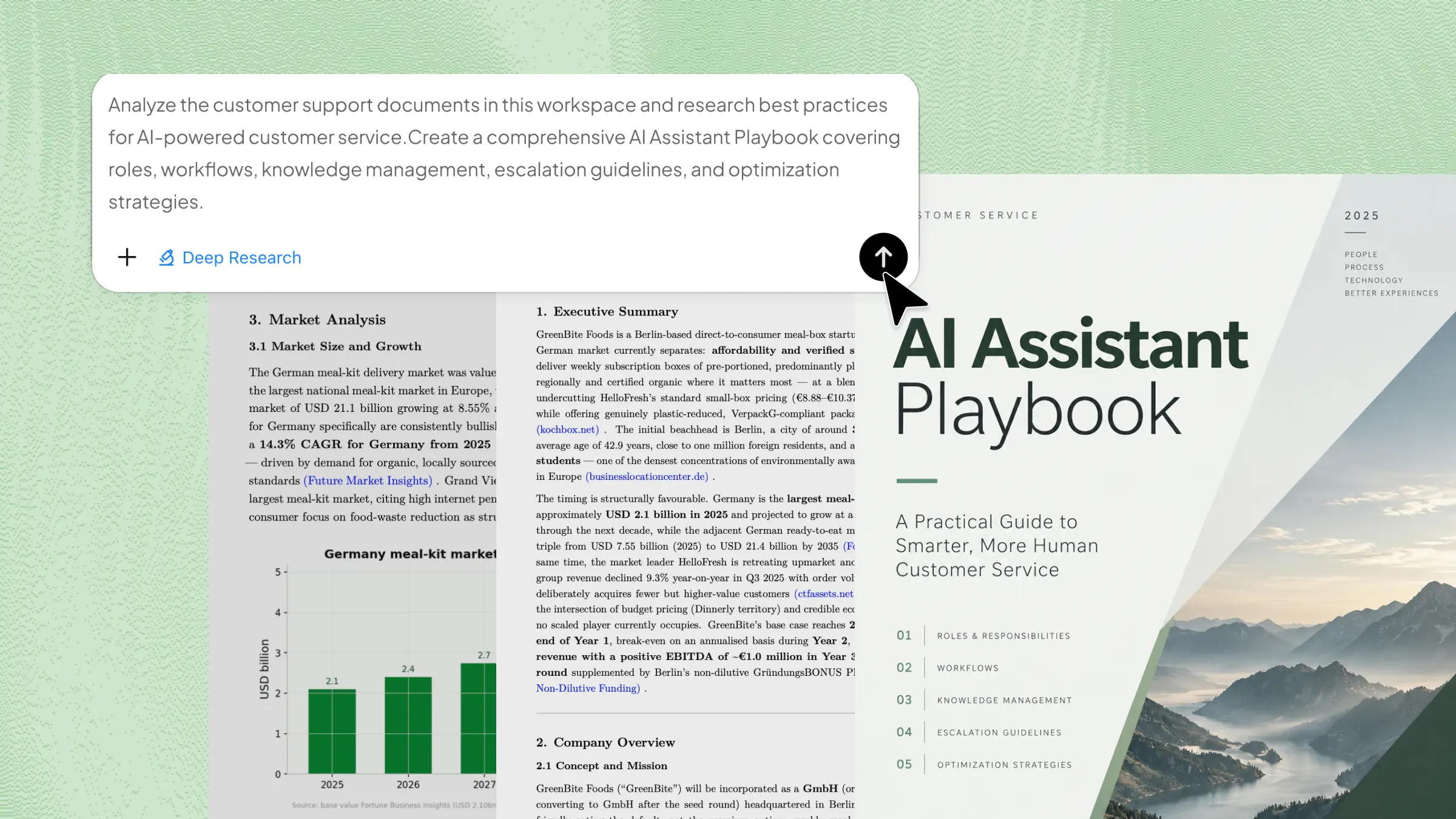
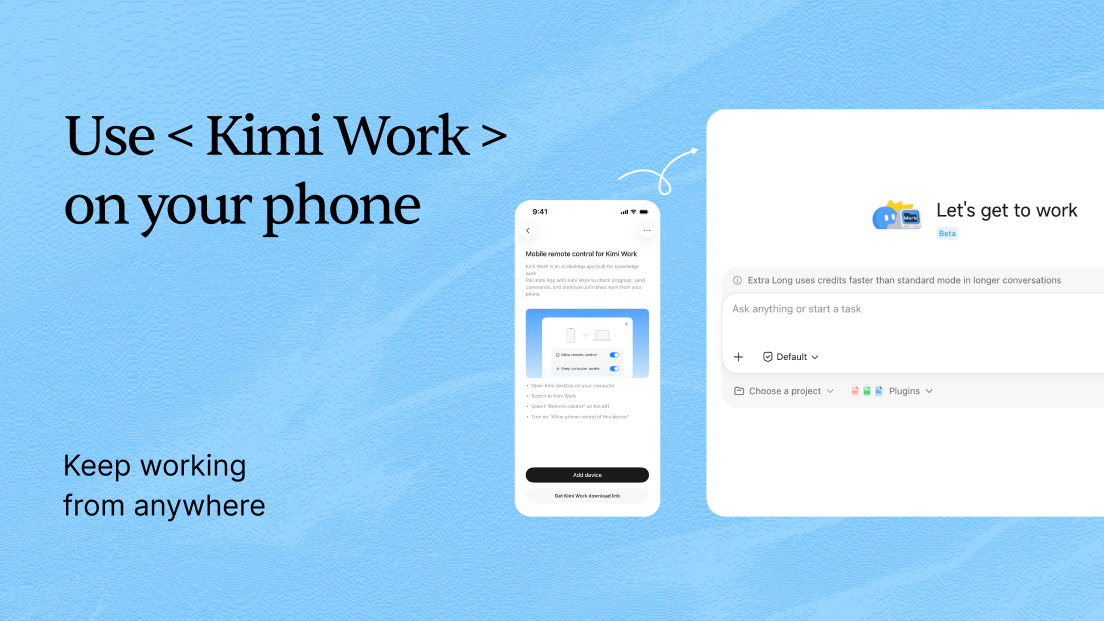
Kimi Work gives you a simple workspace to research markets, organize ideas, and build practical business plans. You can use it to turn rough concepts into structured plans, research materials, and useful business documents. It can help you move from an initial idea to a clearer business direction while keeping your work organized in one place.
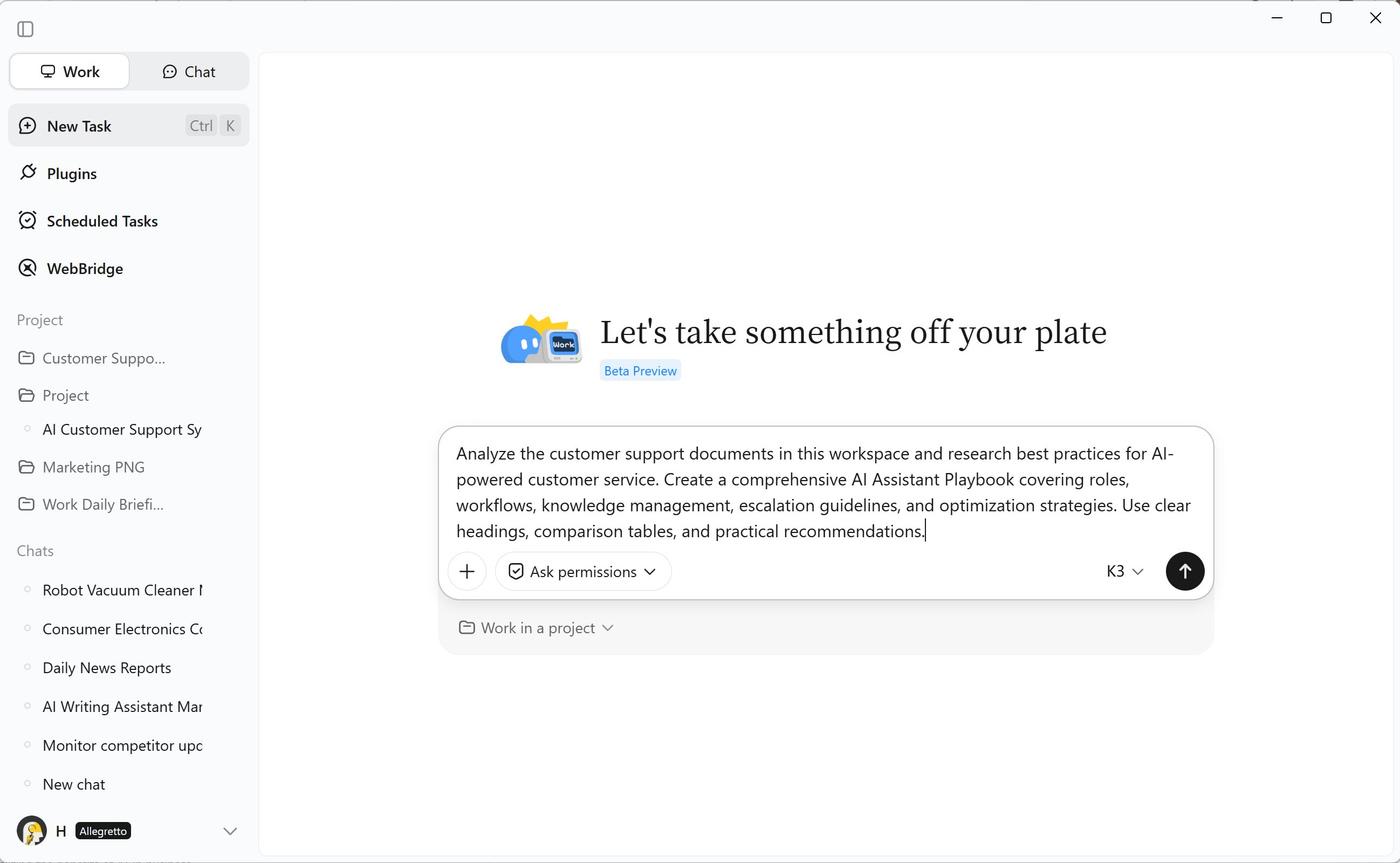
Main features
Goal Mode that turns idea to executed plan: Describe your business idea and what a successful result looks like, and Kimi Work can break it into research, planning, and execution steps, then works through them autonomously.
Agent Swarm that validates the opportunity from every angle at once: Kimi Work splits market research into parallel threads, including competitors, customers, pricing, and market trends. A dedicated agent handles each, then merges the findings into one analysis you can act on.
Work within your own business context: Kimi Work can read your local files and folders with your permission, browse the web across tabs, and pull from professional databases, so the research and plans it produces are grounded in real data rather than generic advice.
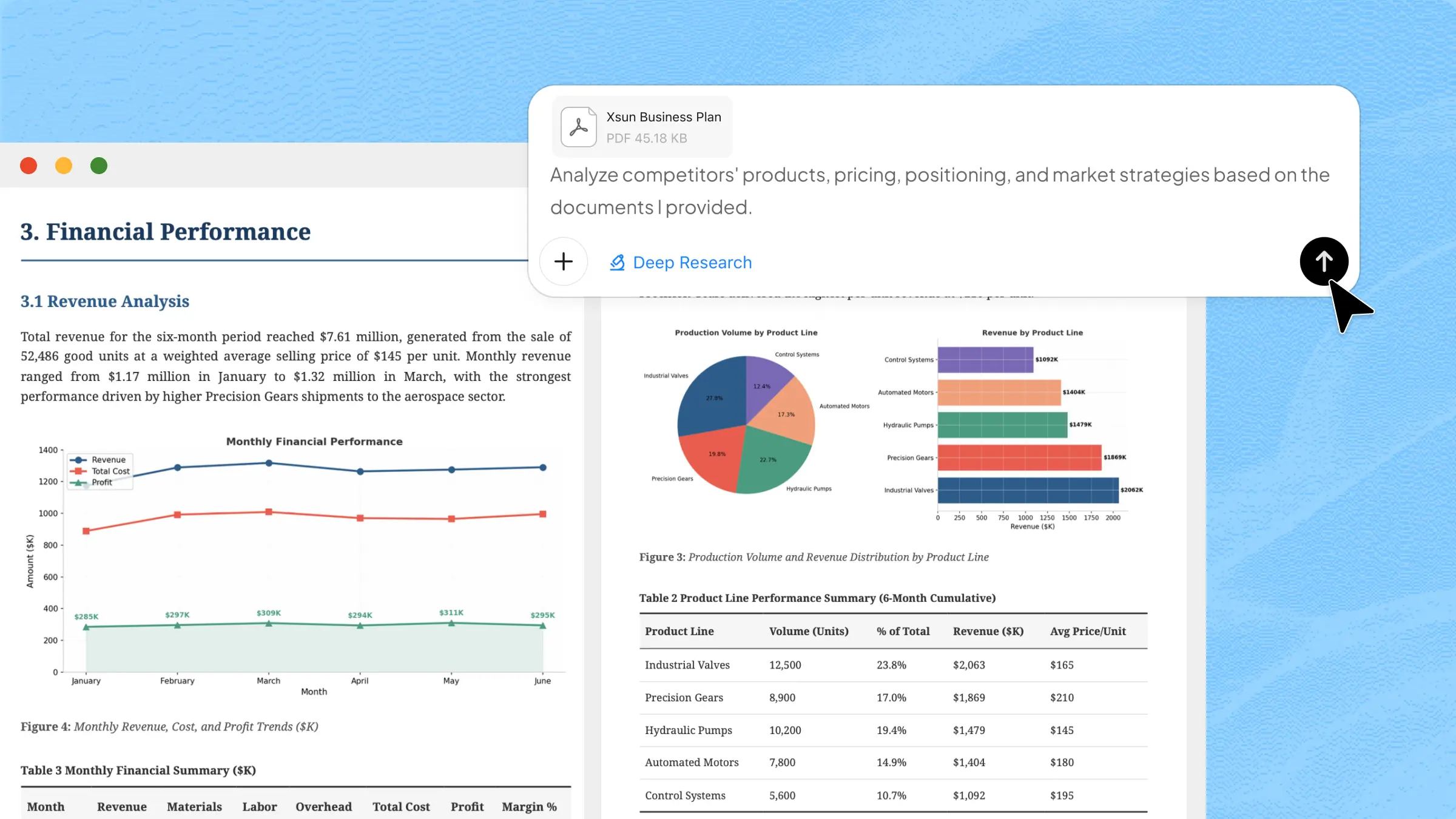
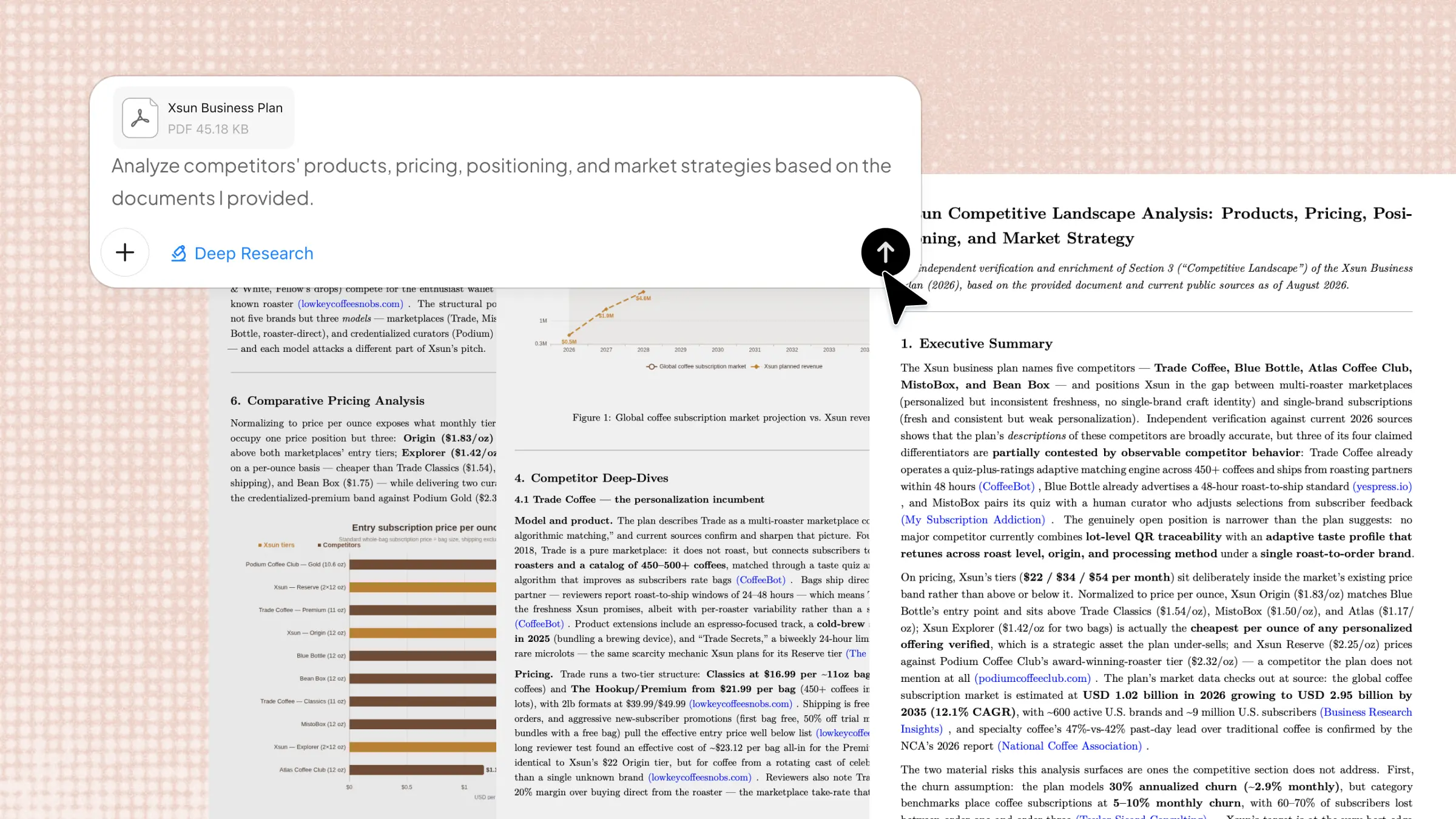
Support in-depth & comprehensive business research: Ask Kimi Work to investigate a business idea, and it can browse the web, gather market and competitor information, analyze relevant data, and organize the findings on its own. For larger research tasks, multiple agents can work on different questions in parallel before combining the results into a broader business analysis.
Real business deliverables: Once the research is done, Kimi Work turns it into editable assets, such as business plans, financial spreadsheets, pitch decks, websites, or code, turning the ideas into something you can actually build on.
Scheduled Tasks and live dashboards. Set a recurring workflow once, and Kimi Work keeps monitoring competitors, market trends, and customer signals in the background, so your research stays current as the business grows.
For teams that need shared workspaces and enterprise-grade data isolation, Kimi Business extends these capabilities across your organization.
Common mistakes to avoid when starting an AI business
Starting an AI business can be exciting, but a good idea still needs careful planning and testing. Small mistakes in product design, customer research, costs, or data handling can make it harder to build something people trust and pay for. Keep these common issues in mind as you develop and test your idea.
Building a generic AI product
Creating another broad AI tool can make it difficult to stand out in a crowded market. Focus on a specific audience, workflow, or problem where your product can offer clear value and solve a specific customer need in a meaningful way.
Skipping customer validation
An idea may sound useful without having enough people willing to pay for it. Talk to potential customers, understand their needs, and test a simple version before investing heavily in development or marketing efforts that may not produce results.
Solving a problem that does not have clear value
Using AI does not automatically make a solution valuable or worth paying for. Your product should save time, reduce costs, improve results, or solve a problem that customers already care about and regularly face in their everyday work and business operations.
Ignoring AI operating costs
AI businesses can have ongoing expenses for models, APIs, storage, infrastructure, and other services. Calculate these costs early, so your pricing leaves enough room for support, marketing, maintenance, and profit as your customer base grows.
Relying on AI output without human review
AI can produce inaccurate, incomplete, or unsuitable results, especially for tasks that require context or specialized knowledge. Add human review where accuracy matters and create clear checks before delivering results to customers or making important business decisions.
Overlooking privacy and compliance
AI products may handle customer, financial, business, or other sensitive information. Understand the privacy, security, and industry requirements that apply to your business, and build appropriate safeguards into your workflow from the beginning to protect both customers and your business.
Conclusion
Exploring AI business ideas is only the beginning of building an AI-driven business. A strong opportunity becomes clearer when you take time to research, test, and refine it. Stay focused on creating something that makes a real difference for the people you serve. Kimi Work can help turn scattered ideas into organized research and actionable plans. Subscribe to Kimi Business to bring more AI capabilities into your business workflows.