Finding fresh game ideas can be challenging when you have a basic concept but are unsure how to develop it into engaging mechanics, clear objectives, and a workable project. A promising concept also needs the right scope, audience, and level of complexity to remain enjoyable without becoming difficult to build. This guide provides practical starting points to help you shape a concept, explore its possibilities, and choose an approach that fits your skills, resources, and development goals.
A quick overview of 40 game ideas
These 40 game ideas cover a range of genres, gameplay styles, and development approaches. Use the overview below to quickly explore each category and identify the type of project you want to build.
| Game type | Core gameplay | Example ideas | Key elements to explore |
|---|---|---|---|
| Platformer | Movement and level progression | Gravity flip adventure, Time-shift runner | Platforms, hazards, power-ups, movement mechanics |
| Puzzle | Problem-solving and discovery | Mystery room escape, Logic grid adventure | Clues, patterns, logic, interconnected challenges |
| Racing | Driving and competitive challenges | Midnight street circuit, Desert rally challenge | Tracks, vehicles, weather, fuel, upgrades |
| RPG | Character progression and choices | Forgotten kingdom chronicles, Dreamwalker's journey | Quests, skills, equipment, relationships, branching choices |
| Card | Strategy through card-based systems | Ancient relic deck, Spellcraft tournament | Deck building, card combinations, resources, tactical choices |
| Tower defense | Strategic defense against enemy waves | Castle siege defense, Alien outpost defense | Towers, enemy types, routes, upgrades, resource management |
| Simulation | Managing interconnected systems | City builder simulator, Virtual restaurant manager | Resources, operations, growth, decisions, events |
| Story-driven | Exploration and narrative choices | The last lighthouse keeper, Letters from tomorrow | Characters, dialogue, clues, choices, multiple outcomes |
40 cool video game ideas for your next project
A strong game idea starts with a clear goal and gameplay that keeps players engaged. The concepts below range from simple arcade challenges to story-driven and strategy-based experiences, making them suitable for small practice projects or larger builds. You can also expand each idea with original characters, challenges, levels, and story elements.
Before choosing an idea, think about your target audience, platform, development skills, and available time. These factors can help you find an idea that fits your resources while giving you enough room to experiment and add your own creative touch.
Platformer games
Platformer games are built around movement, precise timing, and progressing through increasingly challenging levels. For anyone exploring video game ideas, this genre provides a simple foundation that can be expanded with puzzles, enemies, collectibles, power-ups, and unique movement mechanics. Here are five concepts to explore:
Gravity flip adventure
Switch between normal and reversed gravity to navigate platforms, avoid hazards, and reach the exit. New obstacles can require players to change gravity at the right moment.
Time-shift runner
Run through a constantly changing level where players can briefly slow down or rewind time. Use this ability to avoid traps, recover from mistakes, and reach difficult areas.
Crystal cave quest
Explore a dangerous cave system to collect rare crystals while avoiding falling rocks, underground creatures, and environmental hazards. Deeper areas can introduce new movement challenges and rewards.
Moving world
Create a platforming world where the environment constantly shifts around the player. Platforms can move, rotate, disappear, or change position as players progress through each level.
Power-up explorer
Give players different abilities such as double jumping, shrinking, flying, or breaking through walls. Each level can introduce new ways to combine these powers to overcome obstacles.
Puzzle games
Puzzle games depend on well-designed challenges rather than speed or combat, making the rules and solution path central to the player's experience. Developers can control difficulty by adding time limits, limited moves, multiple clues, or interconnected tasks, while different puzzle types create distinct gameplay. The following awesome video game ideas use these elements in different ways:
Mystery room escape
Place players in a locked room filled with clues, objects, and hidden mechanisms. They must connect the evidence and solve a series of puzzles to find a way out.
Pattern matching challenge
Ask players to identify and complete increasingly complex visual or numerical patterns. Later levels can combine multiple patterns or introduce a time limit.
Lost artifact puzzle
Players explore an ancient site to recover a missing artifact by solving environmental puzzles. Each solved puzzle reveals another clue about the artifact's location.
Word discovery quest
Hide words across different environments and give players clues that lead them from one location to another. New levels can introduce anagrams, missing letters, and word combinations.
Logic grid adventure
Turn a traditional logic puzzle into an interactive investigation. Players gather clues, eliminate possibilities, and determine the correct combination of characters, places, or events.
Racing games
Racing games offer more than simply reaching the finish line first. Track design, vehicle control, checkpoints, weather, fuel, and upgrade systems can shape how players handle each race and make decisions along the way. The game ideas for adults below use these elements to create racing experiences with different levels of challenge and strategy.
Midnight street circuit
Race through a city at night while navigating sharp turns, traffic, shortcuts, and changing road conditions. Players can unlock new routes and vehicles as they progress.
Desert rally challenge
Race across changing desert terrain where sandstorms, steep slopes, and limited fuel affect each run. Vehicle upgrades can help players handle different environments.
Storm track racing
Compete on tracks affected by heavy rain, strong winds, and sudden obstacles. Players need to adjust their driving strategy as weather conditions change during the race.
Custom garage league
Build and customize a racing vehicle before competing in a series of events. Winning races earns parts that can improve speed, handling, acceleration, or durability.
Cross-country expedition
Race across a long route that includes forests, mountains, cities, and rural roads. Players must balance speed with fuel management and choose routes that match their vehicle's strengths.
RPG games
RPGs combine character development with systems that give players meaningful choices throughout the game. Progression can come from gaining skills, collecting equipment, completing quests, building relationships, or making decisions that affect later events. This flexibility makes the genre suitable for projects ranging from focused story adventures to larger worlds with multiple paths. Here are five new ideas for games to explore:
Forgotten kingdom chronicles
Explore the ruins of a fallen kingdom and uncover what caused its collapse. Players can recruit companions, complete quests, and make choices that influence which parts of the kingdom are restored.
Elemental guild quest
Join a guild where characters specialize in fire, water, earth, air, or other elemental abilities. Build a team and combine different powers to overcome enemies and environmental challenges.
Outlaw frontier
Build a reputation in a lawless frontier where players can take jobs, trade resources, form alliances, or challenge rival groups. Choices can change how different communities react to the player.
Dreamwalker's journey
Enter the dreams of different characters to solve personal mysteries and uncover hidden connections. Each dream world can have its own rules, visual style, and gameplay mechanics.
Underwater city saga
Explore a submerged civilization while managing oxygen, resources, equipment, and relationships with its inhabitants. Players can uncover the city's history while deciding whether to protect or expose its secrets.
Card games
Card games can give a project a distinct identity by making each card part of the core experience, whether it reveals a secret, introduces a character, or changes what happens next. This format also leaves room for unusual themes and rule systems without requiring a large game world. Among these game ideas, the following five concepts explore various uses of cards:
Ancient relic deck
Collect cards representing powerful relics and combine them to unlock abilities. Each combination can create different effects, encouraging players to experiment with their decks.
Monster card bazaar
Collect and trade monster cards in a fantasy marketplace. Players can build teams based on different abilities and compete in battles to earn rarer cards.
Secret agent hand
Use cards to recruit agents, gather information, and complete covert missions. Players must decide when to reveal certain cards and when to keep their resources hidden.
Kingdom trade cards
Build a trading network by collecting cards representing goods, merchants, and territories. Different combinations can increase profits or unlock new trading routes.
Spellcraft tournament
Build a spell deck and compete against other wizards in tactical matches. Players can combine spells to create stronger effects or counter an opponent's strategy.
Tower defense games
Tower defense is centered on controlling enemy movement and protecting a valuable target from repeated attacks. Each position on the map can affect how well a defense works, while different enemy types may require different responses. Adding upgrade paths, special effects, changing routes, or limited resources can give each level its own tactical challenge.
Castle siege defense
Protect a medieval castle from waves of attackers using archers, cannons, walls, and magical defenses. Players can upgrade their defenses between waves and prepare for stronger enemies.
Alien outpost defense
Defend a remote space station from waves of alien creatures. Different alien types can resist certain defenses, forcing players to adapt their tower placement and upgrades.
Jungle base guardians
Protect an isolated research base from hostile creatures emerging from the jungle. Players can build defenses along paths that change as new areas of the jungle open.
Robot factory defense
Defend a factory from waves of malfunctioning machines. Players can build different automated defenses and use factory resources to create new upgrades.
Underwater fortress defense
Protect an underwater facility from creatures and hostile machines approaching from multiple directions. Pressure systems, limited power, and changing attack routes can add another layer of strategy.
Simulation games
Simulation games turn real-world systems into playable experiences by letting players manage several connected factors at once. A farming game may balance crops, weather, and equipment, while a business simulation can link customer demand, staffing, expenses, and growth. This approach makes computer game ideas more detailed without relying on combat or fast-paced action.
Virtual restaurant manager
Run a growing restaurant by managing menus, staff, ingredients, customer demand, and finances. Players can expand the restaurant and introduce new dishes as the business grows.
City builder simulator
Build and manage a city while balancing housing, transportation, public services, and resources. Player decisions can affect population growth, traffic, and the city's overall development.
Wildlife park manager
Create a wildlife park where players care for animals, design habitats, manage visitors, and maintain the park's finances. Different species can have specific environmental and care requirements.
Space station operator
Manage a space station by balancing power, supplies, crew needs, research, and incoming ships. Unexpected events can force players to prioritize resources and make difficult operational decisions.
Emergency room simulator
Manage a busy emergency department by assigning staff, prioritizing patients, and responding to unexpected situations. Increasing patient volume can challenge players to balance speed, resources, and quality of care.
Story-driven games
A strong story can give a game its own identity by connecting the player's actions to characters, conflicts, and discoveries. Clues can reveal hidden details, dialogue can change relationships, and major choices can shape later events or endings. These elements turn good video game ideas into experiences where players have a reason to follow the story and see what happens next.
The last lighthouse keeper
Play as a lighthouse keeper who begins receiving mysterious signals from ships that disappeared years ago. Investigating the messages gradually reveals a hidden story about the surrounding coast.
Secrets beneath the city
Discover a hidden world beneath a modern city while following clues connected to its forgotten history. Players can explore underground locations, meet unusual characters, and uncover secrets through their choices.
Echoes of a forgotten town
Return to a deserted town where objects and locations reveal fragments of what happened to its former residents. Players piece together the story by exploring the environment and finding hidden clues.
The missing chapter
Discover that an important chapter has disappeared from a famous historical record. Players investigate different locations and characters to reconstruct what happened and determine why the chapter was removed.
Letters from tomorrow
Begin receiving letters that appear to have been written by your future self. Players decide whether to follow the warnings, change events, or discover what caused the letters to be sent.
Turn your game ideas into reality with Kimi Build
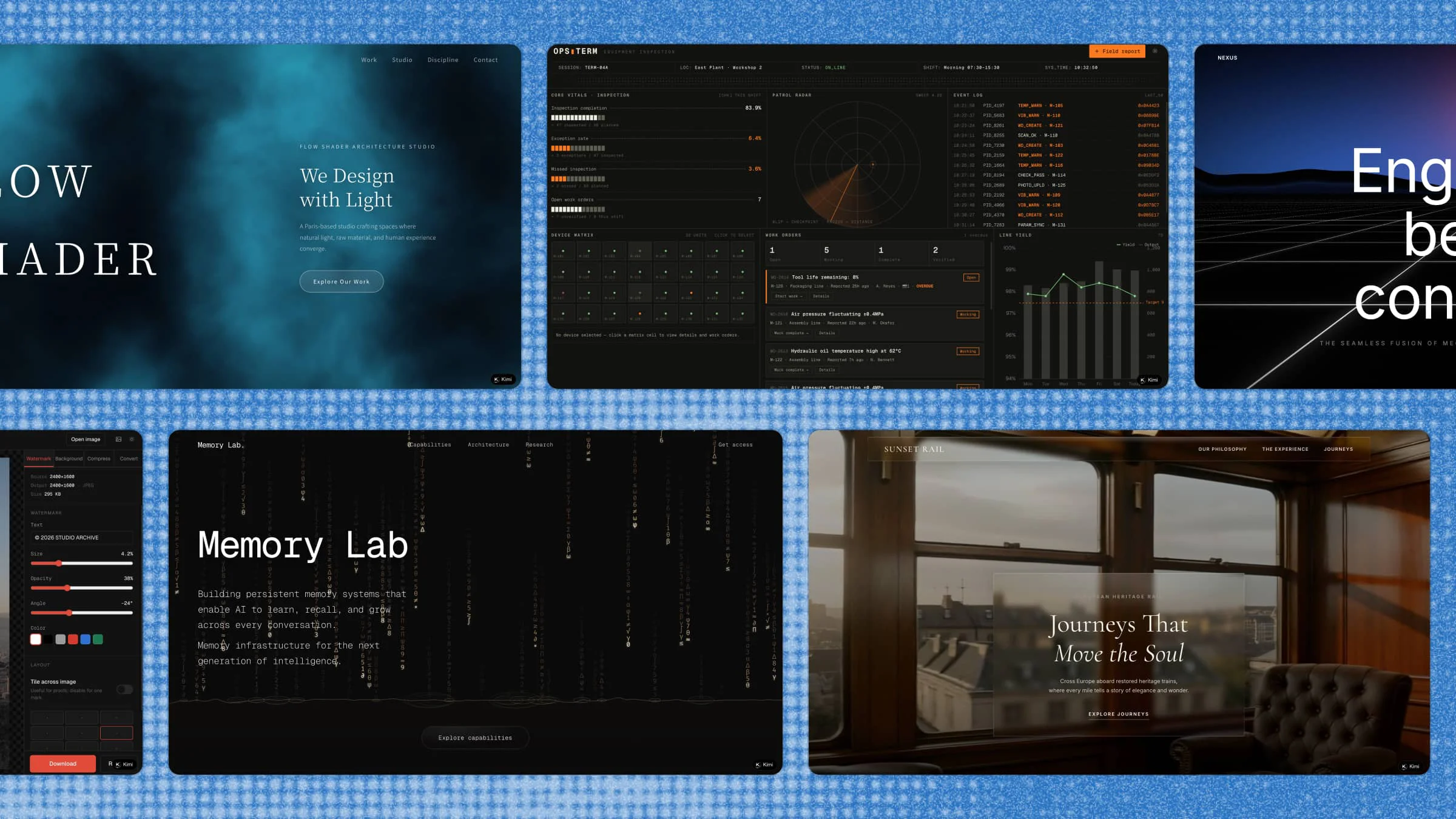
Kimi Build is an AI game maker that can turn an idea into a playable game from a simple description. You can provide details about the genre, story, characters, gameplay, target audience, or project goals, and Kimi Build can use that information to shape the page structure and presentation. It also supports further changes through natural-language prompts, which makes it easier to update sections, adjust the design, and prepare the site for publishing as your game project evolves.
Main features
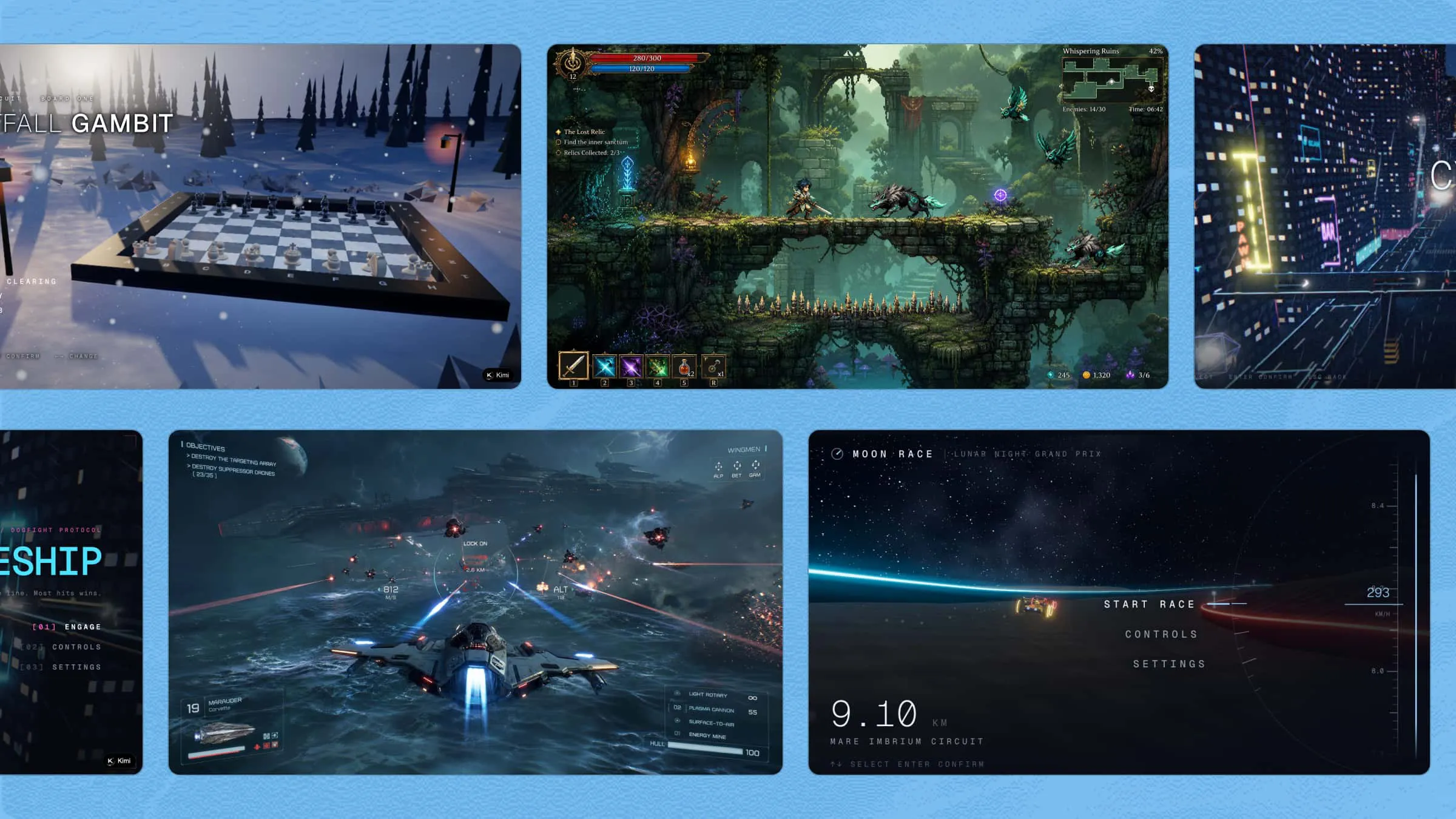
Create games without coding: Describe your game idea in natural language and generate a playable experience without writing code. Continue improving gameplay through conversation and uploading reference images to guide the visual style.
Create polished game visuals with AI: Define your preferred art direction and let AI help create a complete visual system, including colors, lighting, environments, effects, animations, and other details that bring your game world to life.
Build complete game worlds and levels: Create platformers, adventure games, racing games, puzzle experiences, and more. Generate environments with terrain, buildings, skies, and interactive elements such as switches, chests, portals, and challenges.
Add physics and original AI-generated assets: Bring games to life with physics systems such as gravity, collisions, and interactions. Generate unique characters, objects, enemies, animations, and sound effects that fit your game concept.
Generate, refine, and share playable games: Create a complete game experience that you can preview and play directly in the browser, covering menus, gameplay, objectives, progression, and win or lose conditions. Refine your game with version history and rollback options, generate shareable links, and adapt the experience for desktop and mobile screens.
How to convert your idea into a game with AI
If you want to create a game idea or turn your own concept into a playable game with AI, follow the step-by-step process below.
Step 1: Enter a clear prompt
Enter a detailed prompt that covers the game's genre, setting, goal, characters, rules, and expected gameplay. Clear details give the AI enough context to turn your concept into a playable game.
Example prompt:
Create a 2D story-driven adventure game set in a small town where a teenager discovers a hidden underground library. The player should explore different areas, collect clues, talk to characters, and solve simple puzzles to uncover why the library was abandoned. Add three playable chapters, basic character movement, interactive objects, dialogue choices, and a clear ending based on the clues the player finds. Keep the controls simple and make the game suitable for beginners.Step 2: Edit your game
Review the generated game and make changes directly in the chat, or click "Edit" to comment on specific elements and request targeted adjustments. You can also make manual edits to fine-tune characters, levels, rules, gameplay mechanics, and other details.
Step 3: Review and share
Test the game to check its controls, rules, and overall flow. Make final fixes, then share the playable version with others for feedback or testing.
Essential tips for building engaging games
A well-designed game should give players a clear reason to keep playing while making each interaction feel rewarding. The tips below focus on gameplay, challenge, feedback, and player experience to help make your game more engaging.
Design a clear core gameplay loop
Choose one main activity that defines the game, then build supporting actions around it. For example, a survival game might follow a cycle of exploring, gathering materials, crafting equipment, and preparing for the next threat.
Keep controls intuitive and easy to learn
Place essential actions where players can access them quickly, especially during fast or important moments. Use familiar input patterns for movement and interaction, while reserving additional buttons for abilities that players will use less often.
Create balanced challenges and progression
Increase difficulty by combining mechanics players have already learned instead of simply making enemies stronger or tasks longer. Unlocking new abilities, areas, equipment, or strategies can also give advancement a practical purpose.
Use visual and audio feedback to improve interactions
Match each important action with a clear response, such as a distinct sound for collecting an item or a brief animation when an attack connects. These cues communicate information about timing, success, damage, and available actions without interrupting play.
Test gameplay and improve based on feedback
Ask testers to complete common tasks while you watch where they pause, make repeated mistakes, or overlook important information. Compare their behavior with their comments to uncover issues with level design, instructions, pacing, or difficulty.
Conclusion
Turning the game idea into a finished project takes a clear direction, thoughtful mechanics, and steady refinement. Start with the idea that best matches your skills and resources, then shape it through prototyping and player testing. Kimi Build can help bring a detailed idea to life as a functional web experience, which gives you a practical foundation to build on.